Rare species of Massachusetts · Butterflies and moths
Orange Sallow Moth
Status Special Concern · Group Butterflies and moths · Recorded in 48 towns, 47 since 2001 · State sightings records: most recent 2025
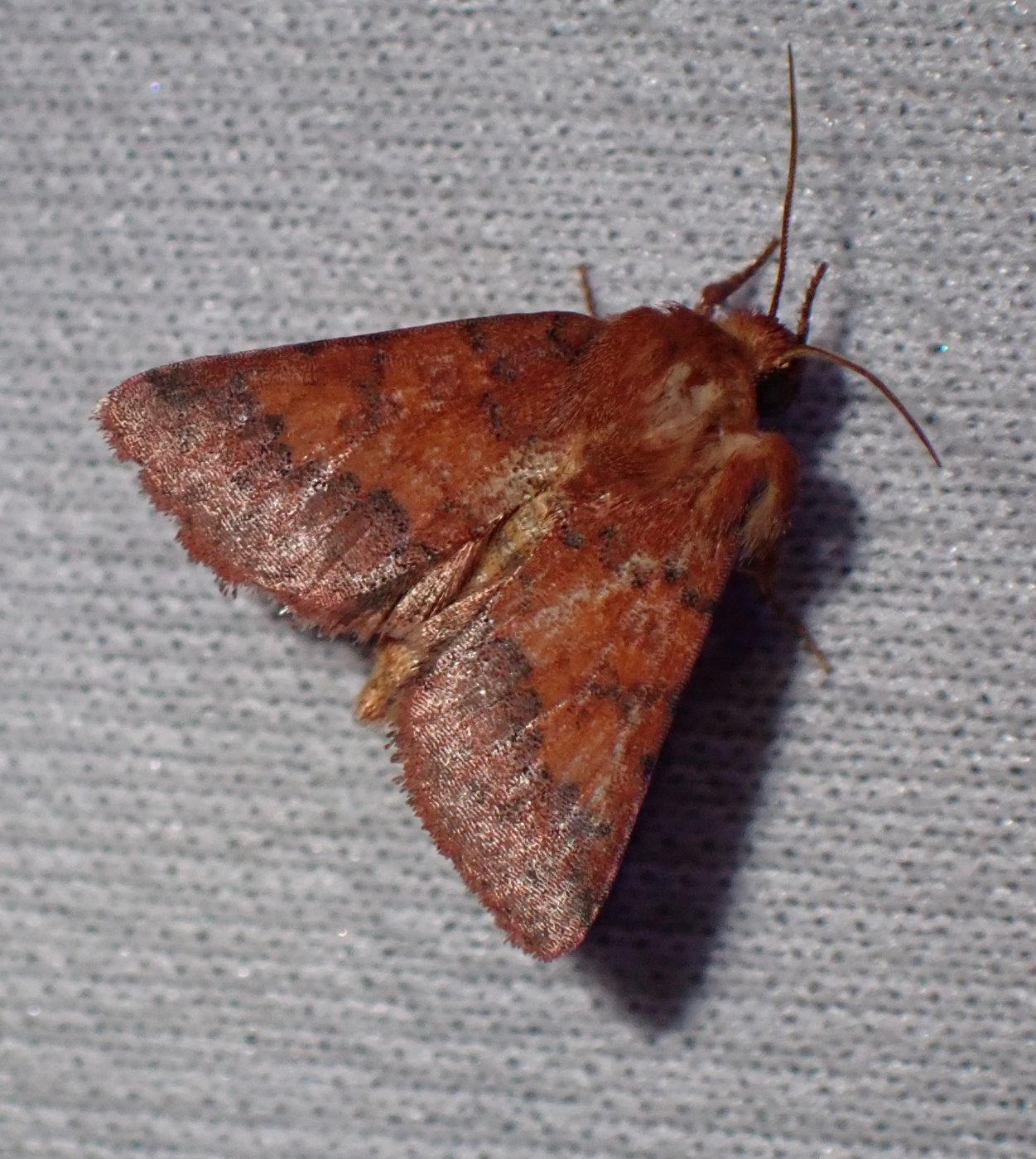
The orange sallow moth (Pyrrhia aurantiago) is an owlet moth with a 25–33 mm wingspan; the wings are predominantly orange, with a purplish outer band on the forewing and yellowish-pink hindwings. Larvae feed only on false foxglove (Aureolaria spp.), hemiparasitic plants of dry oak uplands and rocky slopes. Pupae can remain in diapause through one or more summers, stretching the life cycle beyond a year. In Massachusetts, the moth occurs in scattered colonies from the North Shore west to the Berkshires, absent from the southeast coastal plain. Oak woodland loss, fire suppression, and deer browse of host plants contribute to its Special Concern status.
Where NHESP has recorded it
last recorded since 2001 last recorded earlier
- Lowell 2025
- Woburn 2024
- Hardwick 2023
- Bellingham 2022
- Boston 2022
- Concord 2022
- Montague 2022
- Wendell 2022
- Charlemont 2020
- Palmer 2020
- Shrewsbury 2020
- Holyoke 2019
- Lynn 2019
- Petersham 2019
- Ipswich 2018
- New Salem 2016
- Erving 2015
- Gill 2013
- Clinton 2012
- Worcester 2012
- Melrose 2011
- Warren 2011
- Amherst 2010
- Brimfield 2010
- Dudley 2010
- Granby 2010
- Greenfield 2010
- Medford 2010
- South Hadley 2010
- Sturbridge 2010
- Ware 2010
- Oxford 2009
- Rowe 2009
- Webster 2009
- Boylston 2008
- Hadley 2008
- Montgomery 2008
- Russell 2008
- West Springfield 2008
- Easthampton 2007
- Athol 2006
- Ashby 2005
- Orange 2005
- East Brookfield 2004
- Deerfield 2002
- Milford 2002
- Southbridge 2002
- Florida 1987
Town-level documented observations from NHESP’s Rare Species Viewer, read 4 November 2026; the year is the last documented record, as NHESP prints it, not evidence of absence. NHESP does not publish locations.
More about this species
In Massachusetts
Isolated colonies are known from the North Shore west through the Berkshire hills. The moth is absent from the southeastern portion of the state's coastal plain.
Source: Massachusetts state rare-species fact sheet, Orange Sallow Moth (published March 2025).
Threats
Pressures include loss of rocky upland oak woodland, elimination of natural disturbance, non-native generalist parasitoids, aerial insecticide spray programs, unintended herbicide contact, deer herbivory on caterpillar food plants, and trail or vehicle damage. Increasing temperatures are not expected to be harmful.
Source: Massachusetts state rare-species fact sheet, Orange Sallow Moth (published March 2025).
Protections
Classified as Special Concern under state law and placed on the Greatest Conservation Need priority list. Securing land tenure and conducting active oak woodland stewardship are the chief conservation steps.
Source: Massachusetts state rare-species fact sheet, Orange Sallow Moth (published March 2025).
One fact
Pupae enter diapause and persist dormant well into the next calendar year before completing metamorphosis, extending the total life cycle beyond twelve months.
Source: Massachusetts state rare-species fact sheet, Orange Sallow Moth (published March 2025).
Related species
Owlet moths on the state list:
State list: 321 CMR 10.90, as of 16 August 2024. Rare species of Massachusetts · Trees of Massachusetts