Rare species of Massachusetts · Amphibians
Eastern Spadefoot
Status Threatened · Group Amphibians · Recorded in 41 towns, 27 since 2001 · State sightings records: most recent 2026
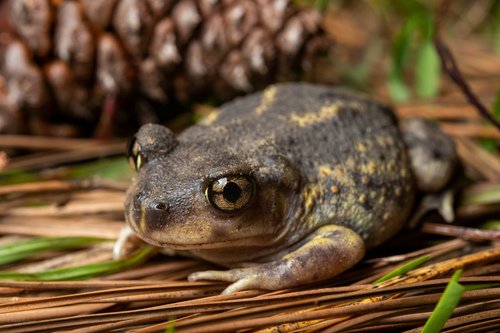
Scaphiopus holbrookii, commonly known as the eastern spadefoot, is a species of American spadefoot toad (family Scaphiopodidae) endemic to the eastern United States. It is not considered a true toad, with Bufonidae being the family of "true toads".
Description: Wikipedia (CC BY-SA 4.0).
Where NHESP has recorded it
last recorded since 2001 last recorded earlier
- Truro 2026
- Yarmouth 2026
- Amherst 2024
- Brewster 2024
- Chicopee 2024
- Eastham 2024
- Edgartown 2024
- Hadley 2024
- Southwick 2024
- Sunderland 2023
- Westport 2023
- Barnstable 2020
- Provincetown 2020
- Sandwich 2020
- Wellfleet 2020
- East Longmeadow 2019
- Rehoboth 2019
- Springfield 2019
- Wayland 2019
- Westfield 2019
- Wilbraham 2019
- Ipswich 2018
- Rowley 2018
- Newbury 2017
- Taunton 2017
- Rochester 2016
- Bourne 2003
- Nantucket 1997
- Halifax 1979
- Falmouth 1970
- Seekonk 1953
- Oak Bluffs 1950
- Northampton 1934
- Boston 1932
- Middleborough 1931
- Cambridge 1892
- Danvers 1843
- Framingham PRE-1852
- Salem PRE-1868
- Topsfield PRE-1852
- Wellesley PRE-1924
Town-level documented observations from NHESP’s Rare Species Viewer, read 4 November 2026; the year is the last documented record, as NHESP prints it, not evidence of absence. NHESP does not publish locations.
More about this species
Population
Statewide records from 2000 through 2024 total 33 distinct groups, with 20 of them — 61% — found on Cape Cod. Groups away from the Cape are typically small, isolated from one another, and reliant on just a single pool for reproduction.
2000-2024 records. Source: Massachusetts state rare-species fact sheet, Eastern Spadefoot (published April 2025).
In Massachusetts
About 11 additional groups occupy isolated patches in Dukes, Hampden, Hampshire, Bristol, and the southern end of Franklin County. Essex County holds a single documented site, and one known Middlesex County location remains on record. The state sits at the range's northern edge.
Source: Massachusetts state rare-species fact sheet, Eastern Spadefoot (published April 2025).
Threats
Conversion and destruction of breeding basins eliminate habitat. Habitat fragmentation and encroachment by invasive vegetation isolate groups from each other. Climate risks include dry spring weather and storm-driven coastal flooding. Vehicles and construction kill individual animals directly. Chytrid fungus and ranaviruses are disease risks for the species.
Source: Massachusetts state rare-species fact sheet, Eastern Spadefoot (published April 2025).
Protections
The species holds Threatened status in Massachusetts. Officially certified vernal pools near known groups may qualify for certain legal protections under state law.
Source: Massachusetts state rare-species fact sheet, Eastern Spadefoot (published April 2025).
One fact
Spadefoot larvae develop from egg to metamorphosis faster than the larvae of every other frog or salamander found in the Northeast.
Source: Massachusetts state rare-species fact sheet, Eastern Spadefoot (published April 2025).
State list: 321 CMR 10.90, as of 16 August 2024. Rare species of Massachusetts · Trees of Massachusetts