Witchhazel
Leaves alternate, simple · Family Hamamelidaceae
What to look for
WITCHHAZEL, a large multi-stem shrub or small tree, is common in Essex County westward. It is frequently found in rich moist soils near streams or along woodland edges.
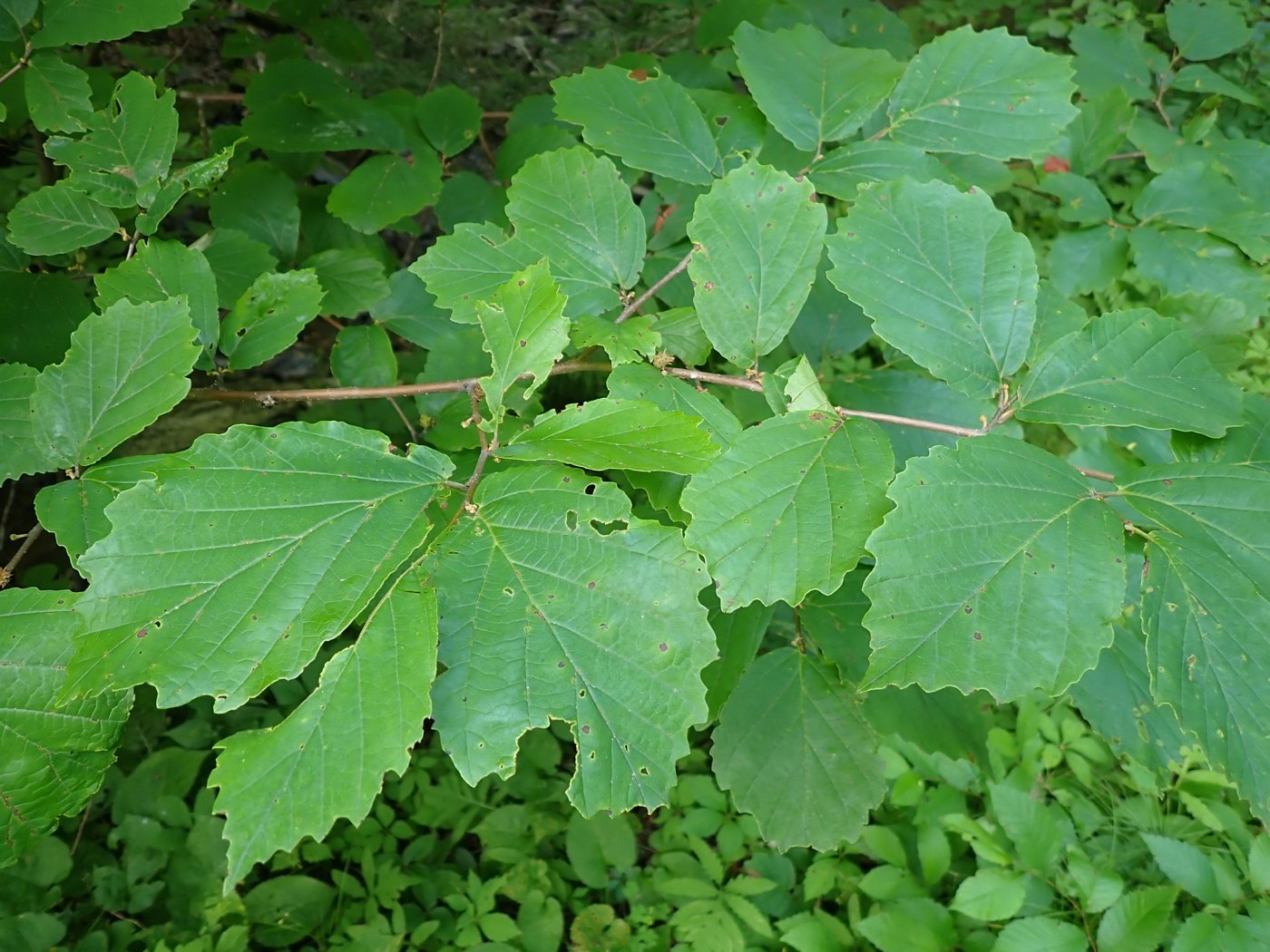
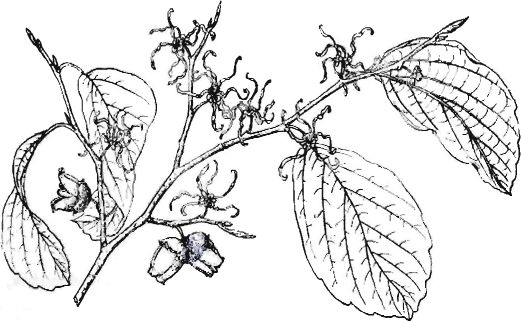
Leaves are alternate, egg-shaped, with the narrow end towards the stem, and margins scalloped. The tips are broadly pointed or rounder, the base unequal, and veins virtually straight and prominent. Leaves are hairy when young, and with hairs along the veins of the underside during summer.
Winter buds are tan to light orange-brown, one-quarter to one-half inch long, covered with hairs, and without bud scales.
Twigs are orange-brown to red-brown, slender, and hairy at first then becoming smooth during the summer.
The bark is light to dark brown.
Flowers open between late September and November. They are yellow, perfect, ribbon-like, with four petals, one-half to two-third inches long and frequently clustered at the end of twigs.
The fruit is a capsule, one-half inch long, hairy, dull, orange-brown, and crowned with woody, persistent sepals. It develops in the summer following the flowering. The fruit splits open at maturity and releases shiny black seeds up to twenty feet away.
The wood is brown, tinged with red, hard, heavy, and close grained. An astringent is made from the alcoholic extract of the bark. Witch Hazel is often planted for the ornamental value of its late autumn flowers.
Where it grows
Mapped in all fourteen counties.
Text and line illustrations: Forest Trees of Massachusetts, 7th edition (2016), Massachusetts Department of Conservation and Recreation, Bureau of Forest Fire Control and Forestry, funded by the USDA Forest Service. Drawings, 1925 descriptions and the “How to know” keys: The Commercial Forest Trees of Massachusetts (1925), Massachusetts Department of Conservation, Division of Forestry. Forest shares before settlement and today: Harvard Forest data archive (Cogbill, Burk and Motzkin 2002; Thompson and others 2013). Insects and disease: USDA Forest Service Insect and Disease Survey, Region 9, with DCR. Photographs: observations on iNaturalist (inaturalist.org), each credited to its photographer under its Creative Commons licence; the list is under “Where the pictures come from” on the guide page. Species ranges by county are as the 2016 manual maps them. Transcribed by script and proofread in part; the manuals govern where they differ.