White Spruce
Leaves needles or scales · Family Pinaceae · Also called Cat Spruce
In the inventory · Live trees fewer than 1 in 100 · Volume under 1% · Growth and mortality too few to estimate. USDA Forest Service, Forest Inventory and Analysis, 2019–2025; live trees an inch or more across, volume of trees five inches or more. Shares quoted only where the sampling error is 30% or less.
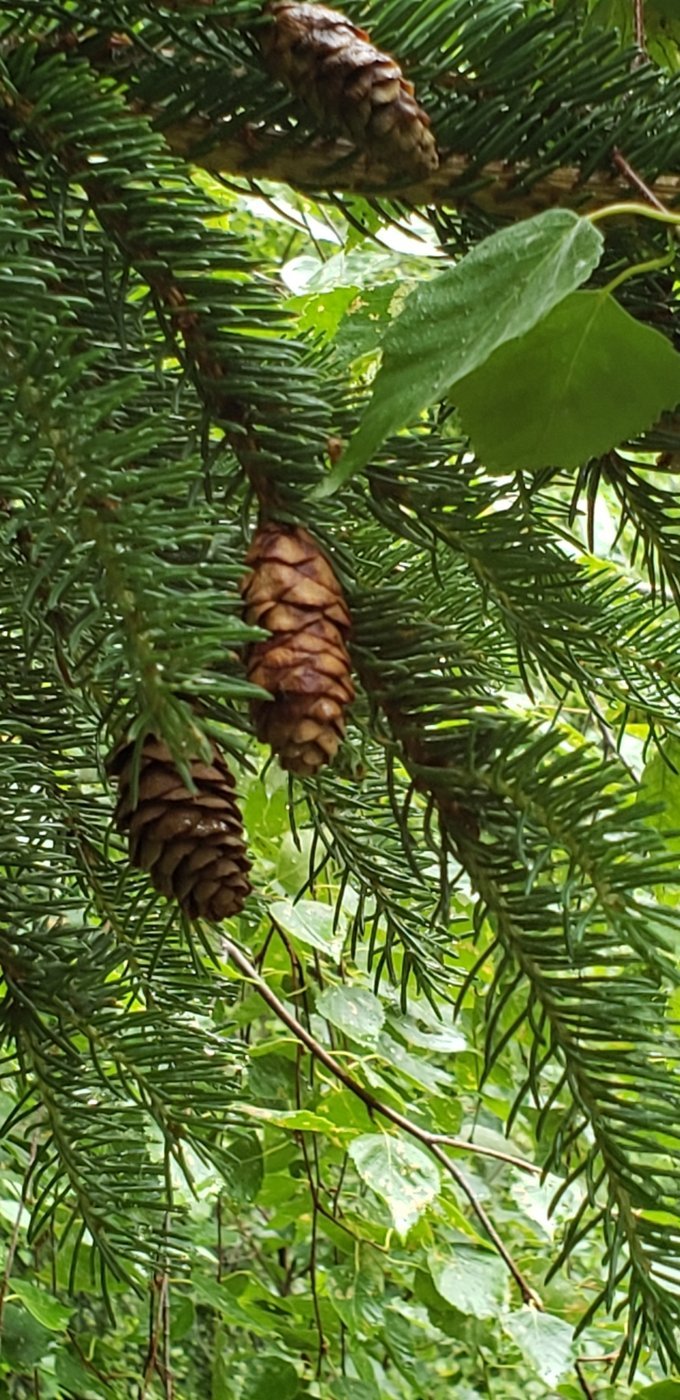
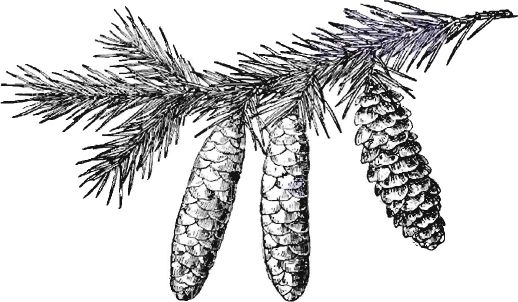
What to look for
WHITE Spruce is not believed to be native to Massachusetts, though it was established in plantations across the state during the reforestation efforts of the Great Depression era and has since naturalized in many locations. It is shade intolerant and will not grow as an understory tree.
A medium-sized tree, it can attain a height of sixty to seventy feet. Its upward-curving branches that densely clothe the trunk aid in its conical appearance.
Bark on old trees is light gray and covered with irregular thin scales, and is light gray and smooth on younger trees.
Leaves (needles) are one-third to three-fourths of an inch long, pale blue-green and powdery at first, later becoming a dark blue-green with whitish lines on each surface. The foliage emits an unpleasant and characteristic odor when bruised.
Cones are slender, cylindrical in shape, pale brown one to two and one-half inches long and shiny when ripe.
Twigs are without hairs, pale brown, and darken with age.
The wood is yellowish, fairly light, soft, and straight-grained. It is used for pulp, boxes, paddles, oars, piano sounding boards, lumber, and in limited amounts for Christmas trees.
White and Black Spruce produce long, tough, pliable roots which were used by Native Americans for tying together pieces of birch bark for canoes, and for
Where it grows
Mapped in 1 of fourteen counties: Dukes. Introduced, not native.
In the forest record
Trees of this group (spruce and fir) were 1% of the trees surveyors recorded at lot corners before settlement and are 1% of trees on inventory plots today, statewide.
Each town’s own numbers are on its habitat, forest and water page.
The spruce and fir group is among the three most common kinds of tree in the surveyors’ record of 4 of the 164 towns with a surviving record, and the largest share of that record is in Tyringham (12%), Northampton (10%), Royalston (9%). The record is by group of trees, not by species, and covers towns with at least 50 recorded trees for the “largest share” list.
Text and line illustrations: Forest Trees of Massachusetts, 7th edition (2016), Massachusetts Department of Conservation and Recreation, Bureau of Forest Fire Control and Forestry, funded by the USDA Forest Service. Drawings, 1925 descriptions and the “How to know” keys: The Commercial Forest Trees of Massachusetts (1925), Massachusetts Department of Conservation, Division of Forestry. Forest shares before settlement and today: Harvard Forest data archive (Cogbill, Burk and Motzkin 2002; Thompson and others 2013). Insects and disease: USDA Forest Service Insect and Disease Survey, Region 9, with DCR. Photographs: observations on iNaturalist (inaturalist.org), each credited to its photographer under its Creative Commons licence; the list is under “Where the pictures come from” on the guide page. Species ranges by county are as the 2016 manual maps them. Transcribed by script and proofread in part; the manuals govern where they differ.