Tree of Heaven
Leaves alternate, compound · Family Simaroubaceae
In the inventory · Live trees fewer than 1 in 100 · Volume no volume estimate (not a timber species) · Growth and mortality too few to estimate. USDA Forest Service, Forest Inventory and Analysis, 2019–2025; live trees an inch or more across, volume of trees five inches or more. Shares quoted only where the sampling error is 30% or less.
What to look for
INTRODUCED in the late 1700’s, this invasive tree was once a commonly planted urban tree mostly due to its fast growth rate, lack of pest problems, pollution tolerance, and an ability to grow in any soil. It is so tolerant of urban conditions that it can even be found growing in pavement and sidewalk cracks. Reaching heights of forty to sixty feet, its widely adaptable properties have allowed it to spread well beyond the urban environment.
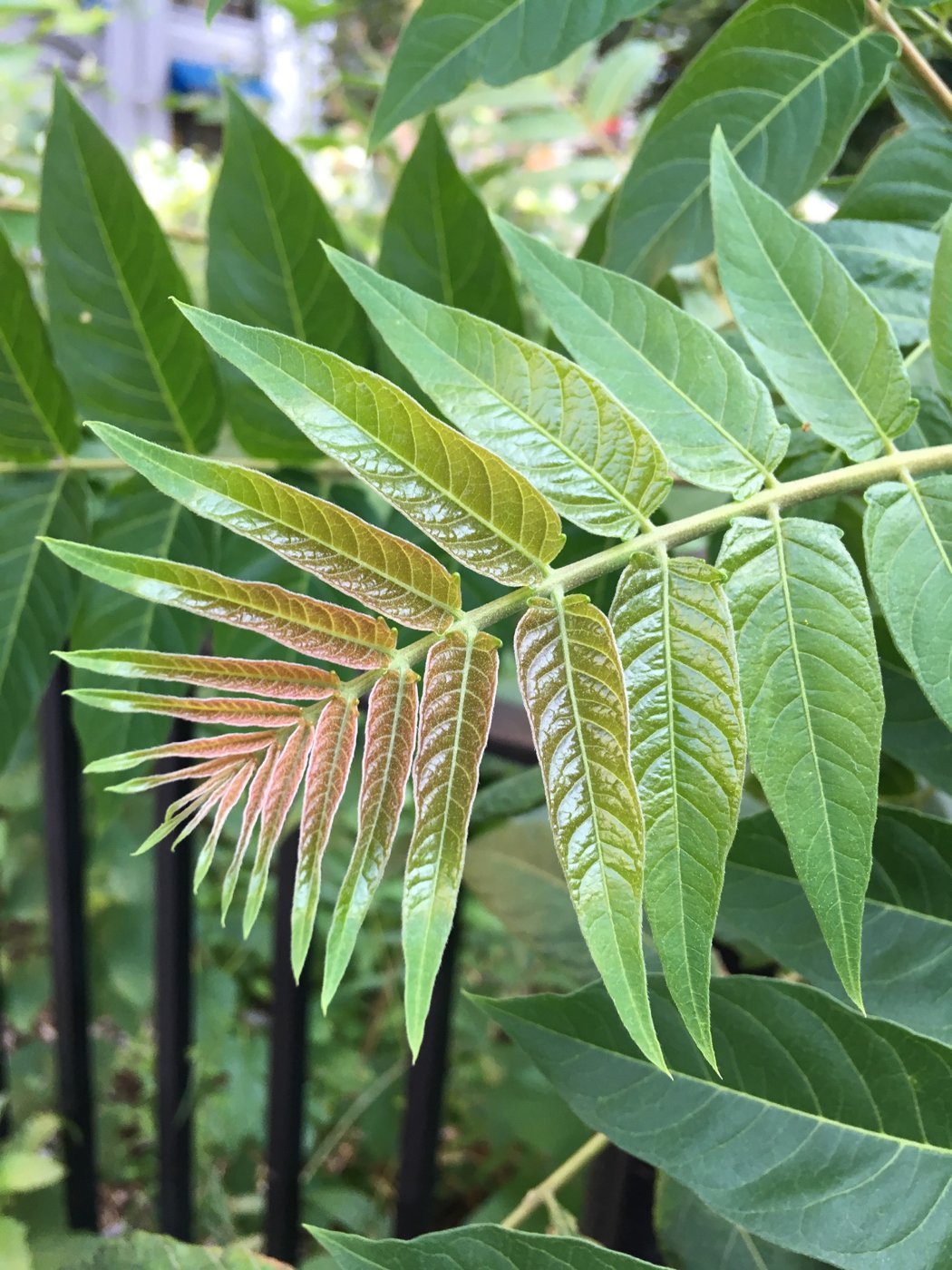
The leaves are pinnately compound, eighteen to twenty four inches long and alternate. There are eleven to twenty five dark green, sharp-pointed leaflets measuring three to five inches long. Each sharply pointed leaflet has two to four coarse teeth at its base. The leaves give off an unpleasant odor when crushed. Fall color is a pale yellow.
Twigs are stout and yellowish to reddish brown. ‘The heart-shaped leaf scars become quite prominent in the winter. A foul odor is emitted when crushed. Pith is light brown and wide.
The small, yellow green flowers are dioecious and are borne in eight to sixteen inch panicles appearing in June. Male flowers have a vile odor that attracts insects, while the female flowers are odorless.
Found only on the female trees and appearing in clusters, the fruit is a samara, one and a half inches long and a half inch wide, with the seed in the center. The color starts as yellow green to orange red and changes to brown. They persist well into winter.
Wood is pale yellow and close grained. It has a tendency to twist and crack as it dries. Mostly used as charcoal and fuel wood, it can also be used for cabinetry.
Where it grows
Mapped in 13 of fourteen counties: Barnstable, Bristol, Dukes, Essex, Franklin, Hampden, Hampshire, Middlesex, Nantucket, Norfolk, Plymouth, Suffolk, Worcester. Introduced, not native.
Text and line illustrations: Forest Trees of Massachusetts, 7th edition (2016), Massachusetts Department of Conservation and Recreation, Bureau of Forest Fire Control and Forestry, funded by the USDA Forest Service. Drawings, 1925 descriptions and the “How to know” keys: The Commercial Forest Trees of Massachusetts (1925), Massachusetts Department of Conservation, Division of Forestry. Forest shares before settlement and today: Harvard Forest data archive (Cogbill, Burk and Motzkin 2002; Thompson and others 2013). Insects and disease: USDA Forest Service Insect and Disease Survey, Region 9, with DCR. Photographs: observations on iNaturalist (inaturalist.org), each credited to its photographer under its Creative Commons licence; the list is under “Where the pictures come from” on the guide page. Species ranges by county are as the 2016 manual maps them. Transcribed by script and proofread in part; the manuals govern where they differ.