Tamarack
Leaves needles or scales · Family Pinaceae · Also called Hackmatack, Eastern Larch, Alaska Larch and American Larch
In the inventory · Live trees fewer than 1 in 100 · Volume under 1% · Growth and mortality too few to estimate. USDA Forest Service, Forest Inventory and Analysis, 2019–2025; live trees an inch or more across, volume of trees five inches or more. Shares quoted only where the sampling error is 30% or less.
What to look for
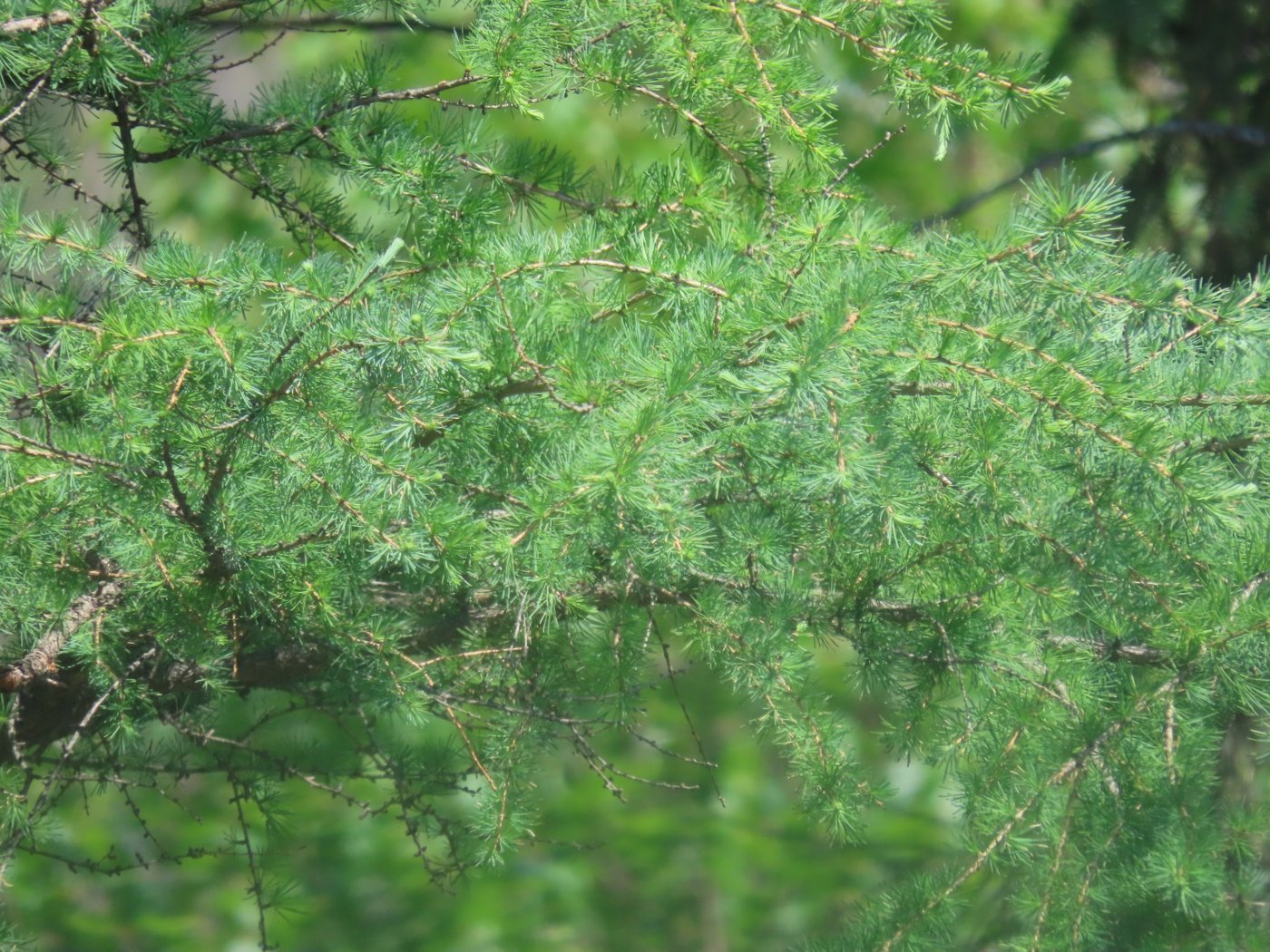
TAMARACK prefers cool, swampy areas, commonly occurring in the northern and western upland sections of the state. Unlike most conifers, which hold their needles more than one year, this species is deciduous, dropping its needles every fall. Tamarack is extremely shade intolerant.
It is a tall tree with a regular and narrow pyramidal outline. Ultimately it acquires a height of forty to eighty feet, and a diameter of one to two feet. The trunk is continuous and tapers rapidly. Branches are slender and horizontal or slightly ascending.
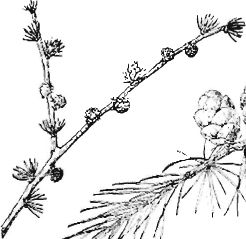
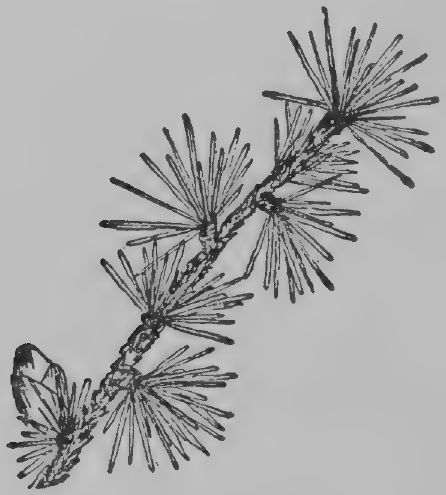
The bark is dark, flaking off in small scales on the trunks. Leaves (needles) are borne in short tufts containing many approximately inch-long needles. They are bright green in summer, but in the autumn they become yellow before they fall.
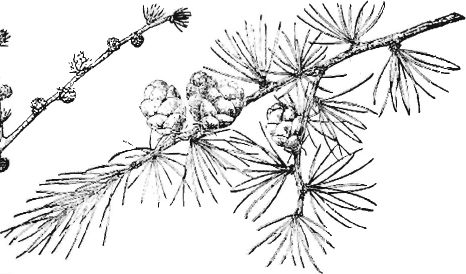
Cones are small, almost globose, nearly three-quarters of an inch long and light brown in color. Seeds are small and winged.
The wood is close-grained, heavy, strong, decay resistant and durable. In the past it was used in ship W) building, for posts, and railroad ties. It is now mainly used for pulpwood, posts, poles, mine timbers, and railroad ties. It is less commonly used for rough lumber.
European larch Larix decidua Japanese larch Larix kaempferi European larch and Japanese larch are commonly planted in areas of human habitation and both have turned up in woodlands. They can be distinguished from our native tamarack by their longer needles (1-1.5 in.). They also may have more needles per bundle. Both European and Japanese larch also have larger cones than L. laricina. Cones may be 1 to 1.5 in. long, compared with cones of tamarack which are less than one -inch long.
Where it grows
Mapped in 10 of fourteen counties: Berkshire, Bristol, Essex, Franklin, Hampden, Hampshire, Middlesex, Norfolk, Plymouth, Worcester.
Forest types where the 2016 manual places it: Spruce-Fir / Northern Hardwoods.
As described in 1925
Show
Listed as Tamarack (Hackmatack, Larch) (Larix laricina Koch).
PREFERRING cool, swampy situations, though often growing on uplands, it occurs in most parts of the State, more commonly in the northern sections than elsewhere.
In habit it is a tall tree with regular and narrow pyramidal outline. Ultimately it acquires a height of fifty to sixty feet and a diameter of eighteen to twenty inches. The trunk is continuous and tapers rapidly. The branches are slender and horizontal or slightly ascending.
The leaves are borne in clusters. They are linear in shape, from three-fourths of an inch to one and a quarter inches in length and bright green in color. In the autumn before they fall they become yellow.
The cones are small, almost globular, nearly three-quarters of an inch long and light brown in color. The seeds are small and winged.
The wood is close-grained, heavy, strong and durable. It is used in shipbuilding, and for posts and railroad ties.
While this species is found in moist places, it often does equally well when planted on upland.
Text and line illustrations: Forest Trees of Massachusetts, 7th edition (2016), Massachusetts Department of Conservation and Recreation, Bureau of Forest Fire Control and Forestry, funded by the USDA Forest Service. Drawings, 1925 descriptions and the “How to know” keys: The Commercial Forest Trees of Massachusetts (1925), Massachusetts Department of Conservation, Division of Forestry. Forest shares before settlement and today: Harvard Forest data archive (Cogbill, Burk and Motzkin 2002; Thompson and others 2013). Insects and disease: USDA Forest Service Insect and Disease Survey, Region 9, with DCR. Photographs: observations on iNaturalist (inaturalist.org), each credited to its photographer under its Creative Commons licence; the list is under “Where the pictures come from” on the guide page. Species ranges by county are as the 2016 manual maps them. Transcribed by script and proofread in part; the manuals govern where they differ.