Sycamore
Leaves alternate, lobed · Family Platanaceae · Also called Buttonwood or Buttonball
In the inventory · Live trees fewer than 1 in 100 · Volume under 1% · Growth and mortality too few to estimate. USDA Forest Service, Forest Inventory and Analysis, 2019–2025; live trees an inch or more across, volume of trees five inches or more. Shares quoted only where the sampling error is 30% or less.

What to look for
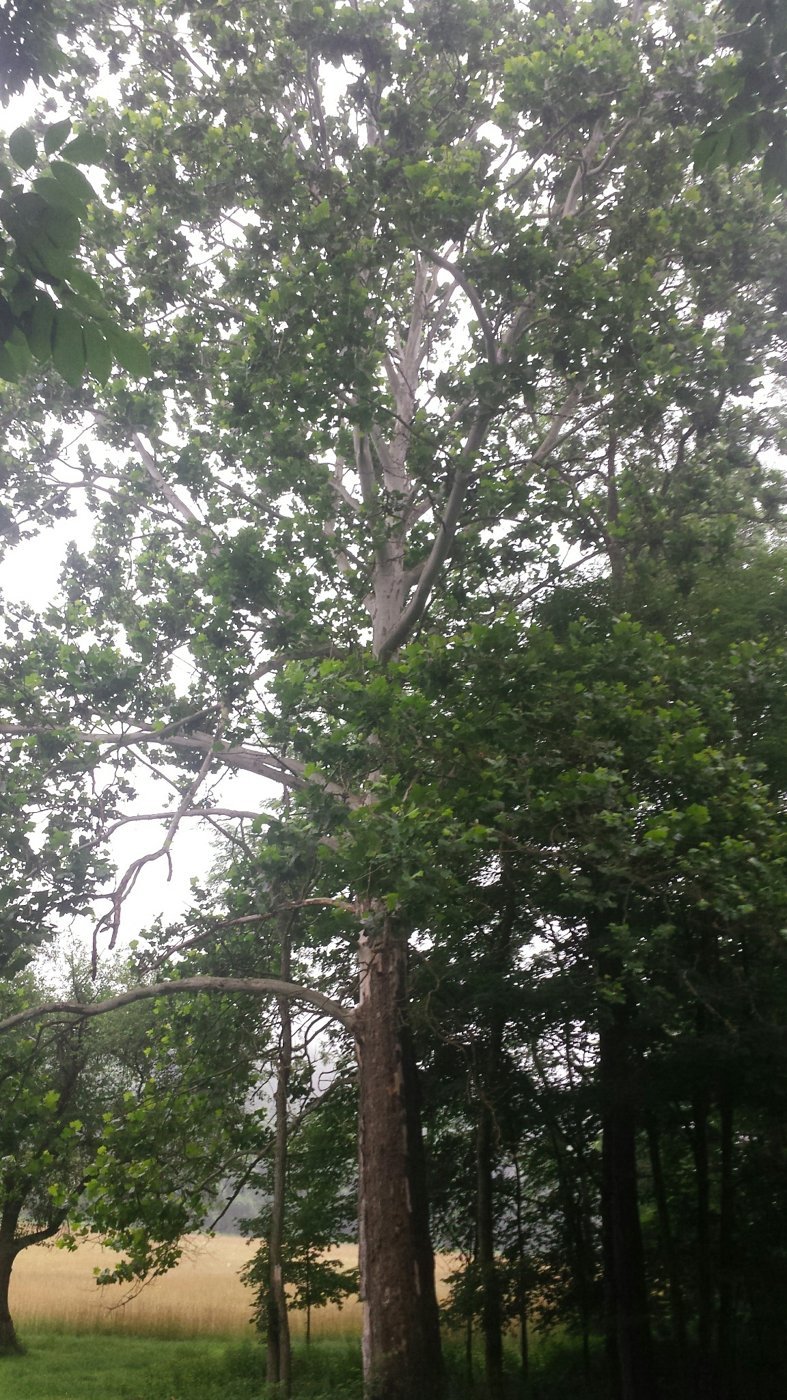
SYCAMORE is the largest of the New England trees, occurring occasionally throughout the. state, frequenting the borders of streams and rich bottomlands. Sycamore is intermediate in shade tolerance.
It grows from fifty to one hundred feet in height and has a trunk diameter of three to eight feet. The trunk may spread near the ground into several large, secondary limbs, or it may rise without branching for a considerable distance and then have large, spreading branches.
Branchlets are very often tufted in appearance, due to the activities of a fungus. Bark on old trunks is thick, dark brown, and peels off in broad scales giving the appearance of camouflage clothing. On younger stems and the upper part of larger trunks, the bark peels off in thin scales exposing white, greenish, and yellowish inner bark.
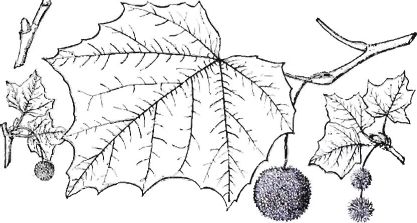
Leaves are simple, alternate, three to five-lobed and light green. The base of the leaf stalk includes the winter bud. Sycamore is one of the last trees to leaf out in the spring.
Twigs are rather stout, at first green and fuzzy, later grayish to brown and smooth. Buds are about one-fourth of an inch long, conical, dull-pointed, smooth and reddish-brown. The terminal bud is absent.
Flowers occur in dense ball-like heads attached to twigs by long slender stalks. Fruit, borne singly, is in the shape of a ball and is about an inch in diameter. It contains many small seeds and usually remains on the tree until spring.
The wood is hard and firm but very perishable when exposed to the weather, and liable to warp. It is used for tobacco boxes, furniture, and interior finish of houses. It is fairly good for fuel.
Where it grows
Mapped in 13 of fourteen counties: Barnstable, Berkshire, Bristol, Dukes, Essex, Franklin, Hampden, Hampshire, Middlesex, Norfolk, Plymouth, Suffolk, Worcester.
Forest types where the 2016 manual places it: Floodplain Forest.
As described in 1925
Show
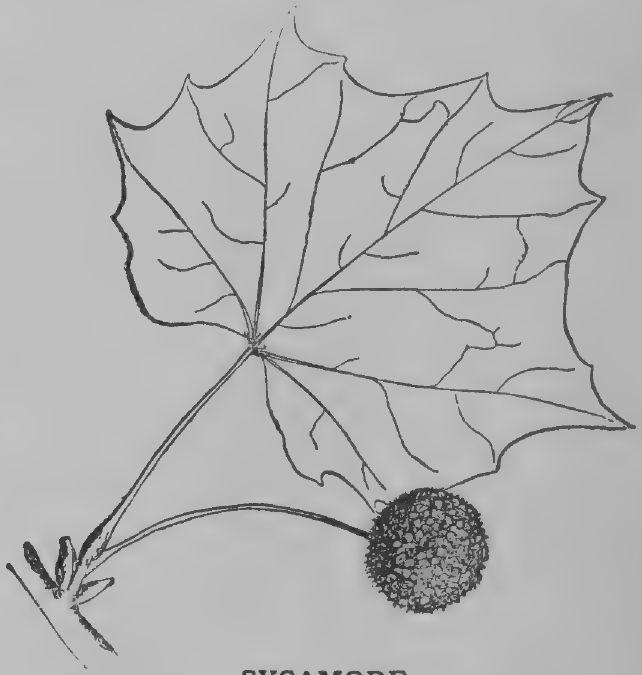
Listed as Sycamore (Buttonwood) (Platanus occidentalis L.).
THIS, the largest of the New England trees, occurs occasionally throughout the State, frequenting the borders of streams and rich bottom-lands. It grows from fifty to one hundred feet in height and has a trunk diameter of three to eight feet. The trunk may spread near the ground into several large, secondary limbs, or it may rise without branching for a considerable distance and then have large, spreading branches.
The branchlets are very often tufted in appearance, due to the activities of a fungus. The bark on the trunk and large limbs is greenish-gray in color and flakes off in broad scales, exposing the inner bark which is at first whitish or light green, then darker. The leaves are simple, alternate, three to five lobed and light green. The base of the leaf-stalk is swollen and includes the winter bud. The fruit is in the shape of a ball and is about an inch in diameter. It contains very many small seeds and usually remains on the tree until spring. The wood is hard and firm but very perishable when exposed to the weather, and liable to warp. It is used for tobacco boxes, furniture and interior finish of houses. It is fairly good for fuel.
Text and line illustrations: Forest Trees of Massachusetts, 7th edition (2016), Massachusetts Department of Conservation and Recreation, Bureau of Forest Fire Control and Forestry, funded by the USDA Forest Service. Drawings, 1925 descriptions and the “How to know” keys: The Commercial Forest Trees of Massachusetts (1925), Massachusetts Department of Conservation, Division of Forestry. Forest shares before settlement and today: Harvard Forest data archive (Cogbill, Burk and Motzkin 2002; Thompson and others 2013). Insects and disease: USDA Forest Service Insect and Disease Survey, Region 9, with DCR. Photographs: observations on iNaturalist (inaturalist.org), each credited to its photographer under its Creative Commons licence; the list is under “Where the pictures come from” on the guide page. Species ranges by county are as the 2016 manual maps them. Transcribed by script and proofread in part; the manuals govern where they differ.