Swamp White Oak
Leaves alternate, lobed · Family Fagaceae
In the inventory · Live trees fewer than 1 in 100 · Volume under 1% · Growth and mortality too few to estimate. USDA Forest Service, Forest Inventory and Analysis, 2019–2025; live trees an inch or more across, volume of trees five inches or more. Shares quoted only where the sampling error is 30% or less.
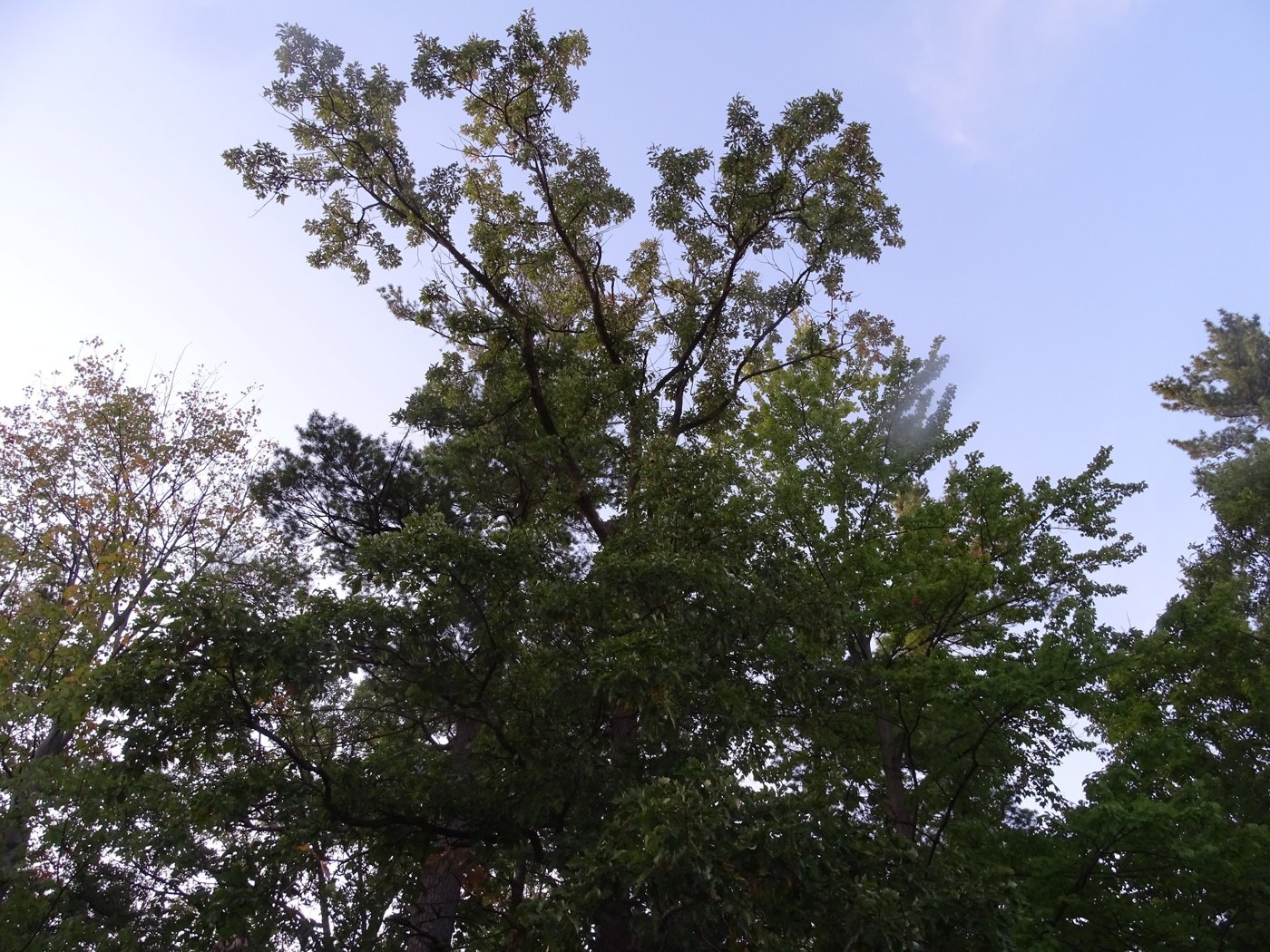
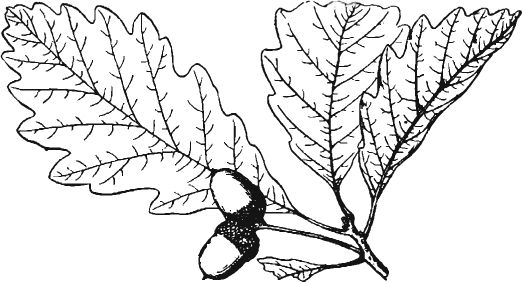

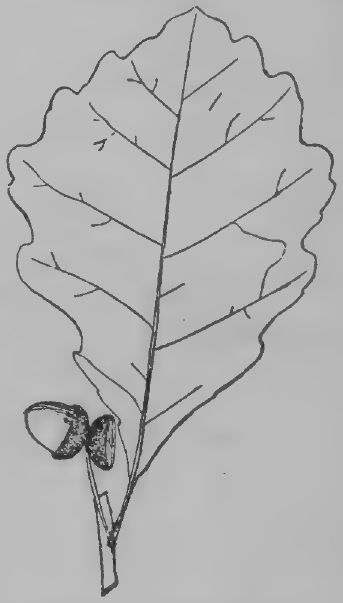
What to look for
SWAMP White Oak is frequently found in swampy areas, growing in rich soil along streams and wetlands. It occurs throughout the state, and is particularly common in the east. The tree is intermediate in shade tolerance, and seedlings become established under moderate shade.
Ordinarily its height is from sixty to seventy feet and its diameter is from two to three feet. The bark on the trunk is grayish-brown and deeply and irregularly divided into broad, flat ridges. Bark of the White Oak is somewhat lighter and the scales finer.
On the young branches, the scales hang loosely, giving a marked appearance to the tree. Leaves are simple, alternate, oblong, four to nine inches long, scalloped or slightly lobed and dark, lustrous green on the upper surface. Twigs are hairless. Buds are chestnut brown, small, blunt, and hairless.
Flowers appear as long dangling catkins in May when the leaves are partially grown. The fruit, an acorn, ripens the first season. It is about one inch long, light chestnut-brown in color and enclosed in the cup for about one-third its length with stalks one to three inches long.
The wood is very similar to that of the White Oak and only slightly inferior in quality. It was used in construction, in carriage building, for interior finishing, for furniture and for fuel in the 1900's. Now, the hard, strong wood is commercially valuable and is usually cut and sold as White Oak.
Where it grows
Mapped in 13 of fourteen counties: Barnstable, Berkshire, Bristol, Essex, Franklin, Hampden, Hampshire, Middlesex, Nantucket, Norfolk, Plymouth, Suffolk, Worcester.
In the forest record
Trees of this group (oak) were 45% of the trees surveyors recorded at lot corners before settlement and are 19% of trees on inventory plots today, statewide.
Each town’s own numbers are on its habitat, forest and water page.
The oak group is among the three most common kinds of tree in the surveyors’ record of 127 of the 164 towns with a surviving record, and the largest share of that record is in Boxford (81%), Natick (80%), Newton (77%). The record is by group of trees, not by species, and covers towns with at least 50 recorded trees for the “largest share” list.
Insects and disease on the record
| Agent | Years seen | Worst year | Acres that year | Last seen |
|---|---|---|---|---|
| Spongy moth | 21 | 2017 | 1,049,099 | 2025 |
| Forest tent caterpillar | 11 | 2006 | 362,694 | 2018 |
| Winter moth | 13 | 2011 | 88,793 | 2018 |
Acres are of mapped damage, which can include other trees and non-forest; some agents attack several hosts.
As described in 1925
Show
Listed as Swamp White Oak (Quercus platanoides Sud.).
How to know the Oaks (1925): Bark — Grayish-brown and deeply and irregularly divided into broad, flat ridges. Leaves — Scalloped or slightly lobed. Fruit — Matures first year. Winter_Buds — Roundish, obtuse at apex, and brown. Compare the oaks ›
THIS species gets its popular designation, Swamp White Oak, from its resemblance to the White Oak and its frequent fondness for swampy situations. Growing in rich soil along streams and swamps, it occurs throughout the State and is rather common in some of the eastern sections. In habit it bears a general likeness to the White Oak, though its branches are not so spreading and its head is less regular and narrower. Ordinarily its height is from forty to fifty feet and its diameter is from two to three feet.
The bark on the trunk is grayish-brown and deeply and irregularly divided into broad, flat ridges. The bark of the White Oak is somewhat lighter and the scales finer.
On the young branches the scales hang loosely, giving a marked appearance to the tree.
The leaves are simple, alternate, obovate or oblong, four to six inches long, scalloped or slightly lobed and dark, lustrous green on the upper surface.
The flowers appear in May when the leaves are partially grown.
The fruit ripens the first season. The acorn is about one inch long, light chestnut-brown in color and enclosed in the cup for about one-third its length.
Its wood is very similar to that of the White Oak and only slightly inferior in quality. It is used in construction, in carriage-building, for interior finishing, for furniture and for fuel.
Text and line illustrations: Forest Trees of Massachusetts, 7th edition (2016), Massachusetts Department of Conservation and Recreation, Bureau of Forest Fire Control and Forestry, funded by the USDA Forest Service. Drawings, 1925 descriptions and the “How to know” keys: The Commercial Forest Trees of Massachusetts (1925), Massachusetts Department of Conservation, Division of Forestry. Forest shares before settlement and today: Harvard Forest data archive (Cogbill, Burk and Motzkin 2002; Thompson and others 2013). Insects and disease: USDA Forest Service Insect and Disease Survey, Region 9, with DCR. Photographs: observations on iNaturalist (inaturalist.org), each credited to its photographer under its Creative Commons licence; the list is under “Where the pictures come from” on the guide page. Species ranges by county are as the 2016 manual maps them. Transcribed by script and proofread in part; the manuals govern where they differ.