Sugar Maple
Leaves opposite, lobed · Family Aceraceae · Also called Rock Maple
In the inventory · Live trees about 1 tree in 20 (4.7%) · Volume 4% · Growth and mortality too few to estimate. USDA Forest Service, Forest Inventory and Analysis, 2019–2025; live trees an inch or more across, volume of trees five inches or more. Shares quoted only where the sampling error is 30% or less.

What to look for
SUGAR Maple may be found abundantly throughout the state, although it is less frequent along the coast. Its favorite habitats are cool, rich woods and on moist, rocky slopes. Sugar Maple is very shade tolerant.
Normally, it grows from fifty to sixty feet high, yet it often reaches a height of at least one hundred feet and a diameter of four feet.
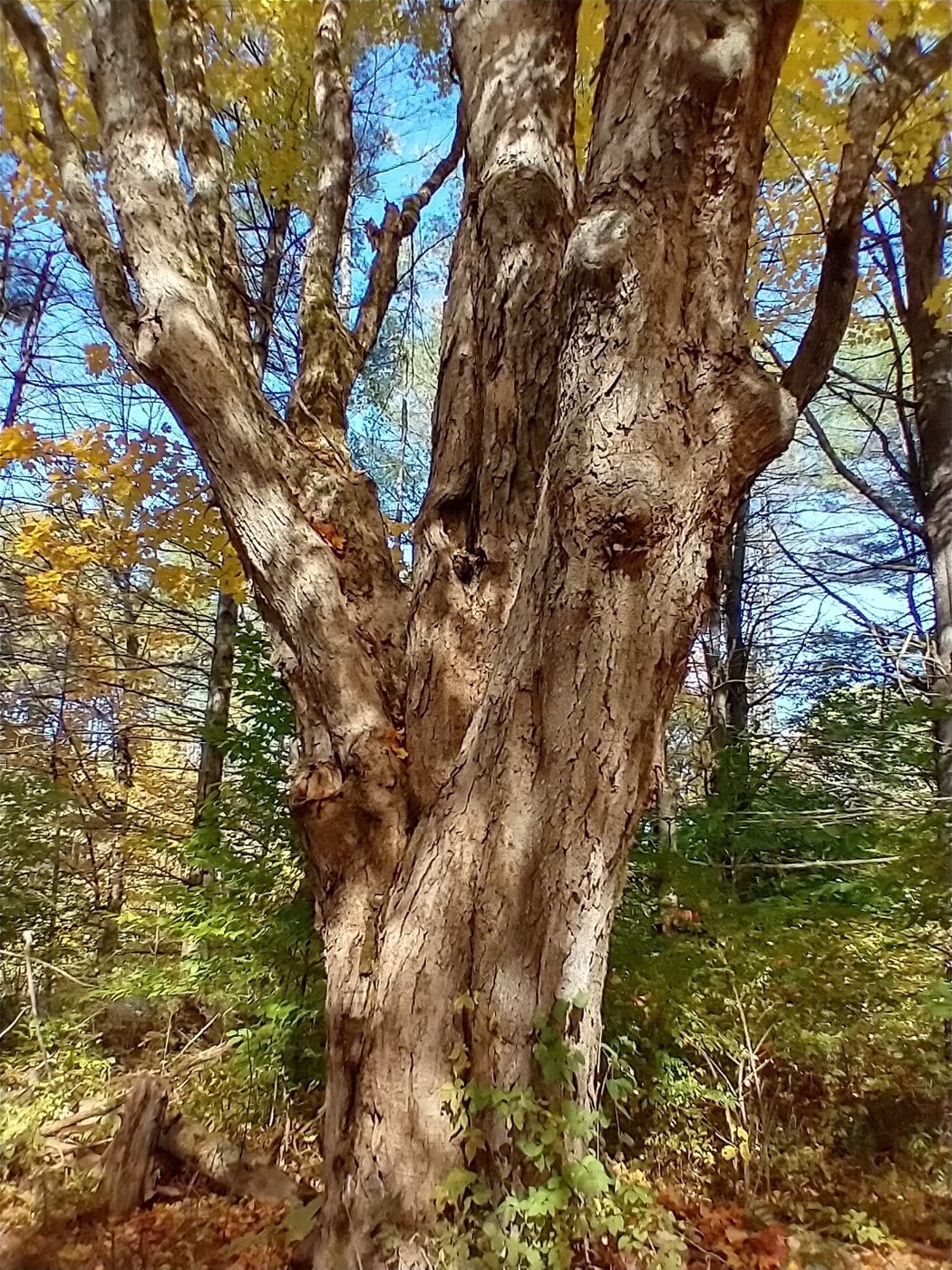
In the open, the branches develop at a distance of eight to ten feet above the ground and make an acute angle with the trunk, thus forming, at least when the tree is young, an egg-shaped head. Later in life the tree may assume a roundish form.
Bark on the old trunk is gray and roughened with long vertical scales which project irregularly at the edges.
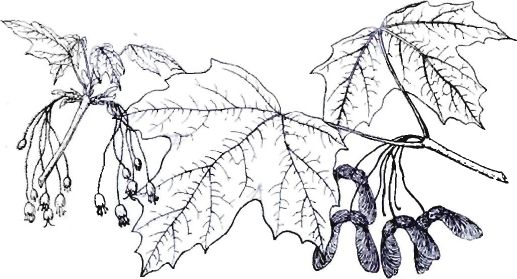
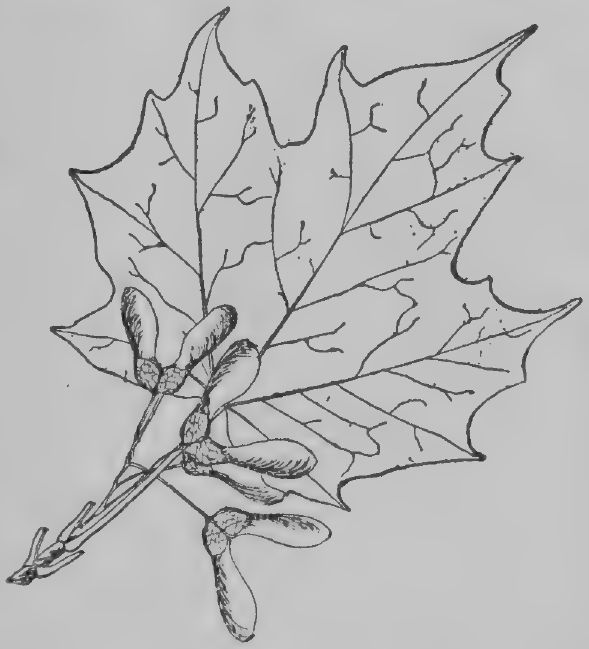
Leaves are simple, opposite, from three to five inches in length, coarsely toothed, dark green and have three to five lobes. The upper surface of the leaf is dark green, and the under surface is pale green. In autumn the foliage takes on brilliant shades of red, scarlet and orange.
Young twigs are reddish-brown in color, lustrous and marked with pale dots. Buds are brown, conical, sharp-pointed, and covered with eight to ten exposed scales.
Flowers, which are greenish-yellow in color, are borne on long, thread-like flower stalks and appear about the middle of April along with the leaves. Both pollen-bearing and seed producing flowers occur in drooping, slender-stalked clusters on the new growth.
Fruit is a two-winged samara, each wing being about an inch long.
The wood is heavy, hard, durable, close-grained and capable of taking and retaining a good polish. It is used largely in the interior finish of buildings, in the making of furniture, flooring, baseball bats, and in ship building.
Sugar Maple is best known for the maple syrup made from the sap.
Where it grows
Mapped in 12 of fourteen counties: Barnstable, Berkshire, Bristol, Essex, Franklin, Hampden, Hampshire, Middlesex, Norfolk, Plymouth, Suffolk, Worcester.
Forest types where the 2016 manual places it: Northern Hardwoods, Spruce-Fir / Northern Hardwoods.
In the forest record
Trees of this group (maple) were 6% of the trees surveyors recorded at lot corners before settlement and are 28% of trees on inventory plots today, statewide.
Each town’s own numbers are on its habitat, forest and water page.
The maple group is among the three most common kinds of tree in the surveyors’ record of 49 of the 164 towns with a surviving record, and the largest share of that record is in West Stockbridge (33%), Pittsfield (25%), Lanesborough (23%). The record is by group of trees, not by species, and covers towns with at least 50 recorded trees for the “largest share” list.
Insects and disease on the record
| Agent | Years seen | Worst year | Acres that year | Last seen |
|---|---|---|---|---|
| Forest tent caterpillar | 11 | 2006 | 362,694 | 2018 |
| Winter moth | 13 | 2011 | 88,793 | 2018 |
Acres are of mapped damage, which can include other trees and non-forest; some agents attack several hosts.
As described in 1925
Show
Listed as Sugar Maple (Rock Maple) (Acer saccharum Marsh.).
How to know the Maples (1925): Habit — When young the outline is usually narrowly egg-shaped. Later it may become roundish. Trunk continuous. Bark_On_Trunk — Gray in color. On old trunk, rough with long ascending scales which project irregularly at the edges. Leaves — Usually 5 lobes, sometimes 3. Bays between lobes rounded. Lobes sparingly toothed. Flowers — Greenish-yellow, in clusters, on long, threadlike stalks. Appear with the leaves. Compare the maples ›
THE Sugar Maple may be found abundantly throughout the State, although its occurrence is much less frequent toward the seacoast. Wherever it may grow, it is much at home in cool, rich woods and on moist, rocky slopes. Normally, it is a tree growing from fifty to sixty feet high, yet it often reaches a height of at least one hundred feet. In the open the branches develop at a distance of eight or ten feet above the ground and make an acute angle with the trunk, thus forming, at least when the tree is young, an egg-shaped head. Later in life the tree may assume a roundish form.
The bark on the old trunk is gray and roughened with long vertical scales which project irregularly at the edges. The young twigs are reddish-brown in color and lustrous.
The leaves are simple, opposite, from three to five inches in length and have three to five lobes. The upper surface of the leaf is dark green, and the under-surface is pale green. In the autumn the foliage takes on brilliant shades of red, scarlet and orange. The flowers, which are greenish-yellow in color, are borne on long, thread-like flower stalks and appear about the middle of April.
The wood is heavy, hard, durable, close-grained and capable of taking and retaining a good polish. It is used largely in the interior finish of buildings, in the making of furniture and in shipbuilding.
Text and line illustrations: Forest Trees of Massachusetts, 7th edition (2016), Massachusetts Department of Conservation and Recreation, Bureau of Forest Fire Control and Forestry, funded by the USDA Forest Service. Drawings, 1925 descriptions and the “How to know” keys: The Commercial Forest Trees of Massachusetts (1925), Massachusetts Department of Conservation, Division of Forestry. Forest shares before settlement and today: Harvard Forest data archive (Cogbill, Burk and Motzkin 2002; Thompson and others 2013). Insects and disease: USDA Forest Service Insect and Disease Survey, Region 9, with DCR. Photographs: observations on iNaturalist (inaturalist.org), each credited to its photographer under its Creative Commons licence; the list is under “Where the pictures come from” on the guide page. Species ranges by county are as the 2016 manual maps them. Transcribed by script and proofread in part; the manuals govern where they differ.