Speckled Alder
Leaves alternate, simple · Family Betulaceae
What to look for
SPECKLED Alder is very common throughout the state, usually growing in wet areas along brooks, swamps, and in pastures.
Alder usually occurs as a large shrub or small tree, rarely more than ten feet tall.
The bark is smooth, brownish to grayish-green, and marked with whitish blotches.
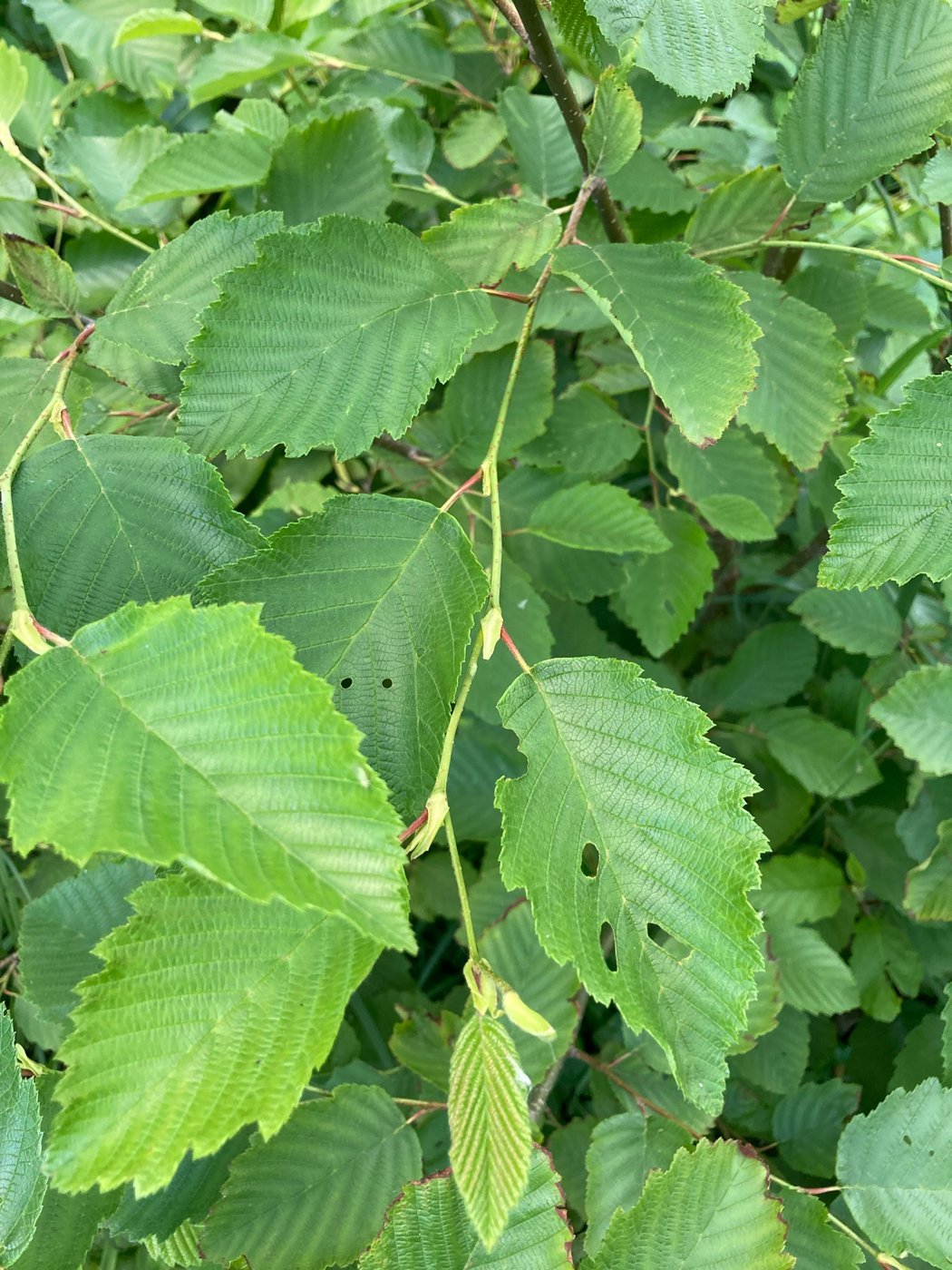
Leaves are alternate, two and one-half to four and one-half inches long, reverse egg-shaped, broadest above the middle, toothed along the margins, and with a characteristic wrinkled (rugose) texture due to depressed veins and tufts of brownish hairs.
Flowers are in catkins that are formed the previous year, and open before the leaves in the spring.
The fruit is woody and cone-like, with a very short stalk.
Buds are egg-shaped, flattened, short-stalked, maroon in color, and with few scales showing.
Twigs are slender, greenish brown; the pith is triangular in cross section.
The wood is whitish, light, and soft. It has been used as fuel, a source of tannin in the manufacturing of leather, and a source of black dye.
Where it grows
Mapped in 13 of fourteen counties: Berkshire, Bristol, Dukes, Essex, Franklin, Hampden, Hampshire, Middlesex, Nantucket, Norfolk, Plymouth, Suffolk, Worcester.
Text and line illustrations: Forest Trees of Massachusetts, 7th edition (2016), Massachusetts Department of Conservation and Recreation, Bureau of Forest Fire Control and Forestry, funded by the USDA Forest Service. Drawings, 1925 descriptions and the “How to know” keys: The Commercial Forest Trees of Massachusetts (1925), Massachusetts Department of Conservation, Division of Forestry. Forest shares before settlement and today: Harvard Forest data archive (Cogbill, Burk and Motzkin 2002; Thompson and others 2013). Insects and disease: USDA Forest Service Insect and Disease Survey, Region 9, with DCR. Photographs: observations on iNaturalist (inaturalist.org), each credited to its photographer under its Creative Commons licence; the list is under “Where the pictures come from” on the guide page. Species ranges by county are as the 2016 manual maps them. Transcribed by script and proofread in part; the manuals govern where they differ.