Red Spruce
Leaves needles or scales · Family Pinaceae · Also called Yellow Spruce, West Virginia Spruce, and Eastern Spruce
In the inventory · Live trees too few to estimate · Volume too few to estimate · Growth and mortality too few to estimate. USDA Forest Service, Forest Inventory and Analysis, 2019–2025; live trees an inch or more across, volume of trees five inches or more. Shares quoted only where the sampling error is 30% or less.
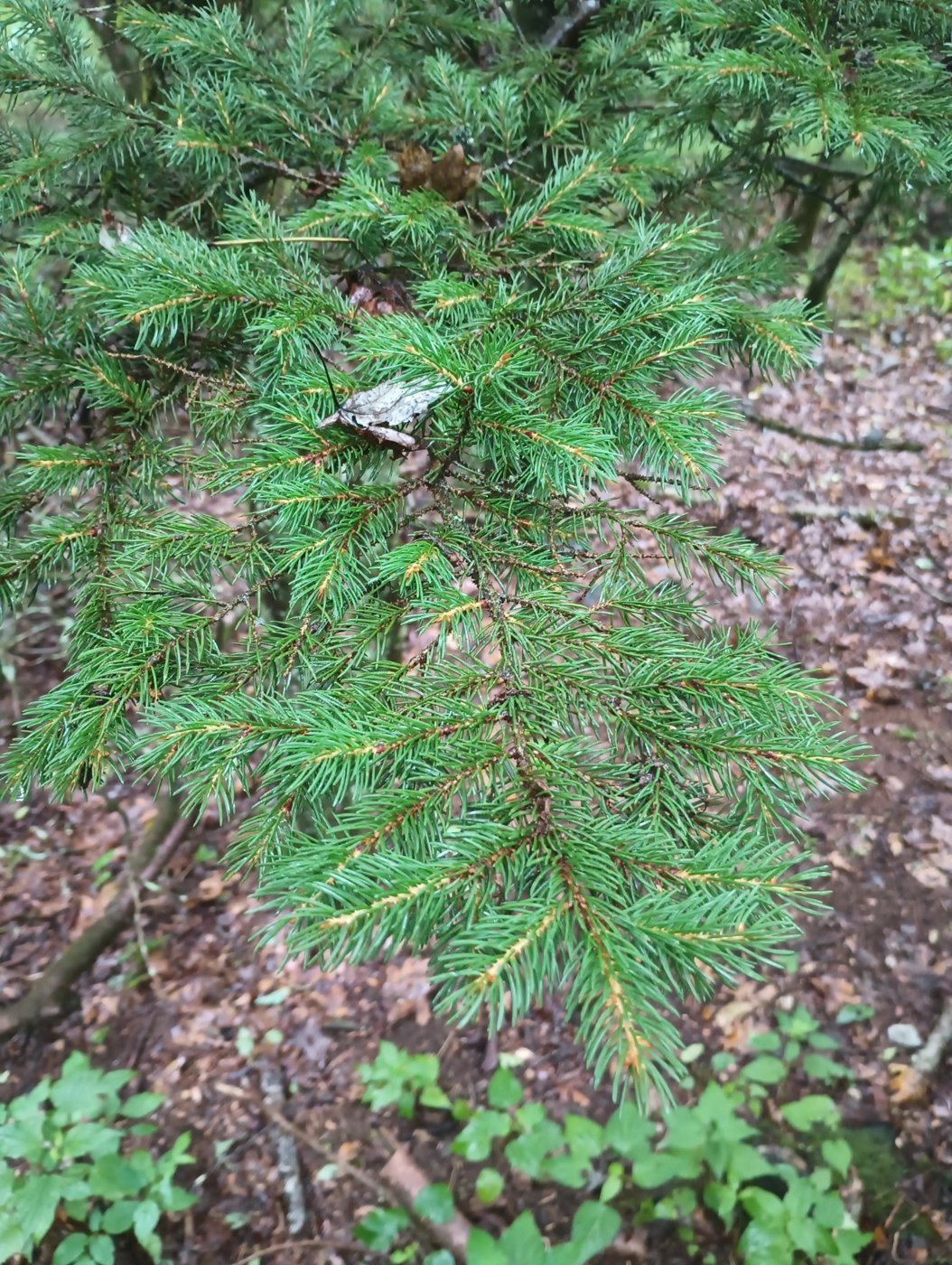
What to look for
RED Spruce is common in the western and northern parts of the State, almost always growing in the higher, well-drained soil of uplands or mountain slopes. It is extremely shade tolerant, but it also readily establishes on scarified open ground.
Its outline is narrowly conical in youth and middle age, and frequently irregular in old age. It is a medium-sized tree, commonly reaching a height of sixty to seventy feet and acquiring a diameter of one to two feet.
Branches are rather long, slightly pendulous, and occur nearly to the ground, persisting for a long time. The bark is red-brown and broken into irregular scales.
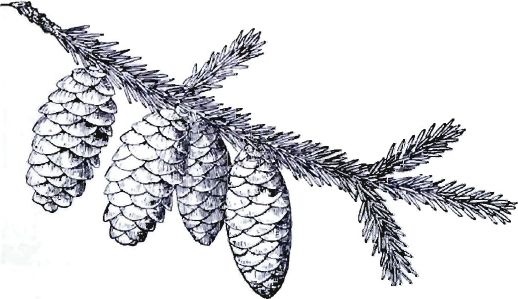
Leaves (needles) are about one-half to five-eighths of an inch in length, curved upward, and dark yellow-green and glossy. The cones are oblong, one to two inches in length and reddish-brown.
The wood of Red, White, and Black Spruce cannot be distinguished with certainty by either gross characteristics or minute anatomy, and all three are usually marketed simply as Eastern Spruce. The wood is light, soft and less durable than pine when exposed to the elements. In the past it was largely used for building-lumber, clapboards, shingles, and was used in the manufacturing of butter-tubs and boxes. Great quantities were consumed in the pulp mills.
The chief uses today are for lumber, pulpwood, and with limited amounts going into poles, piling, boatbuilding stock, and cooperage stock. Oriented strand board and plywood have been made from spruce in recent years. It is also the preferred wood for piano sounding boards, guitars, mandolins, organ pipes, and violin bellies. A unique use of Red Spruce was for spruce chewing gum, made from pitch that accumulates on trunk wounds.
Where it grows
Mapped in 8 of fourteen counties: Berkshire, Essex, Franklin, Hampden, Hampshire, Middlesex, Norfolk, Worcester.
Forest types where the 2016 manual places it: Northern Hardwoods, Spruce-Fir / Northern Hardwoods.
In the forest record
Trees of this group (spruce and fir) were 1% of the trees surveyors recorded at lot corners before settlement and are 1% of trees on inventory plots today, statewide.
Each town’s own numbers are on its habitat, forest and water page.
The spruce and fir group is among the three most common kinds of tree in the surveyors’ record of 4 of the 164 towns with a surviving record, and the largest share of that record is in Tyringham (12%), Northampton (10%), Royalston (9%). The record is by group of trees, not by species, and covers towns with at least 50 recorded trees for the “largest share” list.
As described in 1925
Show
Listed as Red Spruce (Picea rubens Sarg.).
How to know the Spruces (1925): Leaves — Dark yellow-green and very glossy. Cones — One to two inches in length. Usually fall during the first year. Compare the spruces ›
THIS Spruce is common in the western and northern parts of the State, almost always growing in the well-drained soil of uplands or mountain slopes.
As to habit, its outline is narrowly conical in youth and middle age, and frequently irregular and picturesque in old age. It is a medium-sized tree, commonly reaching a height of forty to fifty feet and acquiring a diameter of one to two feet. The trunk is straight and tapers very slowly. The branches are rather long, frequently slightly pendulous, clothe the stem nearly to the ground and persist for a long time.
The bark is red-brown and broken into irregular scales.
The leaves are about one-half inch in length, dark yellow-green and glossy.
The cones are oblong, one to two inches in length and reddish-brown.
The wood is light, soft and less durable than Pine when exposed to the action of the weather.
It is largely used for building-timber and for clapboards and shingles. Owing to the fact that it imparts no flavor, spruce is used in the manufacture of buttertubs and boxes. Great quantities are consumed in the pulp mills. This species, Professor L. R. Jones of Vermont says, was responsible for the suggestion of the name Green Mountain State to that Commonwealth.
It is not uncommon for lumbermen to designate this species as Black Spruce, but, as this is the only commercial Spruce of importance to Massachusetts, we should readily appropriate the right name, or Red Spruce.
Text and line illustrations: Forest Trees of Massachusetts, 7th edition (2016), Massachusetts Department of Conservation and Recreation, Bureau of Forest Fire Control and Forestry, funded by the USDA Forest Service. Drawings, 1925 descriptions and the “How to know” keys: The Commercial Forest Trees of Massachusetts (1925), Massachusetts Department of Conservation, Division of Forestry. Forest shares before settlement and today: Harvard Forest data archive (Cogbill, Burk and Motzkin 2002; Thompson and others 2013). Insects and disease: USDA Forest Service Insect and Disease Survey, Region 9, with DCR. Photographs: observations on iNaturalist (inaturalist.org), each credited to its photographer under its Creative Commons licence; the list is under “Where the pictures come from” on the guide page. Species ranges by county are as the 2016 manual maps them. Transcribed by script and proofread in part; the manuals govern where they differ.