Pitch Pine
Leaves needles or scales · Family Pinaceae · Also called Jack Pine, Hard Pine and Yellow Pine
In the inventory · Live trees about 1 tree in 85 (1.2%) · Volume 1% · Growth and mortality too few to estimate. USDA Forest Service, Forest Inventory and Analysis, 2019–2025; live trees an inch or more across, volume of trees five inches or more. Shares quoted only where the sampling error is 30% or less.
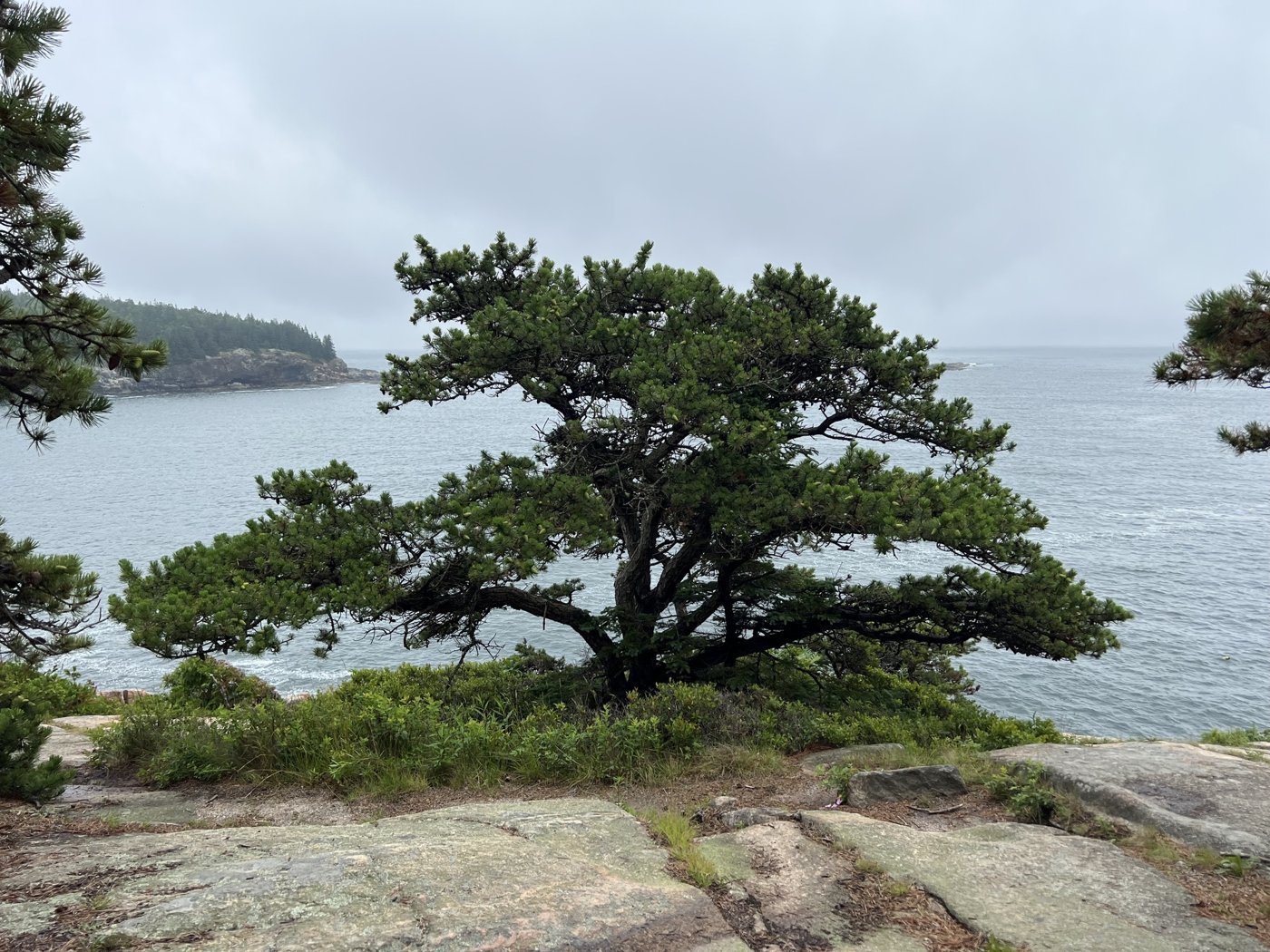
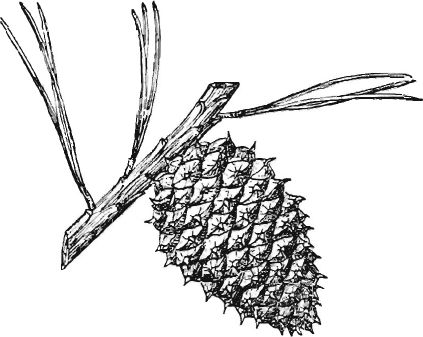
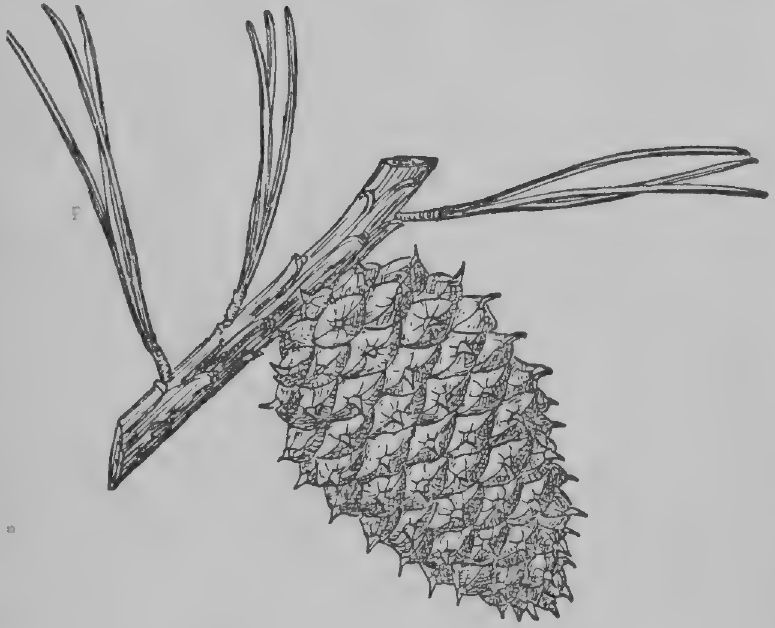
What to look for
PITCH Pine grows in poor, sandy, gravelly soil and on thin-soiled rocky ridges, in almost all parts of the state, from the Cape Islands to Pine Cobble in Williamstown. A thoroughly fire-adapted species, Pitch Pine can resprout from cut stems or defoliation events. Also, in parts of its range it exhibits serotiny, whereby the cones remain closed until heated by wildfire in order to better establish on the bare ground following a fire. However, this trait has not been observed in Massachusetts trees.
Pitch Pine is usually a low tree with irregular and variable outline. It may attain a height of forty to sixty feet, and a diameter of one to two feet. “The trunk is continuous, straight and tapers rapidly. It is highly intolerant of shade and hence is well known as a pioneer species of abandoned fields.
Branches, grouped in threes around the trunk, are up to one-half inch, often contorted, fibrous, and tough. When bent sharply they do not snap cleanly.
Bark on young stems and branches is rough. On old trees it is deep gray or reddish-brown, and irregularly divided into broad, flat, continuous ridges.
Leaves (needles) are in clusters of three. They are three to five inches long, stiff, dark yellow-green, and fall at the end of their second or third year.
Cones are one to three inches long and light brown in color. They often remain on the tree for ten or twelve years. The scales are tipped with sharp prickles, a characteristic likely to aid in the recognition of the species.
The wood is considered a “yellow pine,” with properties more analogous to southern pines than White Pine. Today, Pitch Pine’s principal use is for lumber and pulpwood. It once was a source of resin (pitch), used in making turpentine and tar, and its wood was a chief material in the building of ships. It has also been utilized for charcoal, fuel for locomotives, and box-board lumber. Its capacity to thrive on extremely sterile soil makes it a crucial component in the establishment and maintenance of the ecologically imperiled — sandplain communities.
Where it grows
Mapped in all fourteen counties.
Forest types where the 2016 manual places it: Pitch Pine-Oak.
In the forest record
Trees of this group (pine) were 13% of the trees surveyors recorded at lot corners before settlement and are 16% of trees on inventory plots today, statewide.
Each town’s own numbers are on its habitat, forest and water page.
The pine group is among the three most common kinds of tree in the surveyors’ record of 88 of the 164 towns with a surviving record, and the largest share of that record is in Yarmouth (70%), Barnstable (44%), Truro (44%). The record is by group of trees, not by species, and covers towns with at least 50 recorded trees for the “largest share” list.
Insects and disease on the record
| Agent | Years seen | Worst year | Acres that year | Last seen |
|---|---|---|---|---|
| Lophodermium needle cast of pines | 2 | 2021 | 36,508 | 2022 |
| Nantucket pine tip moth | 8 | 2006 | 29,064 | 2021 |
| Diplodia canker | 12 | 2010 | 5,252 | 2015 |
| Southern pine beetle | 2 | 2025 | 1,817 | 2025 |
Acres are of mapped damage, which can include other trees and non-forest; some agents attack several hosts.
As described in 1925
Show
Listed as Pitch Pine (Pinus rigida Mill.).
How to know the Pines (1925): Leaves — Arranged in 3-leaved clusters. Stiff, dark yellow-green and 3 to 5 inches long. Compare the pines ›
THE Pitch Pine grows in poor, sandy and gravelly soil in all parts of the State, often forming a considerable tract of almost pure growth, as in the southeastern sections near the coast.
In habit it is usually a low tree with irregular and variable outline. Normally, the height is from thirty to forty feet and the diameter from one to two feet. The trunk is continuous, straight and tapers rapidly. The branches, grouped in threes about the trunk, are thick and often contorted. The bark on young stems and branches is rough. On old trees it is deep gray or reddish-brown, and irregularly divided into broad, flat, ridges. The leaves are in clusters of three. They are three to five inches long, stiff, dark yellow-green and fall during their second year.
The cones are one to three inches long and light brown in color. They often remain on the tree for ten or twelve years. The scales are tipped with sharp prickles,— a character likely to aid in the recognition of the species.
The wood is light, soft and brittle. It is sometimes sawed into coarse lumber and is used for charcoal and for fuel. It is chiefly valuable because it will do well on extremely sterile soil, although it is a slow grower. Turpentine and tar were once made from this species in New England. There is a growing tendency to use this species for box-board lumber.
Text and line illustrations: Forest Trees of Massachusetts, 7th edition (2016), Massachusetts Department of Conservation and Recreation, Bureau of Forest Fire Control and Forestry, funded by the USDA Forest Service. Drawings, 1925 descriptions and the “How to know” keys: The Commercial Forest Trees of Massachusetts (1925), Massachusetts Department of Conservation, Division of Forestry. Forest shares before settlement and today: Harvard Forest data archive (Cogbill, Burk and Motzkin 2002; Thompson and others 2013). Insects and disease: USDA Forest Service Insect and Disease Survey, Region 9, with DCR. Photographs: observations on iNaturalist (inaturalist.org), each credited to its photographer under its Creative Commons licence; the list is under “Where the pictures come from” on the guide page. Species ranges by county are as the 2016 manual maps them. Transcribed by script and proofread in part; the manuals govern where they differ.