Pignut Hickory
Leaves alternate, compound · Family Juglandaceae · Also called Sweet Pignut Hickory, Coast Pignut Hickory, Smoothbark Hickory, Swamp Hickory, and Broom Hickory
In the inventory · Live trees about 1 tree in 215 (0.5%) · Volume under 1% · Growth and mortality too few to estimate. USDA Forest Service, Forest Inventory and Analysis, 2019–2025; live trees an inch or more across, volume of trees five inches or more. Shares quoted only where the sampling error is 30% or less.
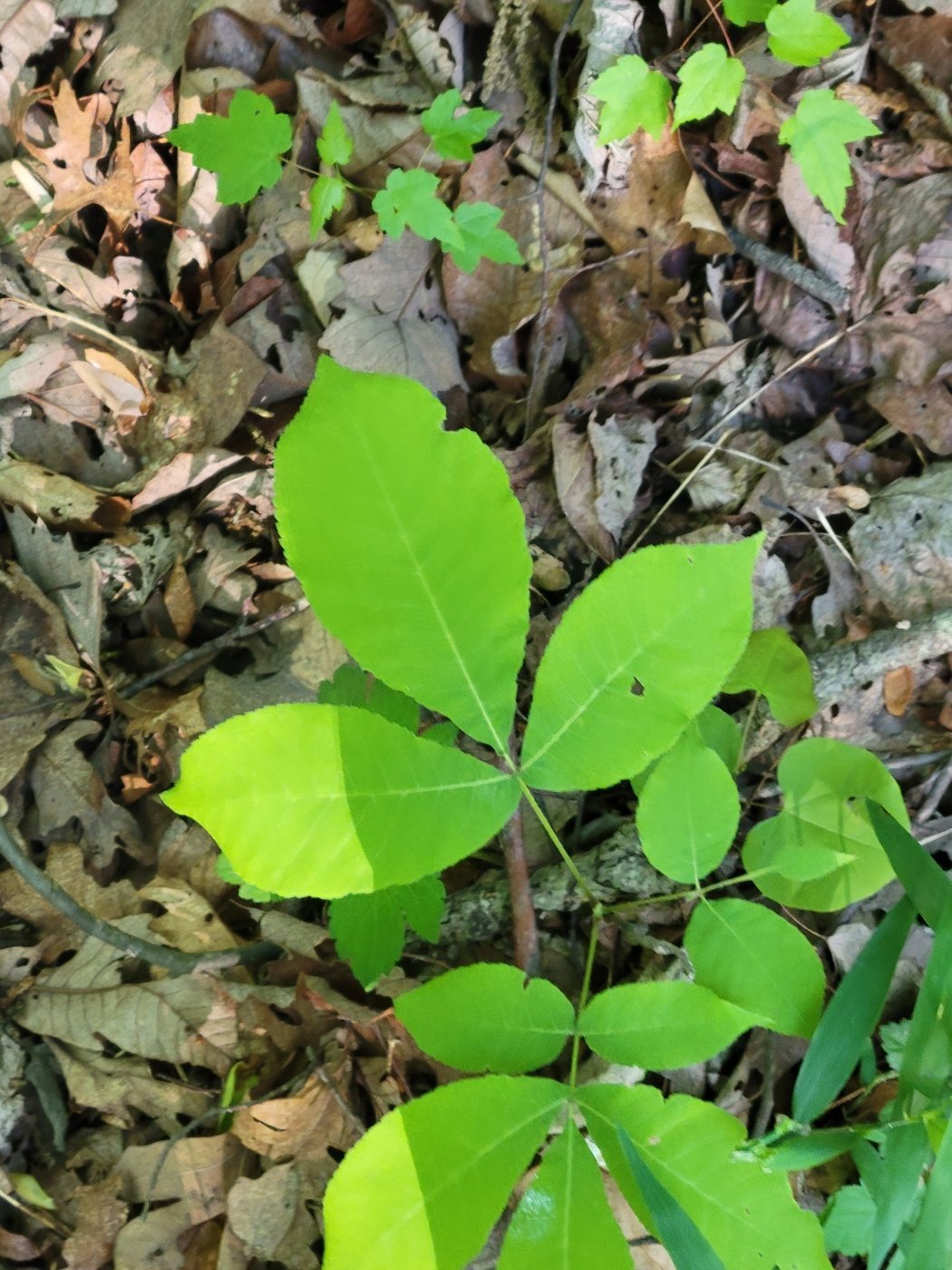
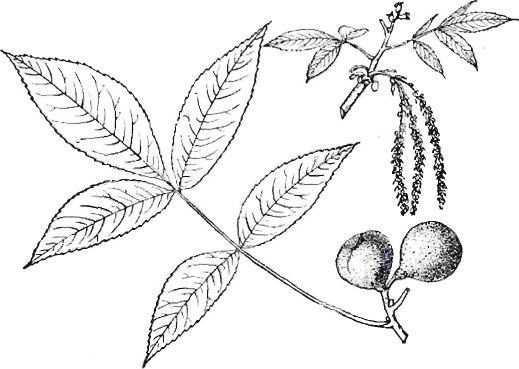

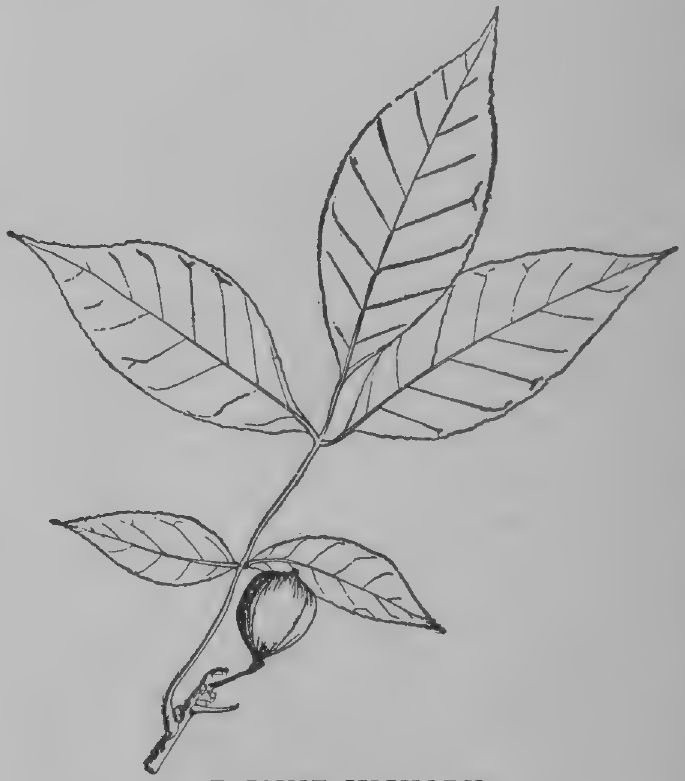
What to look for
PIGNUT Hickory is abundantly distributed throughout Massachusetts. It seems to prefer the dry ridges and hillsides and is usually in the company of other trees. It has been classed as intolerant to shade.
Naturally tall, its height seldom exceeds sixty to ninety feet, and its diameter is from two to three feet. It has a tapering trunk and a cylindrical head of relatively narrow spread.
The bark is smooth until shallow interlocking fissures develop with old age.
Leaves are alternate, compound, eight to twelve inches long, and composed of five to seven leaflets. Individual leaflets are rather small and narrow. Twigs are slender (to one-eighth inch thick), red-brown, and hairless. Buds have overlapping scales, and the end bud is three-eighths to one-half inch long and are covered in silk-like hair after the outer scales drop in autumn.
The fruit, a nut, which ripens in October, is borne singly or in pairs and is variable in shape. Sometimes it is pear-shaped or round, but it can also be egg-shaped. The fruit is usually small and the husk thin.
The wood is heavy, hard, strong, tough and flexible. Early settlers fed the nuts to pigs. In the early 1900’s the wood was used in the manufacturing of wagons, agricultural implements, tool handles, and home heating fuel.
Where it grows
Mapped in all fourteen counties.
Forest types where the 2016 manual places it: Central Hardwoods.
In the forest record
Trees of this group (hickory, ash and other) were 11% of the trees surveyors recorded at lot corners before settlement and are 8% of trees on inventory plots today, statewide.
Each town’s own numbers are on its habitat, forest and water page.
The hickory, ash and other group is among the three most common kinds of tree in the surveyors’ record of 88 of the 164 towns with a surviving record, and the largest share of that record is in Deerfield (29%), Salem (28%), Dighton (26%). The record is by group of trees, not by species, and covers towns with at least 50 recorded trees for the “largest share” list.
As described in 1925
Show
Listed as Pignut (Hicoria glabra Britton).
How to know the Hickories (1925): Bark_On_Trunk — Dark gray. Comparatively smooth. Often broken into plates. Leaves — Leaflets 3, 5 or 7, in number. Winter_Buds — Terminal buds elliptical. Outer scales are dark reddish-brown and usually fall in the autumn. Inner scales yellow-green. Twigs — Smooth. Fruit — Husk usually thin. The shell either thick or thin and the kernel sweet or bitter. Compare the hickories ›
THE Pignut is abundantly distributed throughout Massachusetts. It seems to prefer the dry ridges and hillsides and is usually in the company of other trees.
Naturally a tall tree, its height seldom exceeds fifty to sixty feet and its diameter is from one to two feet. It has a tapering trunk and a cylindrical head of relatively narrow spread.
‘The bark on the trunk is dark gray.
On old trunks it is comparatively smooth, though often it is broken with plates, somewhat after the manner of the Shagbark.
The leaves are alternate, compound, eight to twelve inches long and composed of five to seven leaflets.
The individual leaflets are rather small and narrow.
The fruit, which ripens in October, is borne singly or in pairs and is very variable in shape. Sometimes it is pear-shaped, sometimes round; at other times it is egg-shaped. The fruit is usually small and the husk thin. The wood is heavy, hard, strong, tough and flexible.
It is employed in the manufacture of wagons, agricultural implements and tool handles.
Text and line illustrations: Forest Trees of Massachusetts, 7th edition (2016), Massachusetts Department of Conservation and Recreation, Bureau of Forest Fire Control and Forestry, funded by the USDA Forest Service. Drawings, 1925 descriptions and the “How to know” keys: The Commercial Forest Trees of Massachusetts (1925), Massachusetts Department of Conservation, Division of Forestry. Forest shares before settlement and today: Harvard Forest data archive (Cogbill, Burk and Motzkin 2002; Thompson and others 2013). Insects and disease: USDA Forest Service Insect and Disease Survey, Region 9, with DCR. Photographs: observations on iNaturalist (inaturalist.org), each credited to its photographer under its Creative Commons licence; the list is under “Where the pictures come from” on the guide page. Species ranges by county are as the 2016 manual maps them. Transcribed by script and proofread in part; the manuals govern where they differ.