Norway Spruce
Leaves needles or scales · Family Pinaceae
In the inventory · Live trees fewer than 1 in 100 · Volume under 1% · Growth and mortality too few to estimate. USDA Forest Service, Forest Inventory and Analysis, 2019–2025; live trees an inch or more across, volume of trees five inches or more. Shares quoted only where the sampling error is 30% or less.
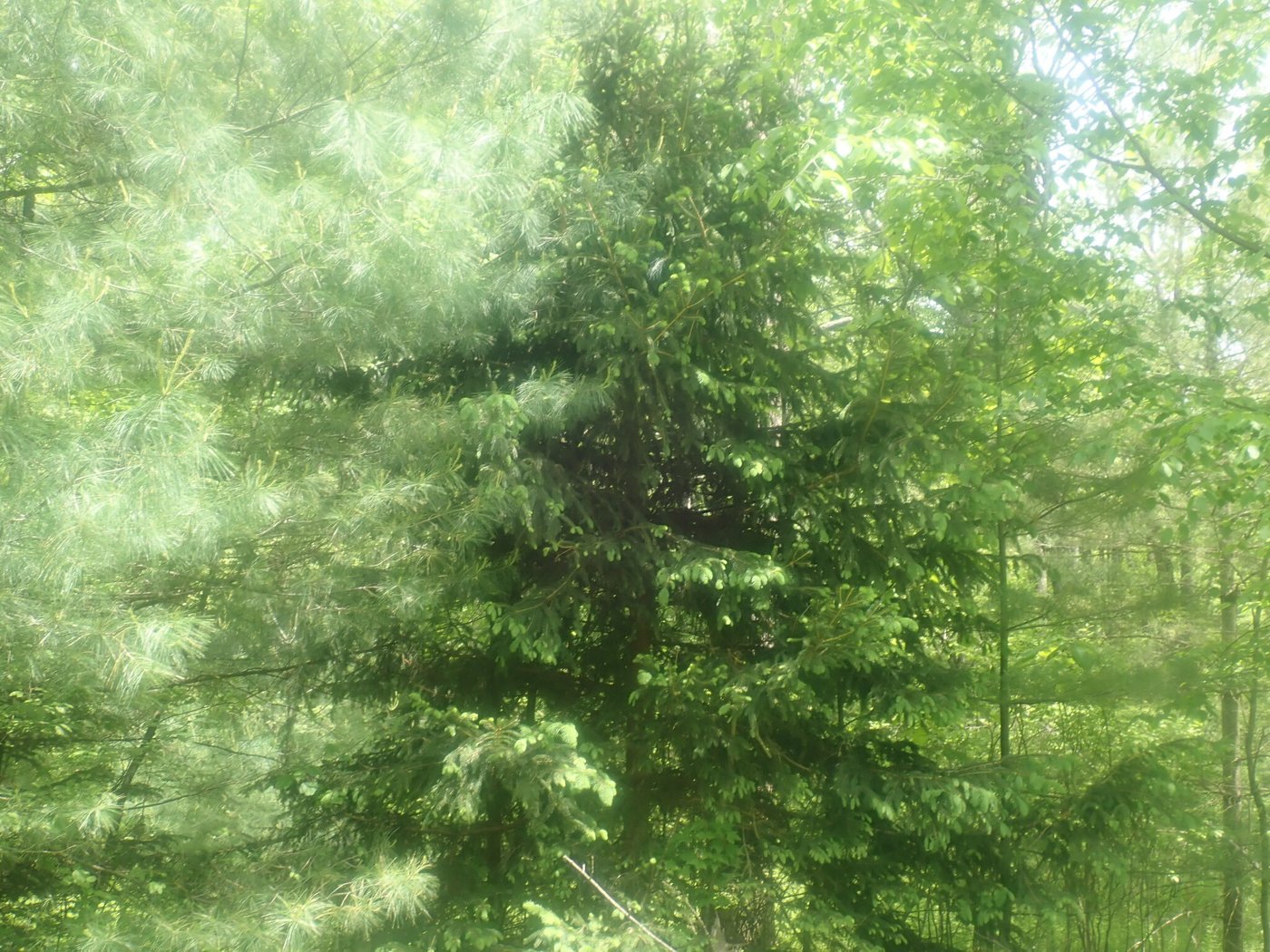
What to look for
NORWAY Spruce has been planted in areas of human habitation in the United States since the colonial period. It is commonly seen in Massachusetts, where is has been planted ornamentally, as a windbreak, and in plantations during the major reforestation efforts of the Great Depression era. It is native to northern and central Europe.
It is typically a single-trunked tree, pyramidal to conical in form, with horizontal branches and pendulous branchlets that give the tree a graceful, weeping shape. It typically reaches heights of forty to sixty feet and widths of twenty-five to thirty feet, though it is capable of growing much larger.
The evergreen leaves (needles) are a shiny medium to dark green, four-sided, stiff and sharp. They bend away from the lower part of the twig. They have two or three stomatal bands on each side. Like all spruces, the leaves are borne on small pegs Twigs are slender and shiny, smooth, and orange-brown in color. Bark on young trees is reddish-brown and scaly. As the tree ages, the bark becomes more gray and flaky. Buds are reddish-brown, about one-quarter inch long and cone-shaped. They are not resinous. Male and female flowers occur on the same tree. Male flowers are yellow-brown, while female flowers are reddish-purple.
The fruits of Norway spruce are in large light brown cones, four to six inches long and up to two inches wide that hang down. The cones are larger than those of our native black or red spruce.
The wood is white, soft, and close-grained. Norway spruce has commonly been used as pulpwood for manufacturing paper, as well as for lumber, crates, millwork, musical instrument soundboards, and for Christmas trees.
Where it grows
Mapped in 3 of fourteen counties: Barnstable, Dukes, Suffolk. Introduced, not native.
In the forest record
Trees of this group (spruce and fir) were 1% of the trees surveyors recorded at lot corners before settlement and are 1% of trees on inventory plots today, statewide.
Each town’s own numbers are on its habitat, forest and water page.
The spruce and fir group is among the three most common kinds of tree in the surveyors’ record of 4 of the 164 towns with a surviving record, and the largest share of that record is in Tyringham (12%), Northampton (10%), Royalston (9%). The record is by group of trees, not by species, and covers towns with at least 50 recorded trees for the “largest share” list.
Text and line illustrations: Forest Trees of Massachusetts, 7th edition (2016), Massachusetts Department of Conservation and Recreation, Bureau of Forest Fire Control and Forestry, funded by the USDA Forest Service. Drawings, 1925 descriptions and the “How to know” keys: The Commercial Forest Trees of Massachusetts (1925), Massachusetts Department of Conservation, Division of Forestry. Forest shares before settlement and today: Harvard Forest data archive (Cogbill, Burk and Motzkin 2002; Thompson and others 2013). Insects and disease: USDA Forest Service Insect and Disease Survey, Region 9, with DCR. Photographs: observations on iNaturalist (inaturalist.org), each credited to its photographer under its Creative Commons licence; the list is under “Where the pictures come from” on the guide page. Species ranges by county are as the 2016 manual maps them. Transcribed by script and proofread in part; the manuals govern where they differ.