Norway Maple
Leaves opposite, lobed · Family Aceraceae
In the inventory · Live trees fewer than 1 in 100 · Volume under 1% · Growth and mortality too few to estimate. USDA Forest Service, Forest Inventory and Analysis, 2019–2025; live trees an inch or more across, volume of trees five inches or more. Shares quoted only where the sampling error is 30% or less.
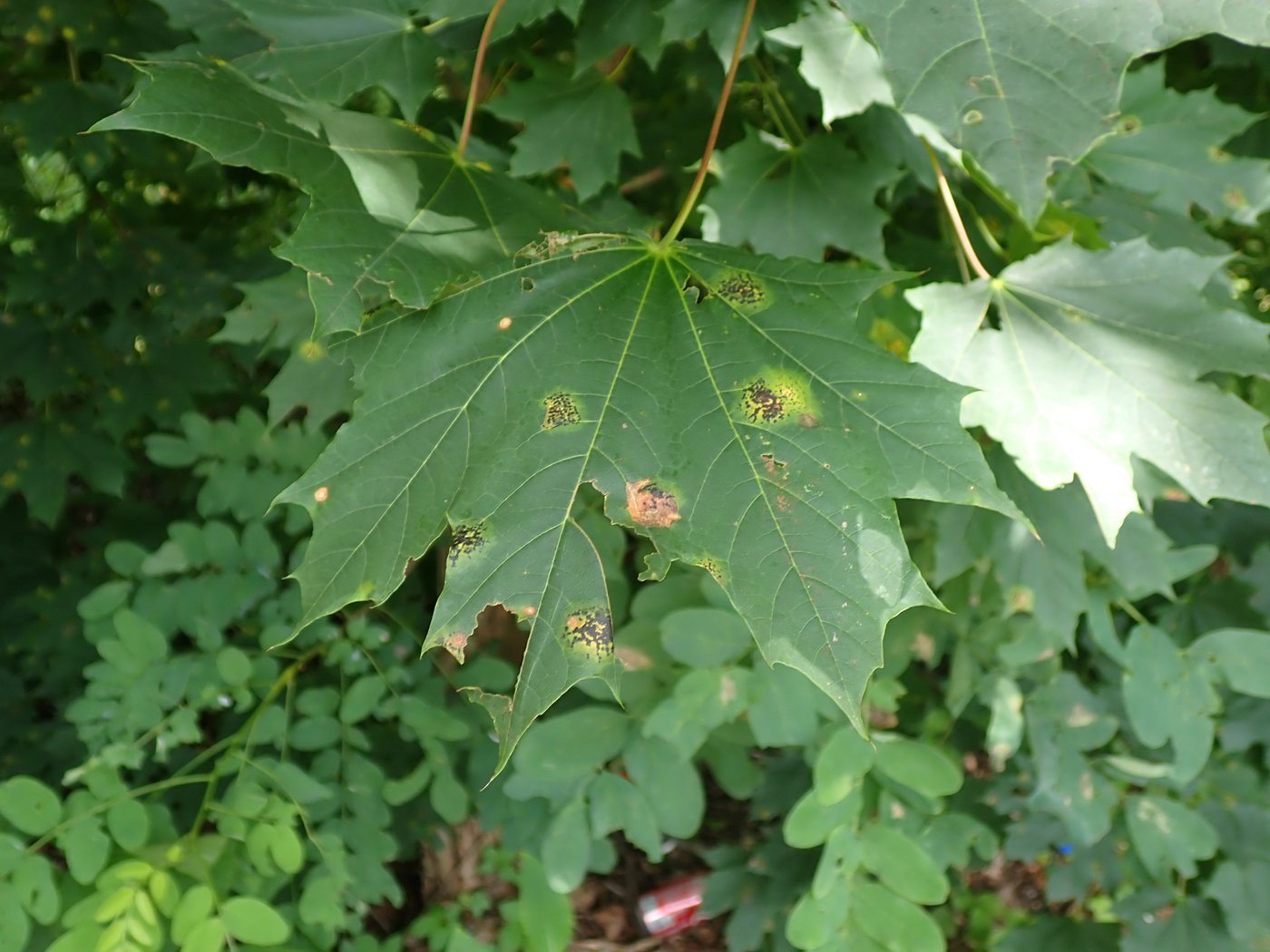
What to look for
NORWAY MAPLE is very common throughout much of the northeast, though it is native to Europe and Asia. Once heavily planted to replace American elms obliterated by Dutch Elm Disease, they have since been declared an invasive species. They seed in easily and not only adapt to a variety of soils but also are tolerant of many stressors like drought and pollution. Norway maples have a broad spreading crown that typically grows forty to fifty feet tall. This species is extremely shade tolerant.
The bark is smooth and gray on younger trees and becomes more corrugated as tree ages.
The dark green leaves are opposite and simple with five to seven sharply pointed lobes. They are four to seven inches tall and wide. A good way to distinguish the Norway Maple from other maples is to pluck a leaf from the stem and look for a milky sap flowing from the petiole. They have a yellow fall color and are one of the last maples to lose their leaves.
Clusters of inconspicuous greenish — yellow flowers appear before the leaves in early spring.
The fruit is a two-winged samara attached at an angle of 180 degrees. Each samara is an inch and a half to two inches long and matures in late summer.
Twigs are smooth, stout and olive-brown with solid white pith. Buds are large, blunt and greenish maroon to maroon.
The wood is hard and heavy with a uniform texture. It is used in furniture, paper, boxes, pallets, and musical instruments.
Where it grows
Mapped in all fourteen counties. Introduced, not native.
In the forest record
Trees of this group (maple) were 6% of the trees surveyors recorded at lot corners before settlement and are 28% of trees on inventory plots today, statewide.
Each town’s own numbers are on its habitat, forest and water page.
The maple group is among the three most common kinds of tree in the surveyors’ record of 49 of the 164 towns with a surviving record, and the largest share of that record is in West Stockbridge (33%), Pittsfield (25%), Lanesborough (23%). The record is by group of trees, not by species, and covers towns with at least 50 recorded trees for the “largest share” list.
Insects and disease on the record
| Agent | Years seen | Worst year | Acres that year | Last seen |
|---|---|---|---|---|
| Winter moth | 13 | 2011 | 88,793 | 2018 |
Acres are of mapped damage, which can include other trees and non-forest; some agents attack several hosts.
Text and line illustrations: Forest Trees of Massachusetts, 7th edition (2016), Massachusetts Department of Conservation and Recreation, Bureau of Forest Fire Control and Forestry, funded by the USDA Forest Service. Drawings, 1925 descriptions and the “How to know” keys: The Commercial Forest Trees of Massachusetts (1925), Massachusetts Department of Conservation, Division of Forestry. Forest shares before settlement and today: Harvard Forest data archive (Cogbill, Burk and Motzkin 2002; Thompson and others 2013). Insects and disease: USDA Forest Service Insect and Disease Survey, Region 9, with DCR. Photographs: observations on iNaturalist (inaturalist.org), each credited to its photographer under its Creative Commons licence; the list is under “Where the pictures come from” on the guide page. Species ranges by county are as the 2016 manual maps them. Transcribed by script and proofread in part; the manuals govern where they differ.