Northern White Cedar
Leaves needles or scales · Family Cupressaceae · Also called Eastern White Cedar, Arborvitae, and Swamp Cedar
What to look for
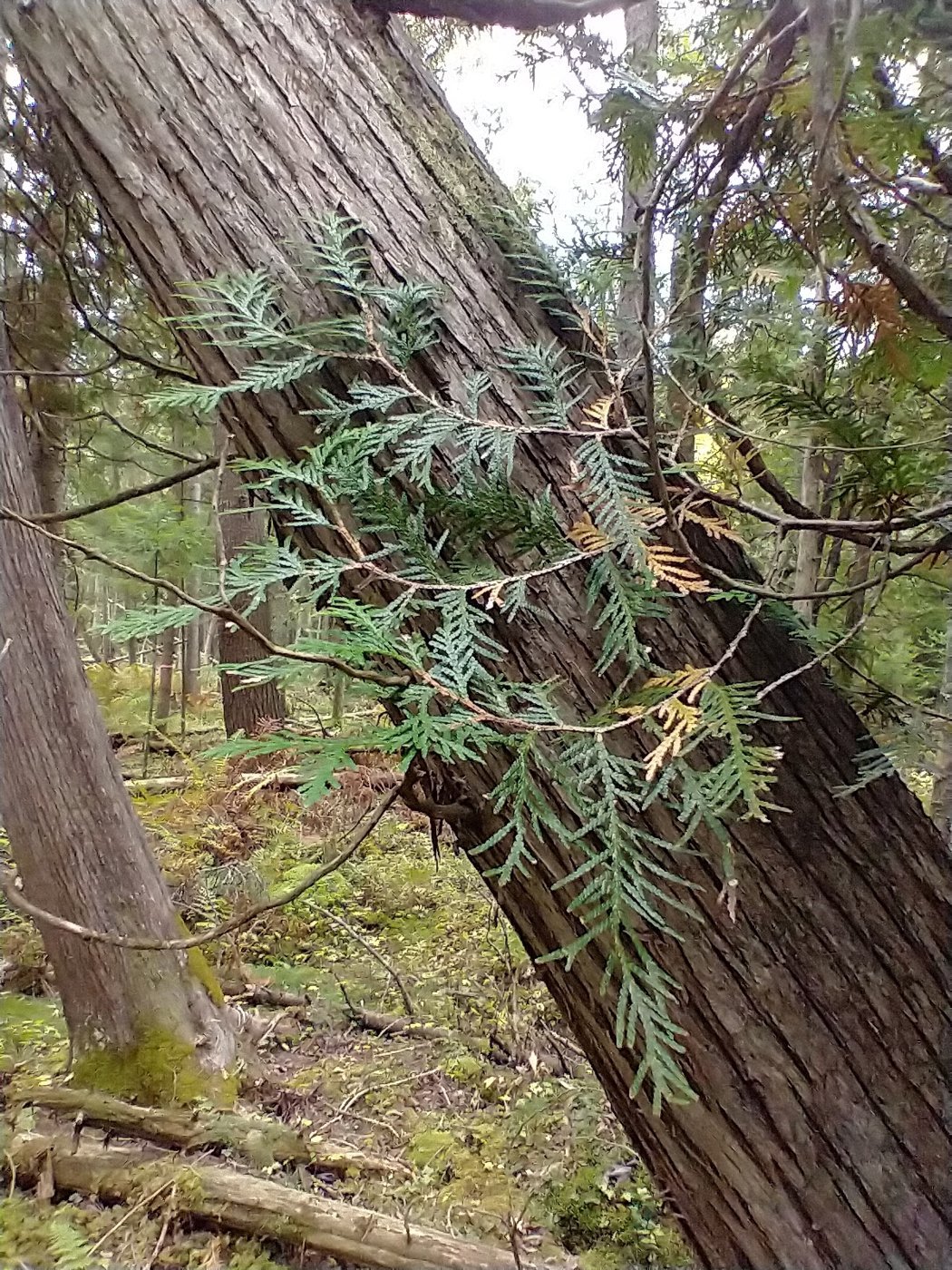
NORTHERN White Cedar is a compact pyramidal tree of medium size with a height of fifty to sixty feet and two to three feet in diameter. The tree is found throughout the state, mostly in ornamental plantings, though it is native to certain rich swamps in the southwestern corner. It also appears on well-drained slopes, usually in mixtures with hardwoods.
It is generally classified as shade tolerant. It is less tolerant than Balsam Fir but slightly more tolerant than Black Spruce. Northern White Cedar can withstand severe suppression for several years.
The trunk, often buttressed, is strongly tapered and frequently divided into two or more direct stems.
Branches are short and nearly horizontal, sometimes forming almost impenetrable thickets, as dead branches are very stiff and persistent. In the open, it develops a conical, symmetrical crown.
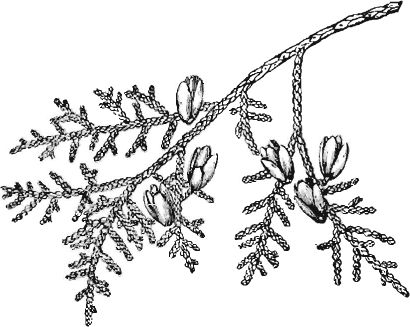
Bark is thin, gray to reddish brown, separating in long, vertical, narrow shredded strips. Leaves (needles) are scale-like with a length of one-eighth to one-quarter inches, and are arranged to make the small branches flat. The scent is pleasant when crushed, but is pungent to the taste.
Fruits are small, oblong cones that mature in one season. They are yellowish-brown and one-third to one-half inch in size, with six to twelve scales borne singly or in large clusters on the ends of branches. Seeds are one-eighth inch long, with two narrow wings almost circling the seed.
The wood is light, soft, brittle, coarse-grained, durable, fragrant, and pale brown in color. It is especially important for making fence posts, poles, rot-resistant lumber, and shingles. Interestingly it was named “Arbor Vitae” (a Latinized French name meaning “tree of life’), after the 16th century explorer Jacques Cartier’s Canadian expedition team learned from the Native Americans how to use the tree's foliage to treat scurvy. As a result of this, it became the first tree to be imported from America to Europe.
Where it grows
Mapped in 10 of fourteen counties: Barnstable, Berkshire, Bristol, Dukes, Essex, Franklin, Hampden, Hampshire, Middlesex, Worcester.
Text and line illustrations: Forest Trees of Massachusetts, 7th edition (2016), Massachusetts Department of Conservation and Recreation, Bureau of Forest Fire Control and Forestry, funded by the USDA Forest Service. Drawings, 1925 descriptions and the “How to know” keys: The Commercial Forest Trees of Massachusetts (1925), Massachusetts Department of Conservation, Division of Forestry. Forest shares before settlement and today: Harvard Forest data archive (Cogbill, Burk and Motzkin 2002; Thompson and others 2013). Insects and disease: USDA Forest Service Insect and Disease Survey, Region 9, with DCR. Photographs: observations on iNaturalist (inaturalist.org), each credited to its photographer under its Creative Commons licence; the list is under “Where the pictures come from” on the guide page. Species ranges by county are as the 2016 manual maps them. Transcribed by script and proofread in part; the manuals govern where they differ.