Northern Red Oak
Leaves alternate, lobed · Family Fagaceae
In the inventory · Live trees about 1 tree in 25 (4.0%) · Volume 11% · Growth and mortality 21.0 million cu ft a year net growth, 11.1 million lost to mortality. USDA Forest Service, Forest Inventory and Analysis, 2019–2025; live trees an inch or more across, volume of trees five inches or more. Shares quoted only where the sampling error is 30% or less.
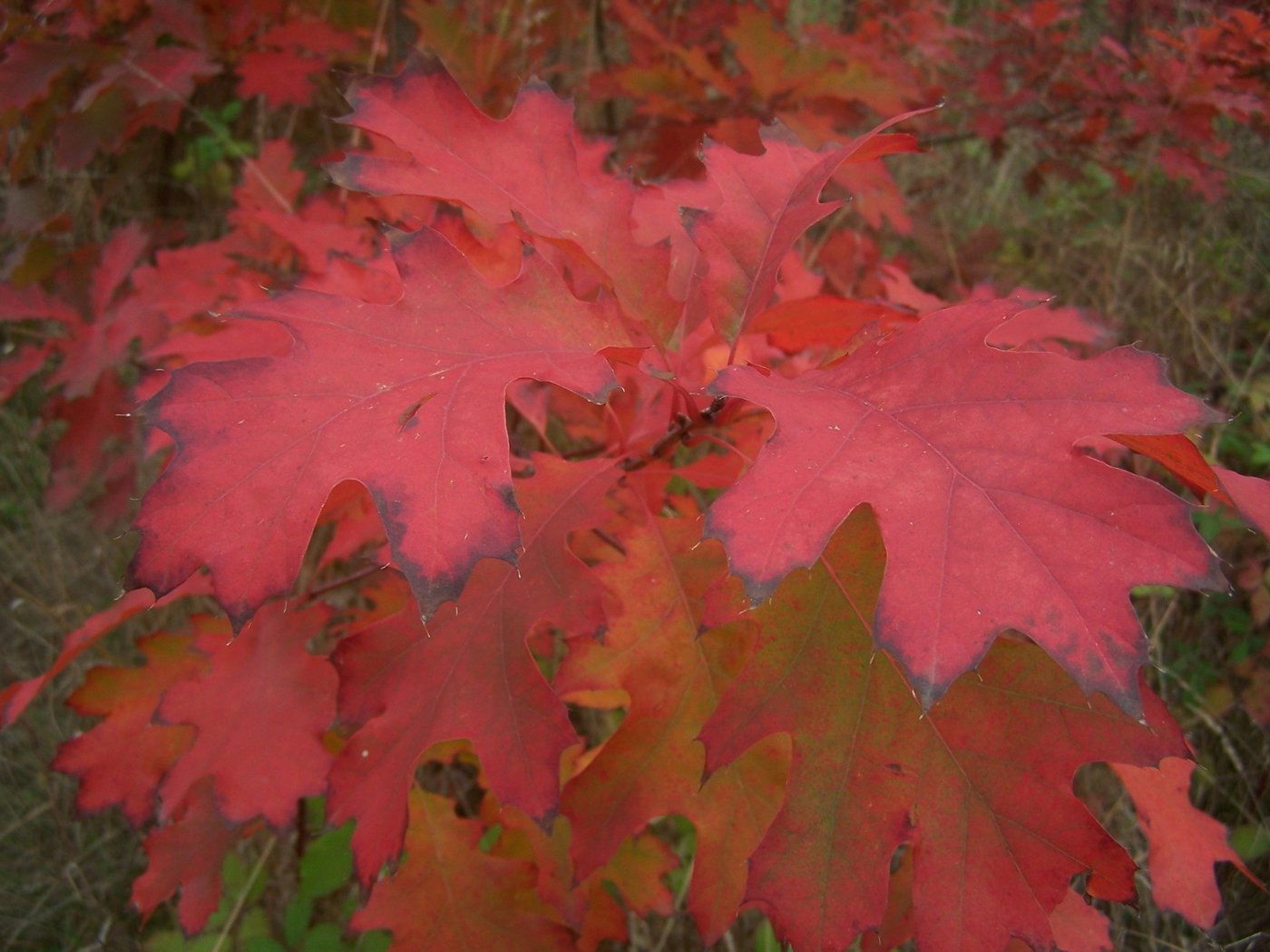
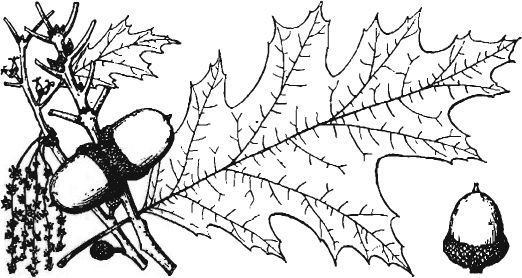

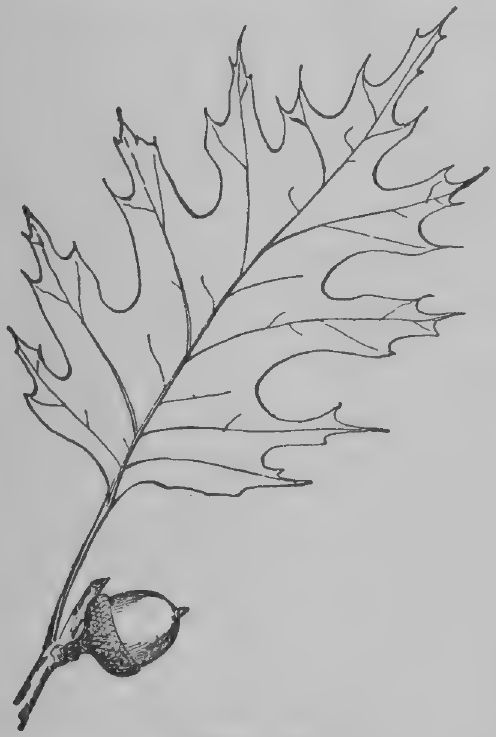
What to look for
NORTHERN Red Oak is abundantly distributed throughout Massachusetts. It occurs in various. soils, except wetland. Northern Red Oak is intermediate in shade tolerance.
One of the most rapid growing of the oaks and the largest of the native species, it attains a height of seventy to eighty feet and a diameter of three to four feet. Frequently a specimen exceeds these dimensions.
Normally the trunk is continuous, dark, furrowed, often laced with broad shiny strips. Branches are stout, upright or horizontal, develop higher up on the trunk than those of the White Oak, and form a narrow, but sometimes broad head.
The bark on the young tree is smooth and gray. On older trees, it is a dark gray or almost black and ridged coarsely and irregularly, yet never becoming extremely rough.
Leaves are simple, alternate, five to eight inches in length and variable in outline. They show seven to nine lobes which end in a point, extending into a bristle. The upper surface is dull to lustrous dark green, while the lower surface is gray to light yellowish-green. Twigs are hairless. Buds are three-sixteenth to five-sixteenth inches, sharp or blunt, and hairless.
Flowers in the form of dangling catkins, the earliest of the oaks, appear in late April or early May when the leaves are partially grown.
The fruit, an acorn, matures the second season. The acorn is larger than that of any other native oak and has a saucer-like cup about an inch across.
The wood is heavy, hard, and strong. It is used for fuel, furniture and interior finishing. This tree is one of the more important lumber species. As Red Oak is easily transplanted, it is a popular shade tree with its good form and dense foliage.
Where it grows
Mapped in all fourteen counties.
Forest types where the 2016 manual places it: Pitch Pine-Oak, Central Hardwoods, Northern Hardwoods, Transition Hardwoods.
In the forest record
Trees of this group (oak) were 45% of the trees surveyors recorded at lot corners before settlement and are 19% of trees on inventory plots today, statewide.
Each town’s own numbers are on its habitat, forest and water page.
The oak group is among the three most common kinds of tree in the surveyors’ record of 127 of the 164 towns with a surviving record, and the largest share of that record is in Boxford (81%), Natick (80%), Newton (77%). The record is by group of trees, not by species, and covers towns with at least 50 recorded trees for the “largest share” list.
Insects and disease on the record
| Agent | Years seen | Worst year | Acres that year | Last seen |
|---|---|---|---|---|
| Spongy moth | 21 | 2017 | 1,049,099 | 2025 |
| Forest tent caterpillar | 11 | 2006 | 362,694 | 2018 |
| Winter moth | 13 | 2011 | 88,793 | 2018 |
Acres are of mapped damage, which can include other trees and non-forest; some agents attack several hosts.
As described in 1925
Show
Listed as Red Oak (Quercus rubra L.).
How to know the Oaks (1925): Bark — Dark gray or almost black and coarsely and irregularly ridged, yet never extremely rough. Inner bark reddish. Leaves — Lobes with sharp tips. Upper surface without lustre. Fruit — Matures second year. Winter_Buds — Conical, reddish-brown and smooth. Compare the oaks ›
THE Red Oak is very abundantly distributed throughout Massachusetts. It occurs in various soils and in various situations, excepting, however, wet land.
One of the most rapid-growing of the Oaks and the largest of the native species, it attains a height of sixty to seventy feet and a diameter of three to four feet. Frequently a specimen exceeds these dimensions. Normally the trunk is continuous. The branches are stout, upright or horizontal, develop higher up on the trunk than do those of the White Oak and form a narrow or sometimes broad head.
The bark on the young tree is smooth and gray.
On the old it is dark gray or almost black and ridged coarsely and irregularly, yet never becoming extremely rough. The leaves are simple, alternate, five to eight inches in length and variable in outline. Frequently they are oblong and show seven to nine lobes. The upper surface is a dull, dark green and the lower surface is yellowish-green. The flowers, the earliest of the Oaks, appear in late April or early May when the leaves are partially grown. The fruit matures the second season. The acorn is from three-fourths to one and one-fourth inches in length and is larger than that of any other native Oak. The wood is heavy, hard and strong. It is less valuable than that of most of the Oaks, though it is used for furniture and interior finishing. For fuel it is held in little esteem.
Text and line illustrations: Forest Trees of Massachusetts, 7th edition (2016), Massachusetts Department of Conservation and Recreation, Bureau of Forest Fire Control and Forestry, funded by the USDA Forest Service. Drawings, 1925 descriptions and the “How to know” keys: The Commercial Forest Trees of Massachusetts (1925), Massachusetts Department of Conservation, Division of Forestry. Forest shares before settlement and today: Harvard Forest data archive (Cogbill, Burk and Motzkin 2002; Thompson and others 2013). Insects and disease: USDA Forest Service Insect and Disease Survey, Region 9, with DCR. Photographs: observations on iNaturalist (inaturalist.org), each credited to its photographer under its Creative Commons licence; the list is under “Where the pictures come from” on the guide page. Species ranges by county are as the 2016 manual maps them. Transcribed by script and proofread in part; the manuals govern where they differ.