Northern Catalpa
Leaves opposite, simple · Family Bignoniaceae
In the inventory · Live trees fewer than 1 in 100 · Volume under 1% · Growth and mortality too few to estimate. USDA Forest Service, Forest Inventory and Analysis, 2019–2025; live trees an inch or more across, volume of trees five inches or more. Shares quoted only where the sampling error is 30% or less.
What to look for
WHILE not native to Massachusetts, Northern Catalpa was a popular tree to plant in communities up and down the eastern seaboard in the late 1800s and finding a suitable environment, it has naturalized and is now found all over Massachusetts. Native from northeastern Arkansas to southwestern Indiana, this fast-growing tree often reaches heights of forty to fifty feet, with an irregular, oval-shaped crown at maturity. After leaf-drop, the texture of Northern Catalpa can be quite coarse. It is often found along roadsides, in yards and parks, and in forest fragments in communities.
The bark is brown-gray in color, with ridges and furrows on mature trees.
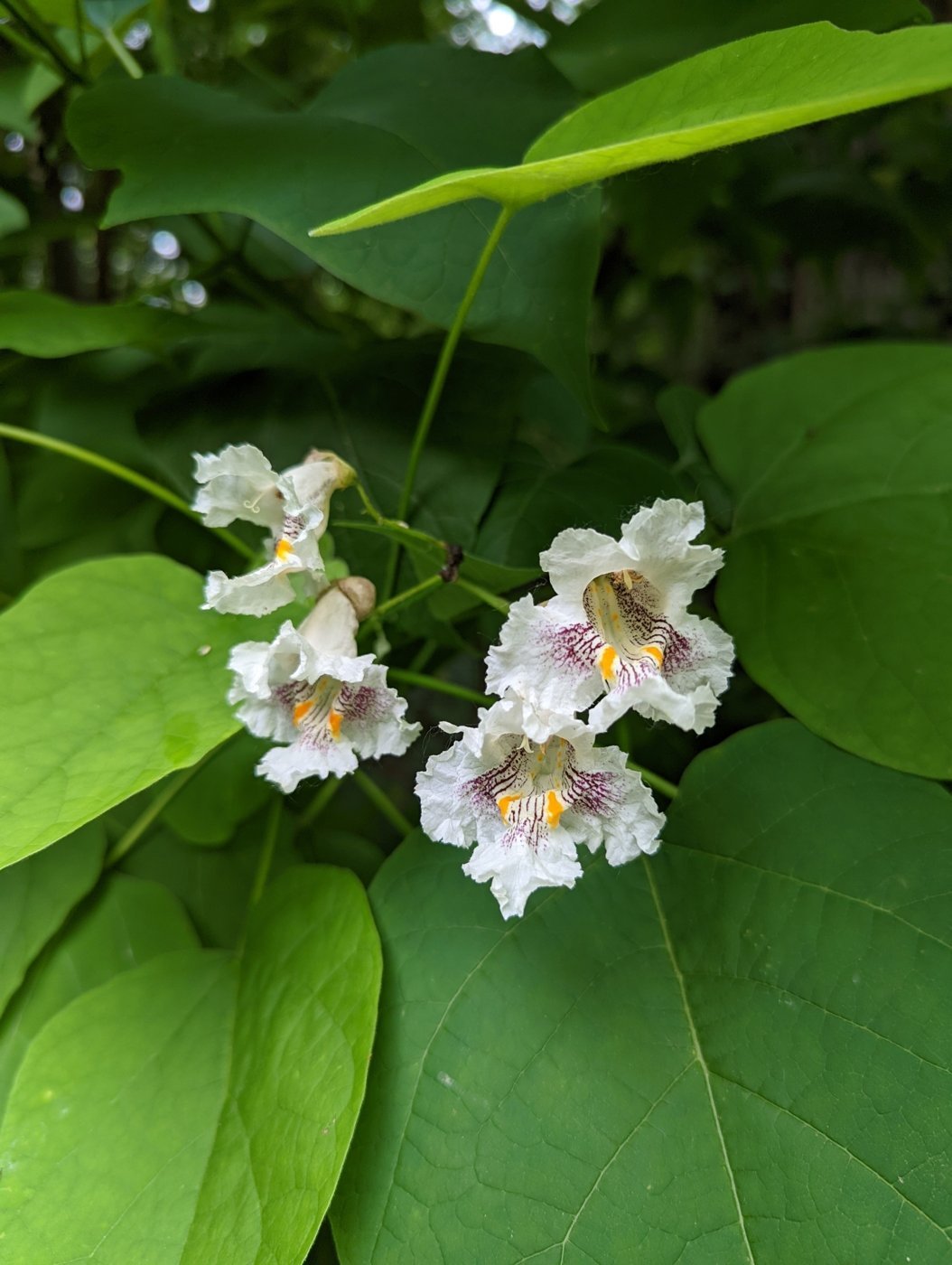
Leaves of catalpa are opposite or whorled and large, six to twelve inches long and three to eight inches wide. They are ovate, have an acuminate tip and a notched base, making them somewhat heart-shaped. The leaves are medium-green in color and paler on the underside. As the summer progresses, leaves may turn black due to sooty mold.
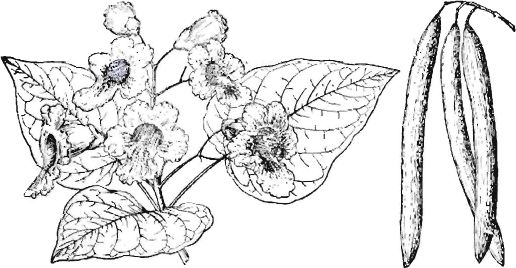
Flowers are perfect, showy, and bell-shaped and approximately two inches long and wide. They have five unequal lobes, fringed at the margin, and are white with two orange stripes and purple spots inside. They are borne in upright panicles in late May or early June.
The fruit is a narrow capsule, eight to eighteen inches long, that is at first green and matures to brown. Inside are numerous winged seeds. The long “pods” persist on the tree throughout winter and can aid in winter identification.
Twigs are smooth or slightly downy, stout, and brown in color, with many large lenticels. Leaf scars are round and concave in the middle, with obvious bundle traces forming a ring. The pith is solid and white.
Wood of Northern Catalpa is lightweight and the heartwood resists decay, and in the past it has been used to make railroad ties. Modern uses for the wood include fence posts, cabinetry, and carving.
Where it grows
Mapped in 5 of fourteen counties: Bristol, Dukes, Nantucket, Plymouth, Suffolk.
Text and line illustrations: Forest Trees of Massachusetts, 7th edition (2016), Massachusetts Department of Conservation and Recreation, Bureau of Forest Fire Control and Forestry, funded by the USDA Forest Service. Drawings, 1925 descriptions and the “How to know” keys: The Commercial Forest Trees of Massachusetts (1925), Massachusetts Department of Conservation, Division of Forestry. Forest shares before settlement and today: Harvard Forest data archive (Cogbill, Burk and Motzkin 2002; Thompson and others 2013). Insects and disease: USDA Forest Service Insect and Disease Survey, Region 9, with DCR. Photographs: observations on iNaturalist (inaturalist.org), each credited to its photographer under its Creative Commons licence; the list is under “Where the pictures come from” on the guide page. Species ranges by county are as the 2016 manual maps them. Transcribed by script and proofread in part; the manuals govern where they differ.