London Planetree
Leaves alternate, lobed · Family Platanaceae
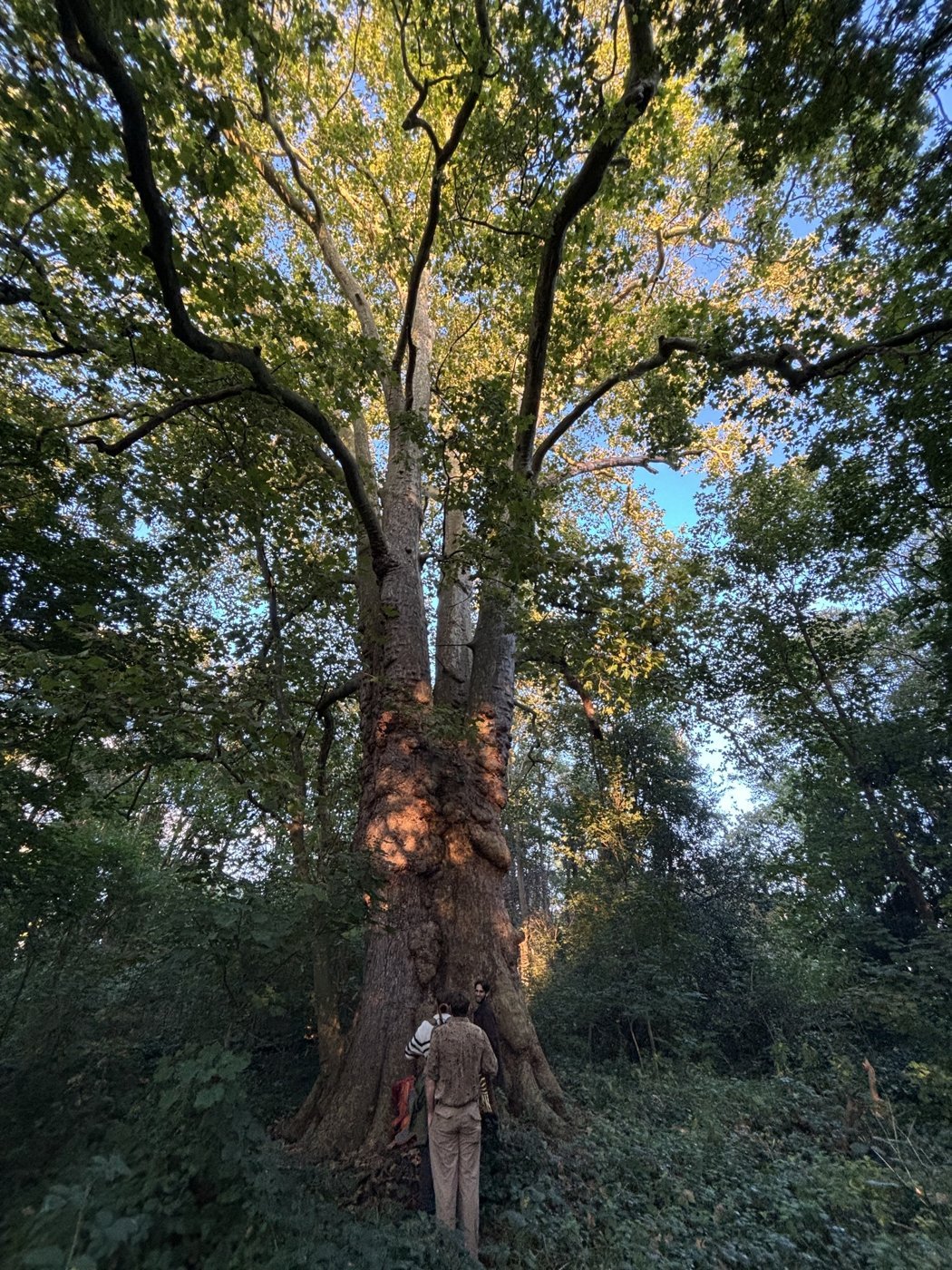
What to look for
A common street-side and park tree of urbanized areas, London Planetree looks like Sycamore, but is actually a hybrid of P. occidentalis and P. orientalis. London Planetree looks remarkably similar to Sycamore. It has the same creamy, exfoliating bark and large maple-like leaves, but it can be distinguished from sycamore by the fruit. Instead of being borne singly, fruit on the London Planetree is typically borne in twos. Location can also be a clue—London Planetree is usually the tree lining streets and parks in urbanized areas; sycamore is more likely to be found in natural areas.
Where it grows
No county map in the 2016 manual.
Text and line illustrations: Forest Trees of Massachusetts, 7th edition (2016), Massachusetts Department of Conservation and Recreation, Bureau of Forest Fire Control and Forestry, funded by the USDA Forest Service. Drawings, 1925 descriptions and the “How to know” keys: The Commercial Forest Trees of Massachusetts (1925), Massachusetts Department of Conservation, Division of Forestry. Forest shares before settlement and today: Harvard Forest data archive (Cogbill, Burk and Motzkin 2002; Thompson and others 2013). Insects and disease: USDA Forest Service Insect and Disease Survey, Region 9, with DCR. Photographs: observations on iNaturalist (inaturalist.org), each credited to its photographer under its Creative Commons licence; the list is under “Where the pictures come from” on the guide page. Species ranges by county are as the 2016 manual maps them. Transcribed by script and proofread in part; the manuals govern where they differ.