Hornbeam
Leaves alternate, simple · Family Betulaceae · Also called Blue-Beech, Ironwood, Water-Beech or Musclewood
In the inventory · Live trees about 1 tree in 70 (1.4%) · Volume under 1% · Growth and mortality too few to estimate. USDA Forest Service, Forest Inventory and Analysis, 2019–2025; live trees an inch or more across, volume of trees five inches or more. Shares quoted only where the sampling error is 30% or less.
What to look for
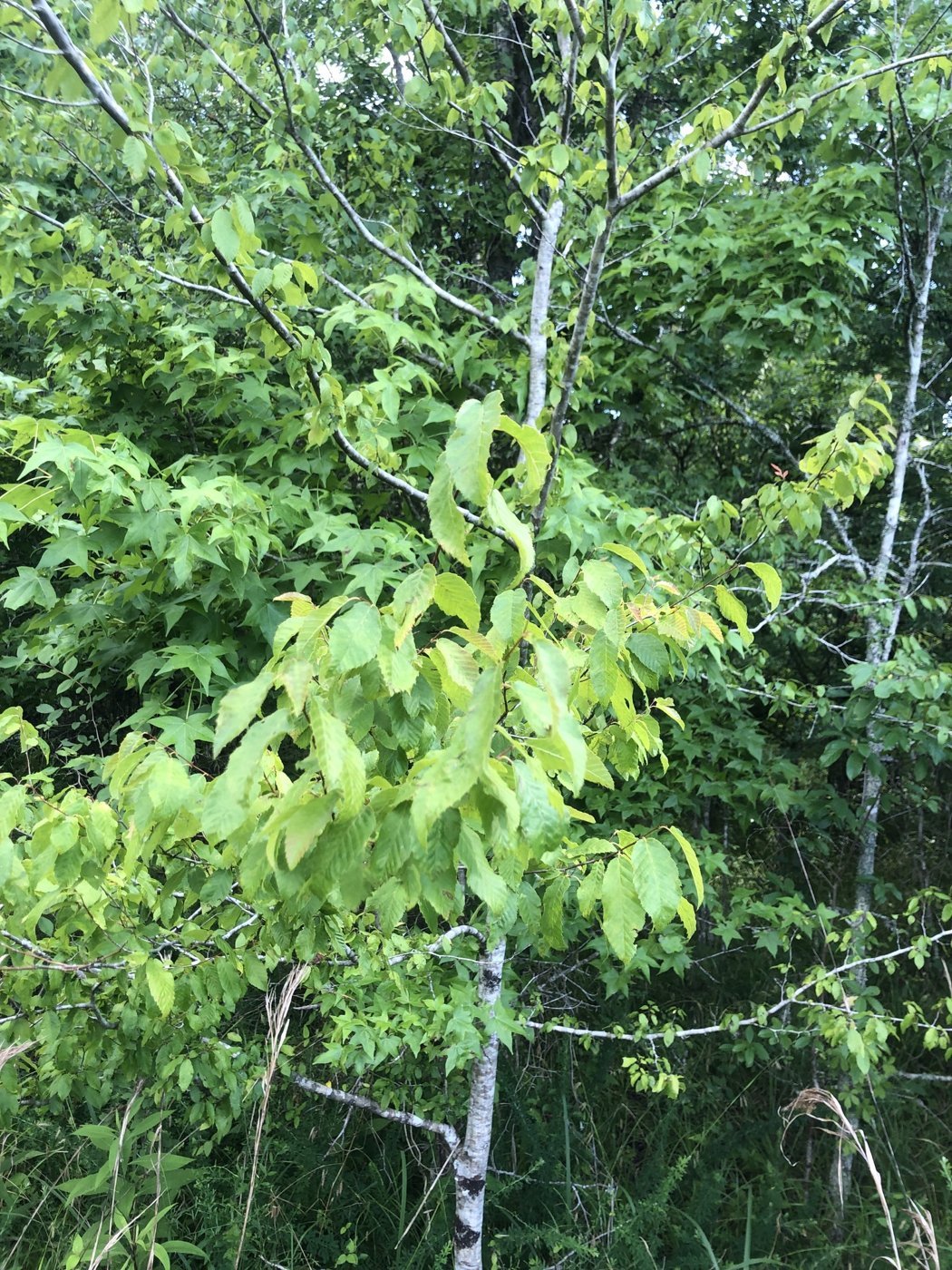
HORNBEAM inhabits wet woods, and the borders of swamps and streams. It commonly occurs throughout the state, though less frequently near the coast. Hornbeam is shade tolerant, and capable of persisting in the understory of climax communities.
It is a slow-growing, small tree, twenty to forty feet high, with a short trunk not more than ten to twenty-four inches in diameter.
The trunk is marked with irregular, longitudinal ridges, resembling the muscles of a flexed arm.
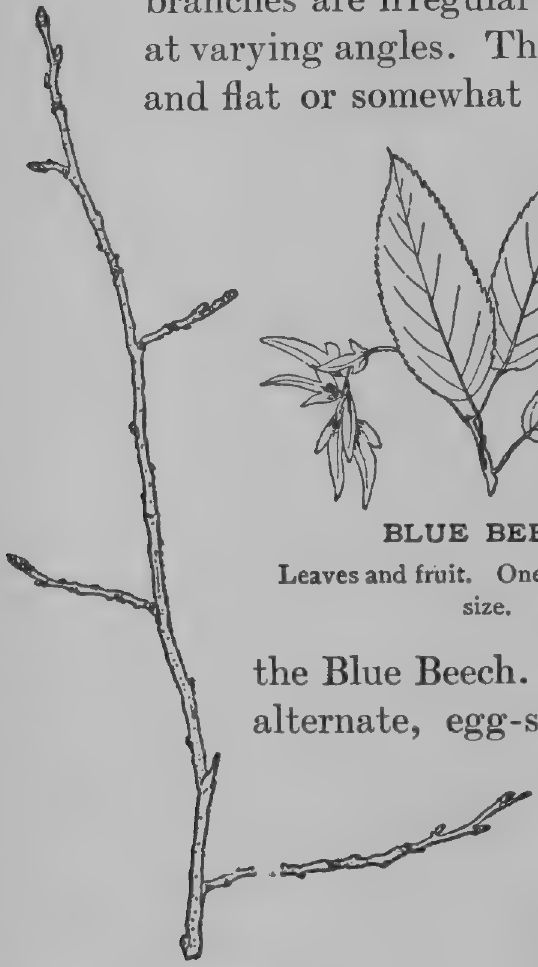
Branches are irregular and crooked and extend at varying angles. The head is compact, broad and flat, or somewhat roundish.
Its bark is smooth like that of the Beech, and is bluish-gray in color. For this reason it is called the Blue Beech.
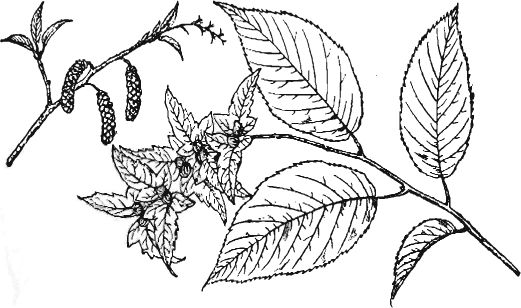
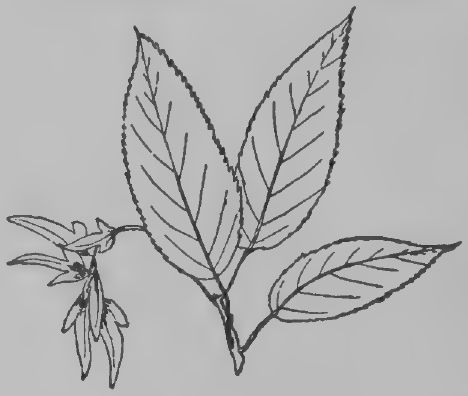
Leaves are simple, alternate, egg-shaped or oval, double-toothed, sometimes long pointed, one to five inches in length, and very similar to those of the Black Birch, though the wintergreen aroma is not present.
Buds are brown and somewhat square in cross section, with numerous scales in four rows. Twigs are variably hairy or not.
Flowers are borne in catkins in April and male catkins are not present in the winter. Both the fertile and the sterile ones appear in the spring.
Fruits are tiny nuts that are attached to three pointed leafy bracts. This nutlet is three-lobed and not inflated, differing in this respect from the fruit of the Eastern HopHornbeam.
The wood is compact, close-grained, tough, durable and very strong. As in the early 1900’s, it is still used for levers, beetles (wooden hammers), wedges, mallets, and the handles of tools. The paradox is in how quickly it decays when coming in prolonged contact with the soil.
Where it grows
Mapped in 13 of fourteen counties: Barnstable, Berkshire, Bristol, Dukes, Essex, Franklin, Hampden, Hampshire, Middlesex, Norfolk, Plymouth, Suffolk, Worcester.
As described in 1925
Show
Listed as Blue Beech or Hornbeam (Water Beech) (Carpinus caroliniana Walt.).
INHABITING wet woods and the border of swamps and streams, the Blue Beech is of common occurrence throughout the State, though less frequent near the coast than inland. It is a slow-growing, small tree, ten to thirty feet high, with a short trunk not more than six to twelve inches in diameter. The branches are irregular and crooked and extend at varying angles. The head is compact, broad and flat or somewhat roundish. The trunk is marked with irregular, longitudinal ridges.
Its bark is smooth like that of the Beech and of a bluish-gray color.
For this reason it is called the Blue Beech. The leaves are simple, alternate, egg-shaped or oval, sharply and irregularly toothed, two to three inches in length and very similar to those of the Sweet Birch, though the aromatic flavor is wanting.
The flowers are borne in catkins. Both the fertile and the sterile ones appear in the spring.
In the fruit, the leaf-like body which subtends the nutlet is three-lobed and not inflated, differing in this respect from the fruit of the Hornbeam.
The wood is compact, close-grained, tough, durable and very strong.
It is sometimes used for levers, beetles and the handles of tools.
Text and line illustrations: Forest Trees of Massachusetts, 7th edition (2016), Massachusetts Department of Conservation and Recreation, Bureau of Forest Fire Control and Forestry, funded by the USDA Forest Service. Drawings, 1925 descriptions and the “How to know” keys: The Commercial Forest Trees of Massachusetts (1925), Massachusetts Department of Conservation, Division of Forestry. Forest shares before settlement and today: Harvard Forest data archive (Cogbill, Burk and Motzkin 2002; Thompson and others 2013). Insects and disease: USDA Forest Service Insect and Disease Survey, Region 9, with DCR. Photographs: observations on iNaturalist (inaturalist.org), each credited to its photographer under its Creative Commons licence; the list is under “Where the pictures come from” on the guide page. Species ranges by county are as the 2016 manual maps them. Transcribed by script and proofread in part; the manuals govern where they differ.