Honey Locust
Leaves alternate, compound · Family Fabaceae
In the inventory · Live trees fewer than 1 in 100 · Volume under 1% · Growth and mortality too few to estimate. USDA Forest Service, Forest Inventory and Analysis, 2019–2025; live trees an inch or more across, volume of trees five inches or more. Shares quoted only where the sampling error is 30% or less.
What to look for
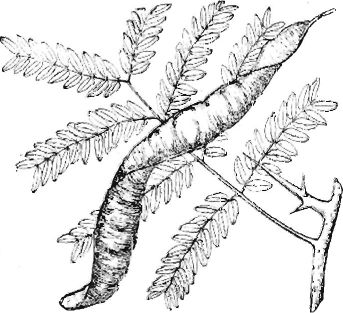
THE Honey Locust is named for the edible sweet pulp that is found inside its pods. Native to central North America it is commonly planted in urban environments for its fast growth rate, salt tolerance, and drought resistance. Street trees tend to be thorn-less varieties, however, trees grown in the wild have sharp multi branched thorns that range from three to six inches long each. The single-trunk tree usually grows thirty to seventy feet with an open and spreading crown creating light shade.
The bark is dark gray and black and develops deep fissures as it ages forming large plates of bark on mature trees.
Twigs are greenish brown to reddish brown and have a zigzag form.
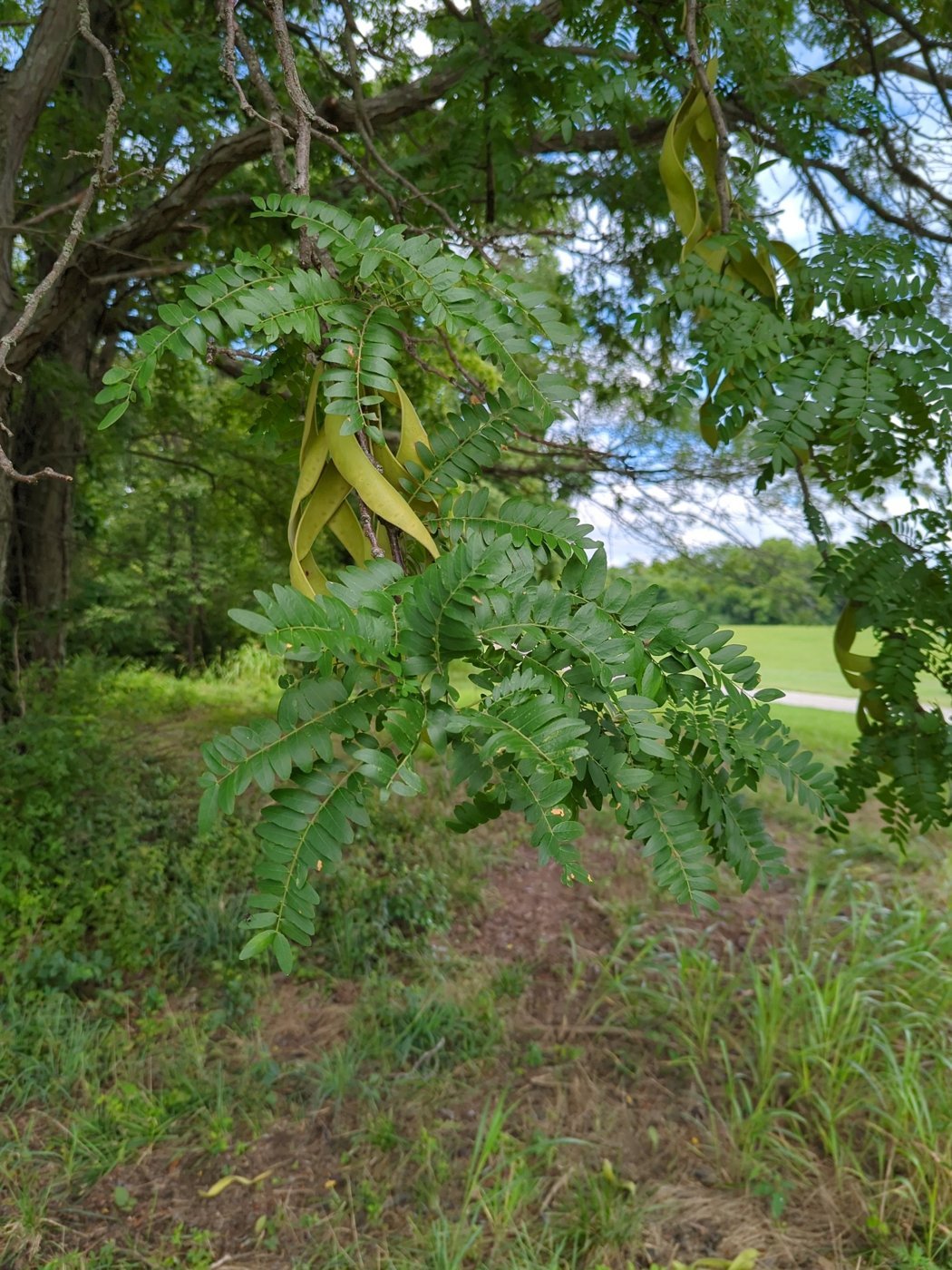
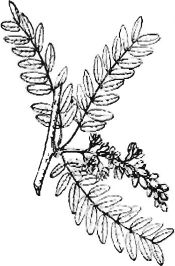
The pinnately to bipinnately compound leaves are bright green, alternate, and are six to eight inches in length. The leaflets are oblong-lanceolate and range from one-third to one and one-half inches long and about one-third as wide. Leaves appear later in the spring than most trees. Fall color is yellow. The base of the petiole is swollen and encloses the bud.
Flowers are in clusters, greenish yellow, fragrant and inconspicuous. Each tree produces perfect and imperfect flowers in the late spring.
Fruit is an irregularly twisted flat pod ranging from six to eighteen inches long and one inch wide. The green pods turn a reddish brown as they mature in early autumn and persist through the winter. Pods contain fragrant edible pulp and numerous shiny brown seeds that are extremely hard.
The reddish wood is very dense and strong. It tends to rot slowly and has been used for fence posts and railroad ties, as well as for furniture, tool handles, and fuel.
Where it grows
Mapped in 6 of fourteen counties: Barnstable, Essex, Franklin, Nantucket, Suffolk, Worcester. Introduced, not native.
Text and line illustrations: Forest Trees of Massachusetts, 7th edition (2016), Massachusetts Department of Conservation and Recreation, Bureau of Forest Fire Control and Forestry, funded by the USDA Forest Service. Drawings, 1925 descriptions and the “How to know” keys: The Commercial Forest Trees of Massachusetts (1925), Massachusetts Department of Conservation, Division of Forestry. Forest shares before settlement and today: Harvard Forest data archive (Cogbill, Burk and Motzkin 2002; Thompson and others 2013). Insects and disease: USDA Forest Service Insect and Disease Survey, Region 9, with DCR. Photographs: observations on iNaturalist (inaturalist.org), each credited to its photographer under its Creative Commons licence; the list is under “Where the pictures come from” on the guide page. Species ranges by county are as the 2016 manual maps them. Transcribed by script and proofread in part; the manuals govern where they differ.