Hawthorn
Leaves alternate, lobed · Family Rosaceae · Also called Thorn-Apple
In the inventory (genus figures) · Live trees fewer than 1 in 100 · Volume no volume estimate (not a timber species) · Growth and mortality too few to estimate. USDA Forest Service, Forest Inventory and Analysis, 2019–2025; live trees an inch or more across, volume of trees five inches or more. Shares quoted only where the sampling error is 30% or less. Genus-level: FIA records Crataegus spp. as one group.
What to look for
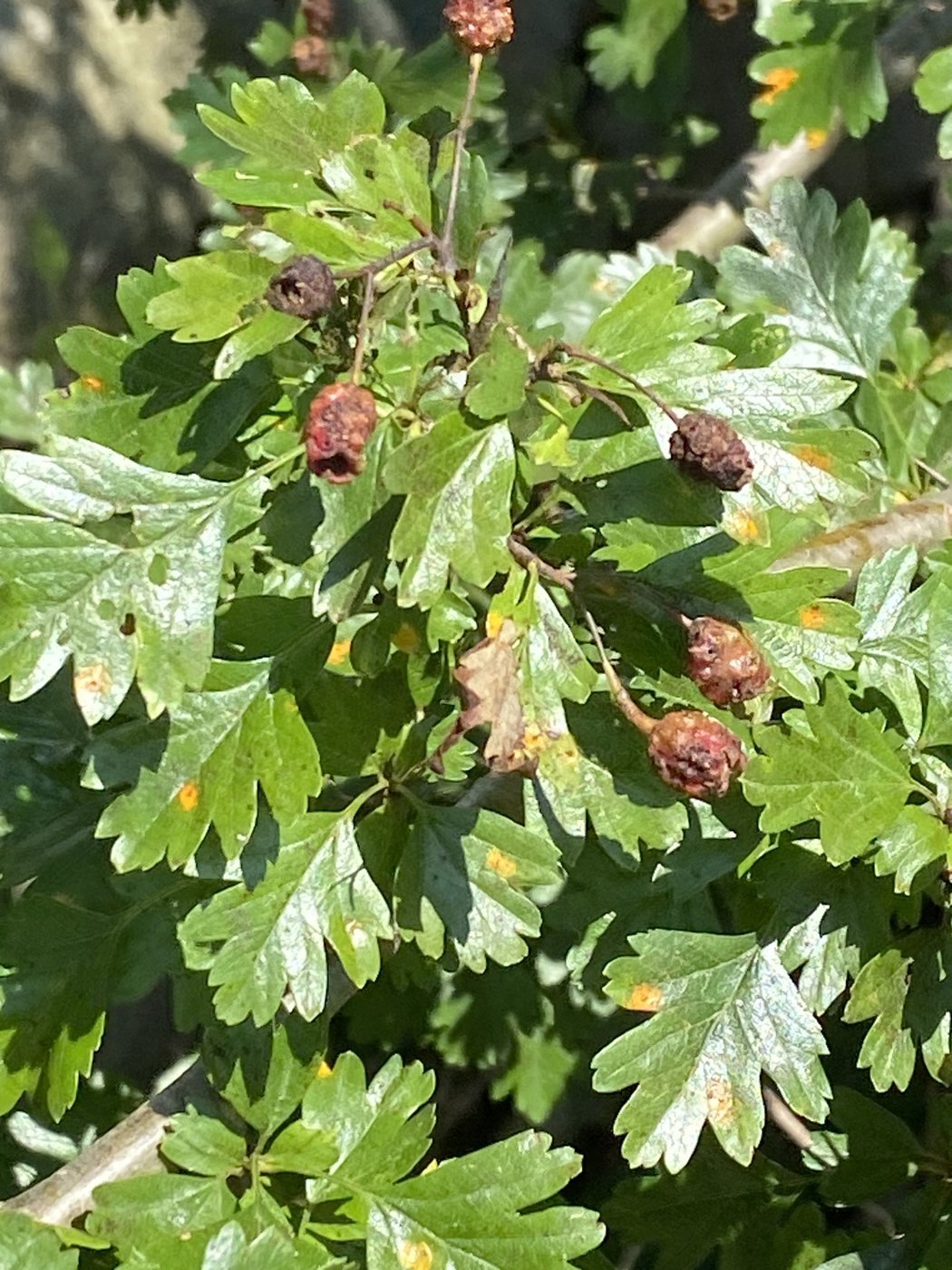
HAWTHORN is scattered throughout the state as a low spreading tree or shrub, rarely reaching a height of more than twenty five to thirty feet. Thirty one different species and varieties are found in the state. Hawthorns can usually be recognized by the small apple-like fruits and the thorns on the branches.
The bark is ashy gray, and somewhat scaly.
Leaves are alternate, doubly toothed, usually somewhat lobed, smooth, thin, dark green, and one to four inches long.
Flowers appear about the first of June in flat, showy white clusters that have an unpleasant odor.
Fruit, which resembles miniature apples, is about one-half inch in diameter. The flesh is thin, mealy, and encloses one to five round nutlets. It is often used for making jellies.
Twigs are slender, rigid, usually armed with long thorns, light brown or gray in color, and have a zigzagged pattern of growth.
The wood is heavy, hard, close grained, and difficult to split. It is used to some extent for handles and other small articles.
Where it grows
Mapped in all fourteen counties.
Text and line illustrations: Forest Trees of Massachusetts, 7th edition (2016), Massachusetts Department of Conservation and Recreation, Bureau of Forest Fire Control and Forestry, funded by the USDA Forest Service. Drawings, 1925 descriptions and the “How to know” keys: The Commercial Forest Trees of Massachusetts (1925), Massachusetts Department of Conservation, Division of Forestry. Forest shares before settlement and today: Harvard Forest data archive (Cogbill, Burk and Motzkin 2002; Thompson and others 2013). Insects and disease: USDA Forest Service Insect and Disease Survey, Region 9, with DCR. Photographs: observations on iNaturalist (inaturalist.org), each credited to its photographer under its Creative Commons licence; the list is under “Where the pictures come from” on the guide page. Species ranges by county are as the 2016 manual maps them. Transcribed by script and proofread in part; the manuals govern where they differ.