Hackberry
Leaves alternate, simple · Family Ulmaceae
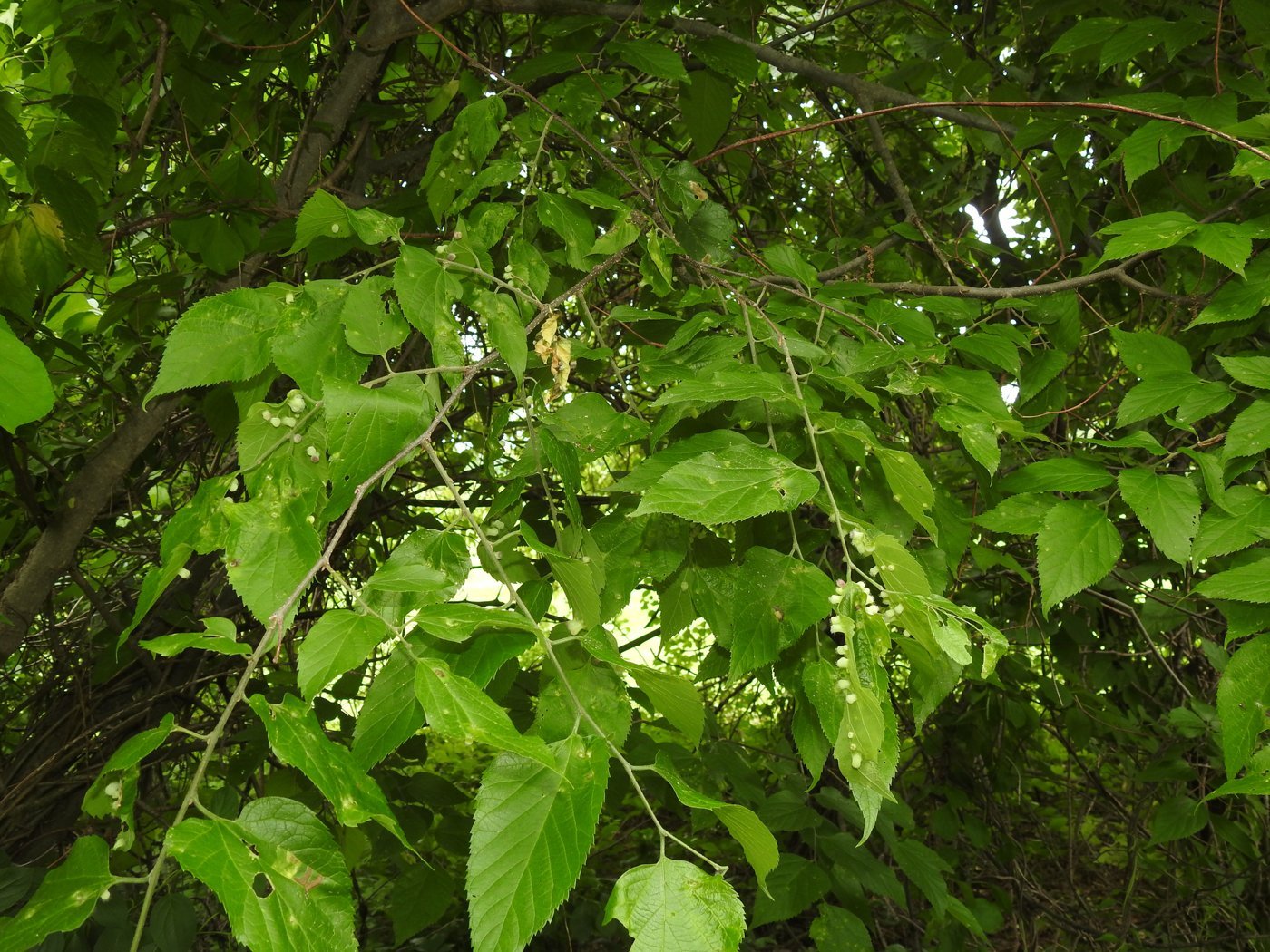
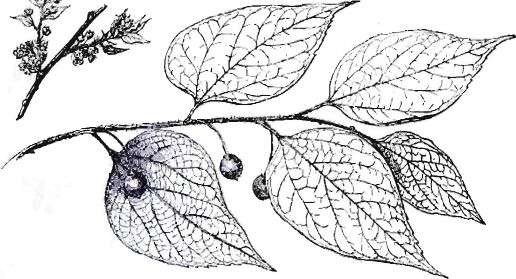

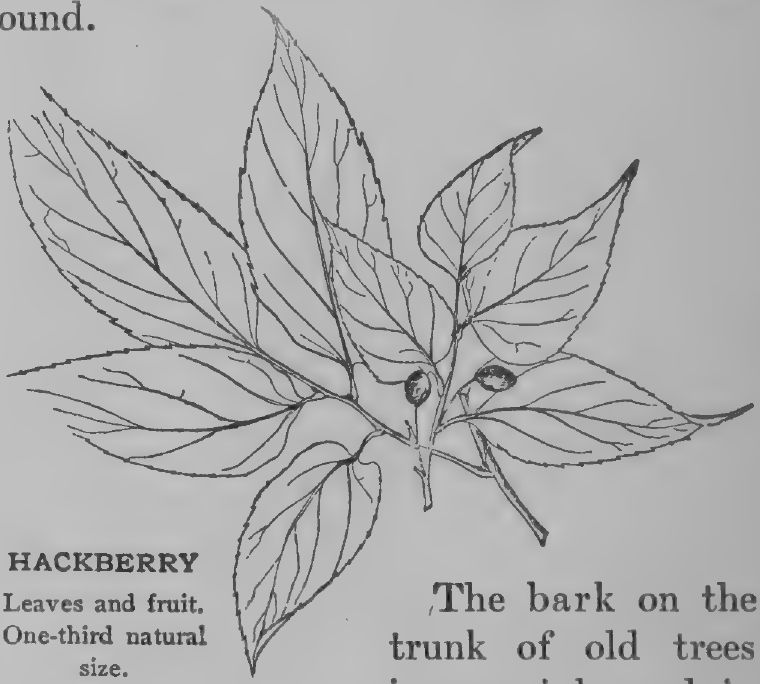
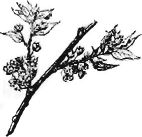
What to look for
HACKBERRY grows in various areas, sometimes in moist, rich ground, yet more frequently on gravelly soil or rocky hillsides. It occurs occasionally throughout the state, but it is somewhat more abundant in the central sections. Hackberry is intermediate in shade tolerance. Trees suppressed for an extended period are often poorly formed.
A slow-growing tree of medium dimensions, it attains a height of twenty to forty feet and a diameter of eight to twenty inches. The trunk is short and the branches are stout, spreading. The head is low and round.
Bark on the trunk of old trees is grayish-brown and is broken into thin scales. It is often marked with corky warts and ridges. The bark on the current season’s shoots is reddish-brown.
Leaves are simple, alternate, two to four inches long and variable in outline. They bear some resemblance to the leaf of the American Elm.
Twigs are extremely slender, tend to zigzag, and are often grouped in dense clusters known as “witches brooms.” The pith is made up of thin white plates separated by wide air spaces and is known as “chambered pith.”
Flowers are greenish and appear in May with the leaves. Fruit is a round drupe about one-fourth of an inch in diameter. The flesh is sweet and the outer surface is purplish-red, changing in winter to a brownish-orange.
The wood is yellowish, rather heavy, soft, weak and quick to decay. It is employed in making the cheaper grades of furniture, crates, boxes, and agricultural implements.
Where it grows
Mapped in 11 of fourteen counties: Berkshire, Bristol, Essex, Franklin, Hampden, Hampshire, Middlesex, Norfolk, Plymouth, Suffolk, Worcester.
As described in 1925
Show
Listed as Hackberry (Celtis occidentalis L.).
GROWING in various situations, sometimes in moist, rich ground, yet more frequently on gravelly soil or rocky hillsides, it occurs occasionally throughout the State, nevertheless it is somewhat more abundant in the southeastern sections near the coast. Here it is a slow-growing tree, of medium dimensions, and attains a height of twenty to forty feet and a diameter of eight to twenty inches. Its habit is somewhat variable. The trunk is short and the branches are stout, spreading and angular. The twigs are extremely slender. The head is low and round.
The bark on the trunk of old trees is grayish and is broken into thin scales. It is often marked with ridges or with varying excrescences. The bark on the season’s shoots is reddish-brown.
The leaves are simple, alternate, two to four inches long and variable in outline. They bear some resemblance to the leaf of the American Elm. The flowers are greenish and appear in May with the leaves.
The fruit is a globular drupe about one-fourth of an inch in diameter. The flesh is sweet and the outer surface is purplish-red, changing in winter to brownish-orange. The wood is heavy, rather soft, weak and quick to decay. It is employed in making the cheaper grades of furniture.
Text and line illustrations: Forest Trees of Massachusetts, 7th edition (2016), Massachusetts Department of Conservation and Recreation, Bureau of Forest Fire Control and Forestry, funded by the USDA Forest Service. Drawings, 1925 descriptions and the “How to know” keys: The Commercial Forest Trees of Massachusetts (1925), Massachusetts Department of Conservation, Division of Forestry. Forest shares before settlement and today: Harvard Forest data archive (Cogbill, Burk and Motzkin 2002; Thompson and others 2013). Insects and disease: USDA Forest Service Insect and Disease Survey, Region 9, with DCR. Photographs: observations on iNaturalist (inaturalist.org), each credited to its photographer under its Creative Commons licence; the list is under “Where the pictures come from” on the guide page. Species ranges by county are as the 2016 manual maps them. Transcribed by script and proofread in part; the manuals govern where they differ.