Green Ash
Leaves opposite, compound · Family Oleaceae · Also called Red Ash
In the inventory · Live trees fewer than 1 in 100 · Volume under 1% · Growth and mortality too few to estimate. USDA Forest Service, Forest Inventory and Analysis, 2019–2025; live trees an inch or more across, volume of trees five inches or more. Shares quoted only where the sampling error is 30% or less.
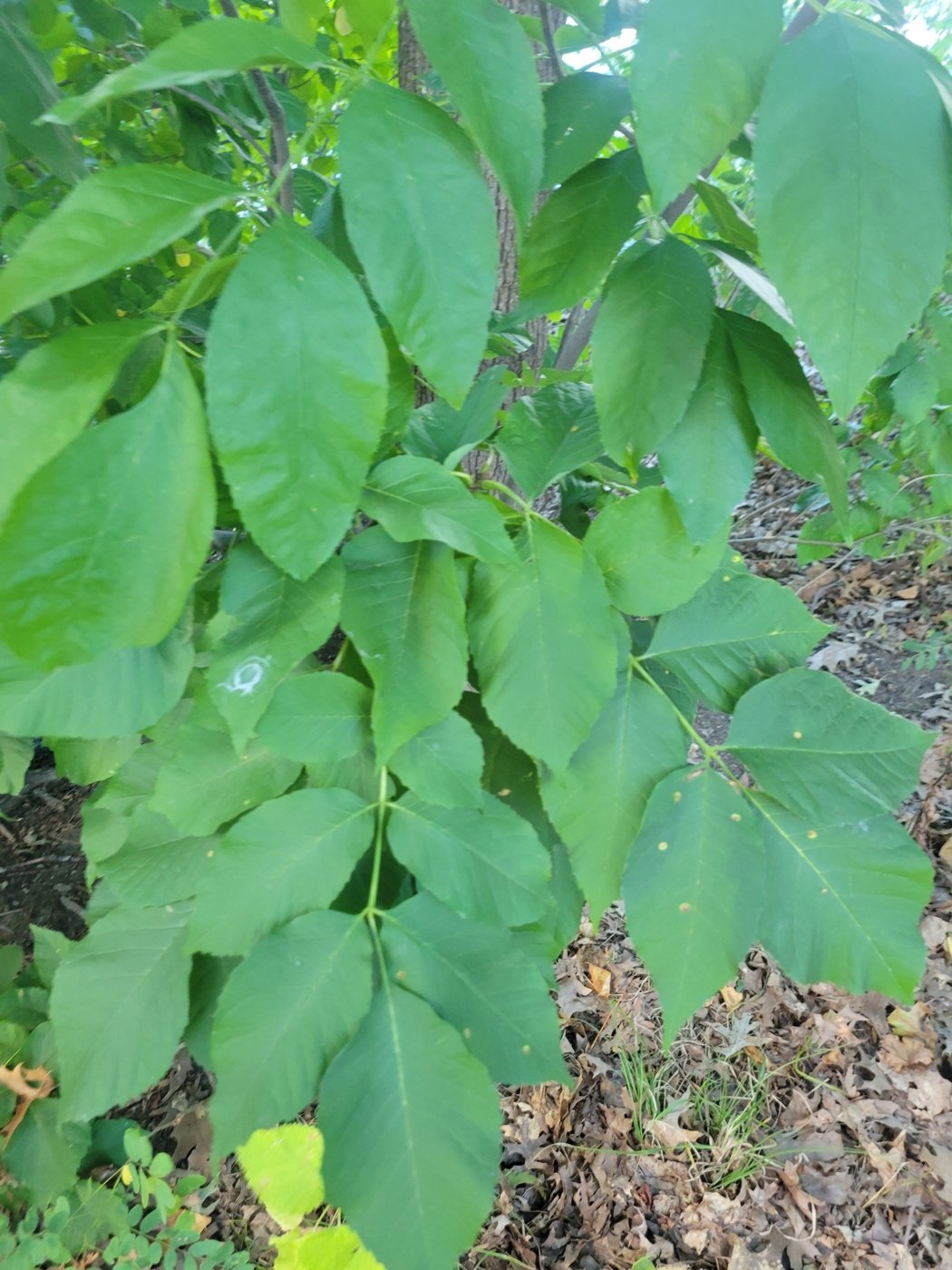
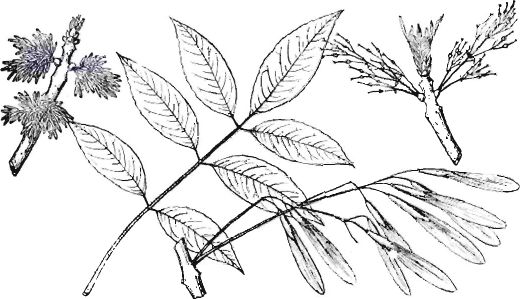
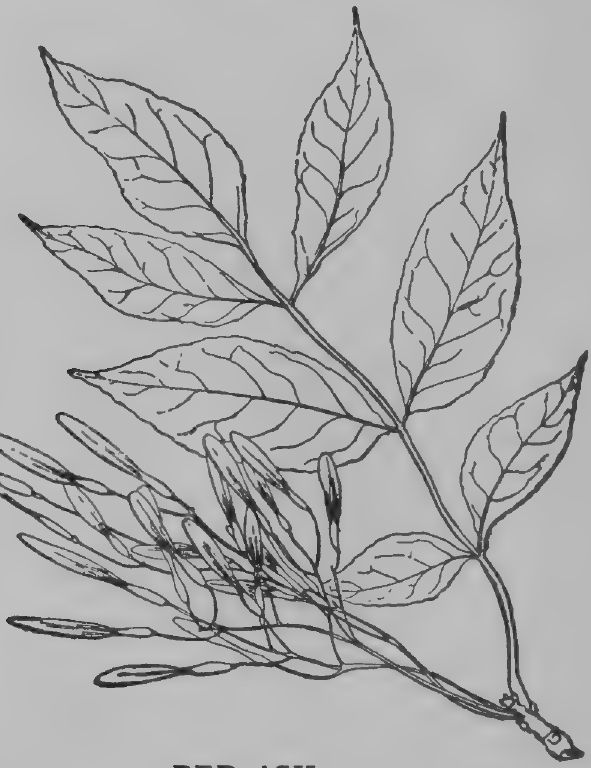
What to look for
GREEN Ash, frequently mistaken for White Ash, occurs occasionally throughout Massachusetts. Its home is in low, rich soil near streams and swamps and is moderately or intermediate in shade tolerance.
Green Ash is very much like the White Ash, though it is usually smaller in every way. It seldom grows to a height of more than fifty or sixty feet and its diameter rarely exceeds eighteen to twenty inches. In the open, the head is rather broad and round-topped.
The bark on the trunk of a mature tree is dark gray or brown and furrowed, but less deeply and more regularly than in the case of the White Ash. New twigs are greenish-gray and coated with numerous fine hairs which often persist until the second season.
Leaves are opposite, compound, ten to twelve inches in length and composed of seven to nine leaflets.
a Flowers and fruit, for all intents and purposes, are similar to those of the White Ash.
The wood is heavy, hard, and brittle. Although it is inferior to that of the White Ash, it is used for many of the same purposes.
Where it grows
Mapped in 11 of fourteen counties: Berkshire, Bristol, Essex, Franklin, Hampden, Hampshire, Middlesex, Norfolk, Plymouth, Suffolk, Worcester.
Forest types where the 2016 manual places it: Floodplain Forest.
In the forest record
Trees of this group (hickory, ash and other) were 11% of the trees surveyors recorded at lot corners before settlement and are 8% of trees on inventory plots today, statewide.
Each town’s own numbers are on its habitat, forest and water page.
The hickory, ash and other group is among the three most common kinds of tree in the surveyors’ record of 88 of the 164 towns with a surviving record, and the largest share of that record is in Deerfield (29%), Salem (28%), Dighton (26%). The record is by group of trees, not by species, and covers towns with at least 50 recorded trees for the “largest share” list.
Insects and disease on the record
| Agent | Years seen | Worst year | Acres that year | Last seen |
|---|---|---|---|---|
| Emerald ash borer | 8 | 2025 | 36,167 | 2025 |
| Ash yellows disease | 7 | 2010 | 4,192 | 2013 |
Acres are of mapped damage, which can include other trees and non-forest; some agents attack several hosts.
As described in 1925
Show
Listed as Red Ash (Fraxinus pennsylvanica Marsh.).
How to know the Ashes (1925): Leaves — Leaflets 7 to 9 and supported by short stalks. Winter_Buds_And_Twigs — Buds brown. Shoots greenish and more or less covered with down. Compare the ashes ›
THE Red Ash, not infrequently mistaken for the White Ash, occurs occasionally throughout Massachusetts. Its home is in low, rich soil near streams and swamps.
In habit it is very much like the White Ash, though it is usually smaller in every way. It seldom grows to a height of more than fifty or sixty feet and its diameter rarely exceeds eighteen to twenty inches. In the open the head is rather broad and round-topped.
The bark on the trunk of a mature tree is dark gray or brown and furrowed, but less deeply and more regularly than in the case of the White Ash. The season’s shoots are greenish-gray and coated with numerous fine hairs which often persist until the second season.
The leaves are opposite, compound, ten to twelve inches in length and composed of seven to nine leaflets.
The flowers and fruit, to all intents and purposes, are similar to those of the White Ash.
The wood is heavy, hard and brittle. It is much inferior to that of the White Ash, though it is used for many of the same purposes.
Text and line illustrations: Forest Trees of Massachusetts, 7th edition (2016), Massachusetts Department of Conservation and Recreation, Bureau of Forest Fire Control and Forestry, funded by the USDA Forest Service. Drawings, 1925 descriptions and the “How to know” keys: The Commercial Forest Trees of Massachusetts (1925), Massachusetts Department of Conservation, Division of Forestry. Forest shares before settlement and today: Harvard Forest data archive (Cogbill, Burk and Motzkin 2002; Thompson and others 2013). Insects and disease: USDA Forest Service Insect and Disease Survey, Region 9, with DCR. Photographs: observations on iNaturalist (inaturalist.org), each credited to its photographer under its Creative Commons licence; the list is under “Where the pictures come from” on the guide page. Species ranges by county are as the 2016 manual maps them. Transcribed by script and proofread in part; the manuals govern where they differ.