Flowering Dogwood
Leaves opposite, simple · Family Cornaceae
In the inventory not found in the current inventory sample (USDA Forest Service, 2019–2025); that is a sampling result, not a count of none left.
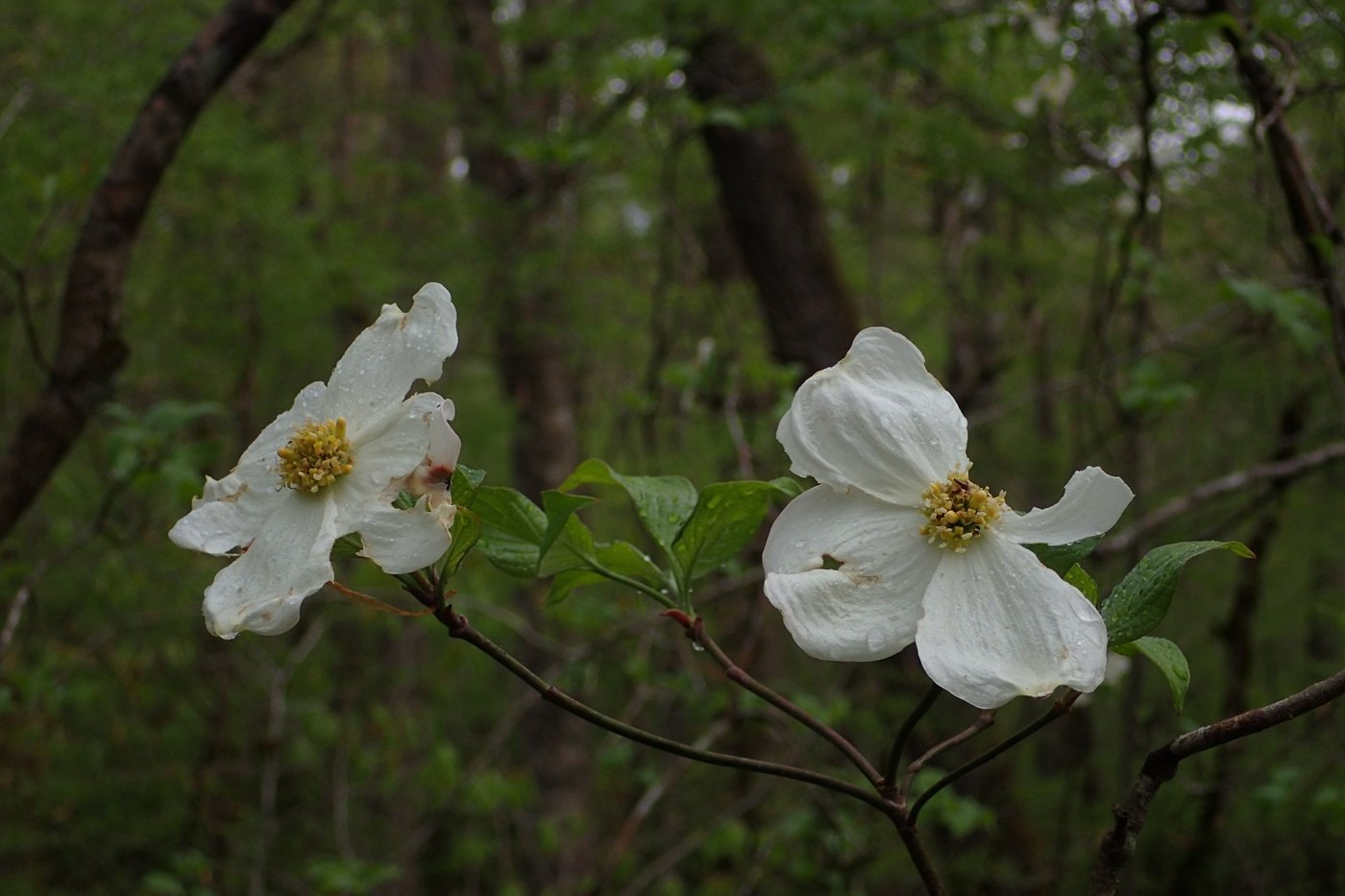
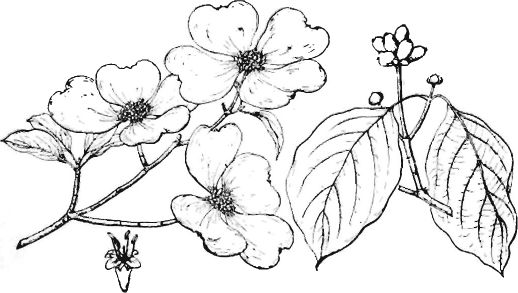
What to look for
FLOWERING Dogwood is an unusually beautiful shrub or small tree and is found growing naturally throughout the state, especially in the southern half, except for outer Cape Cod. Typically in the understory, reaches a height of fifteen to thirty feet.
Leaves are three to six inches long, opposite, entire, broadly ovate to elliptic, bright with scattered hairs, and pale green with hairs on the veins beneath.
Flowers are greenish white or yellowish and are arranged in dense umbels surrounded by four large, white petal-like bracts which give the appearance of large spreading flowers, and appear in late spring.
Fruit is a bright red, egg-shaped drupe about one-half inch long and occurs in clusters.
Twigs are slender, smooth, greenish, and have conspicuous opposite leaf scars. Leaf buds are conical, while flower buds are flattened, globose, and covered by two valve-like scales.
The wood is reddish brown, hard, heavy, strong, close-grained. Formerly, it was used for spools, tool handles, pulleys, and turned articles. Today, primarily it is planted as an ornamental tree.
Where it grows
Mapped in 10 of fourteen counties: Berkshire, Essex, Franklin, Hampden, Hampshire, Middlesex, Norfolk, Plymouth, Suffolk, Worcester.
Text and line illustrations: Forest Trees of Massachusetts, 7th edition (2016), Massachusetts Department of Conservation and Recreation, Bureau of Forest Fire Control and Forestry, funded by the USDA Forest Service. Drawings, 1925 descriptions and the “How to know” keys: The Commercial Forest Trees of Massachusetts (1925), Massachusetts Department of Conservation, Division of Forestry. Forest shares before settlement and today: Harvard Forest data archive (Cogbill, Burk and Motzkin 2002; Thompson and others 2013). Insects and disease: USDA Forest Service Insect and Disease Survey, Region 9, with DCR. Photographs: observations on iNaturalist (inaturalist.org), each credited to its photographer under its Creative Commons licence; the list is under “Where the pictures come from” on the guide page. Species ranges by county are as the 2016 manual maps them. Transcribed by script and proofread in part; the manuals govern where they differ.