European Buckthorn
Leaves opposite, simple · Family Rhamnaceae
In the inventory · Live trees fewer than 1 in 100 · Volume under 1% · Growth and mortality too few to estimate. USDA Forest Service, Forest Inventory and Analysis, 2019–2025; live trees an inch or more across, volume of trees five inches or more. Shares quoted only where the sampling error is 30% or less.
What to look for
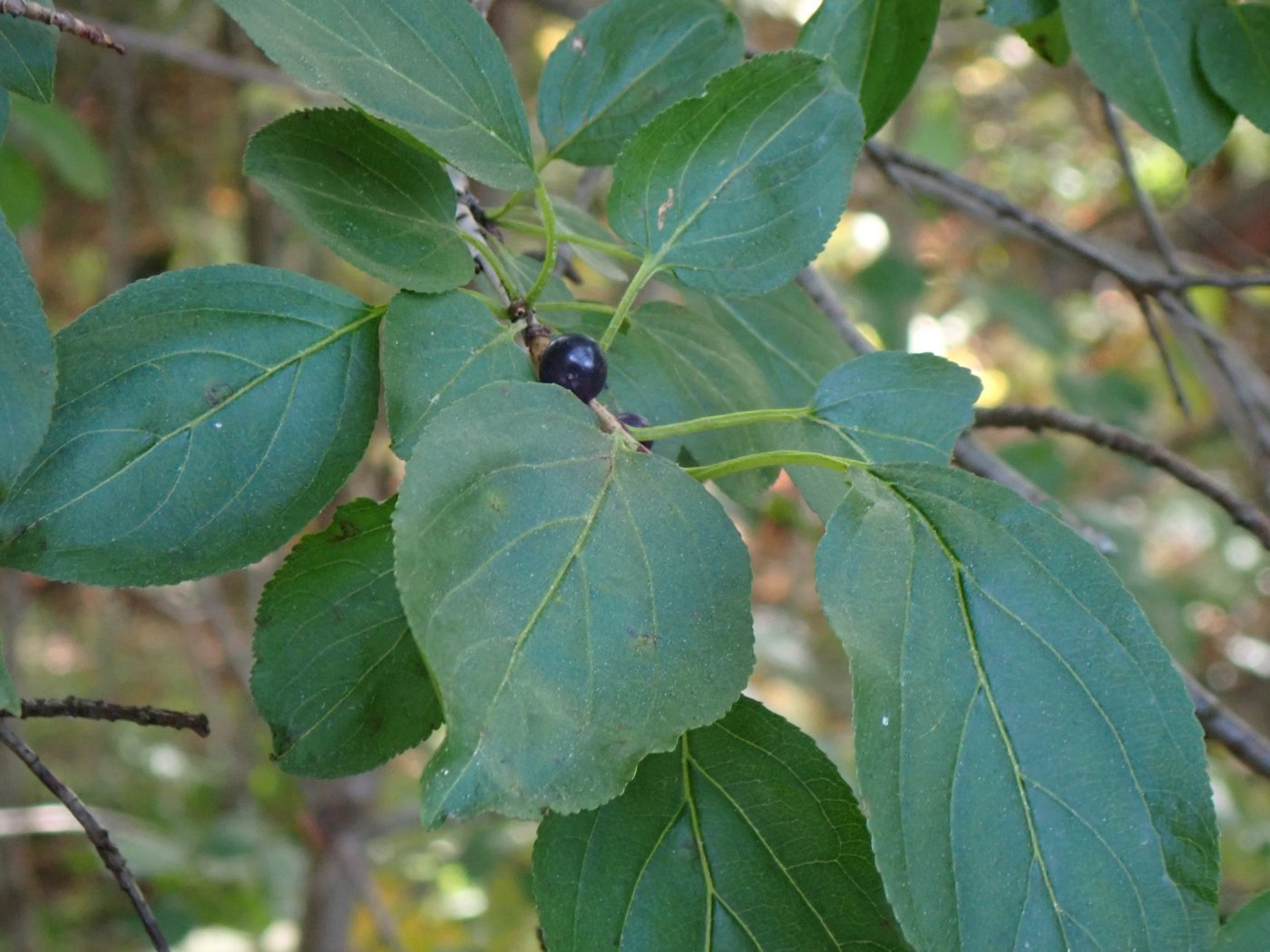
Native to Europe and western and northern Asia. Common Buckthorn is a large shrub or small tree, typically reaching heights of 25 feet. Leaves are simple, subopposite or opposite, broadly oval, and finely serrate. The upper surface is shiny, dark green, and is lighter in color underneath. The twig is slender and reddish-brown with a gray layer that exfoliates. The terminal bud is a sharp thorn, typically as long as the buds. Borne in umbels at the base of shoots, flowers are small and yellow-green. The fruit is a black drupe, one-quarter-inch wide, containing three to four seeds, and persisting on the plant into the winter. Birds eat the fruit and spread the seeds, contributing to the escape of the plant into woodlands.
Where it grows
Mapped in 13 of fourteen counties: Barnstable, Berkshire, Bristol, Dukes, Essex, Franklin, Hampden, Hampshire, Middlesex, Norfolk, Plymouth, Suffolk, Worcester. Introduced, not native.
Text and line illustrations: Forest Trees of Massachusetts, 7th edition (2016), Massachusetts Department of Conservation and Recreation, Bureau of Forest Fire Control and Forestry, funded by the USDA Forest Service. Drawings, 1925 descriptions and the “How to know” keys: The Commercial Forest Trees of Massachusetts (1925), Massachusetts Department of Conservation, Division of Forestry. Forest shares before settlement and today: Harvard Forest data archive (Cogbill, Burk and Motzkin 2002; Thompson and others 2013). Insects and disease: USDA Forest Service Insect and Disease Survey, Region 9, with DCR. Photographs: observations on iNaturalist (inaturalist.org), each credited to its photographer under its Creative Commons licence; the list is under “Where the pictures come from” on the guide page. Species ranges by county are as the 2016 manual maps them. Transcribed by script and proofread in part; the manuals govern where they differ.