Eastern White Pine
Leaves needles or scales · Family Pinaceae · Also called Weymouth pine and Northern white pine
In the inventory · Live trees about 1 tree in 8 (12%) · Volume 30% · Growth and mortality 61.7 million cu ft a year net growth, 15.8 million lost to mortality. USDA Forest Service, Forest Inventory and Analysis, 2019–2025; live trees an inch or more across, volume of trees five inches or more. Shares quoted only where the sampling error is 30% or less.
What to look for
EASTERN White Pine has a wide distribution throughout the state. According to the publication Forests of Massachusetts, 2014, Eastern White Pine is the most common coniferous tree species, accounting for 25% of the Commonwealth’s total tree volume. It is intermediate in shade tolerance, prevalent in moist fertile soil and uplands. It can also grow in forest wetlands, well-drained sandy soils, and anywhere mineral soil is exposed. It is the only five-needled pine native to the eastern United States.
In the open, the young tree has a symmetrical, pyramidal outline. In the forest, its trunk is usually without branches for a considerable distance and the head is narrow. The trunk is continuous, gradually tapering as it gets taller. The tree becomes very irregular and picturesque in old age, commonly growing to heights in excess of one hundred feet and one to two feet in diameter. The tallest trees in New England are Eastern White Pines, with the tallest ones growing in our own Mohawk State Forest. Because it is an early succession tree in fields, a stand of Eastern White Pine often indicates abandoned farmland.
The branches are usually in whorls of five and extend horizontally. The bark on young stems is thin, and green tinged with red. The bark is not scaly, as in many other pines, but dark with deep furrows.
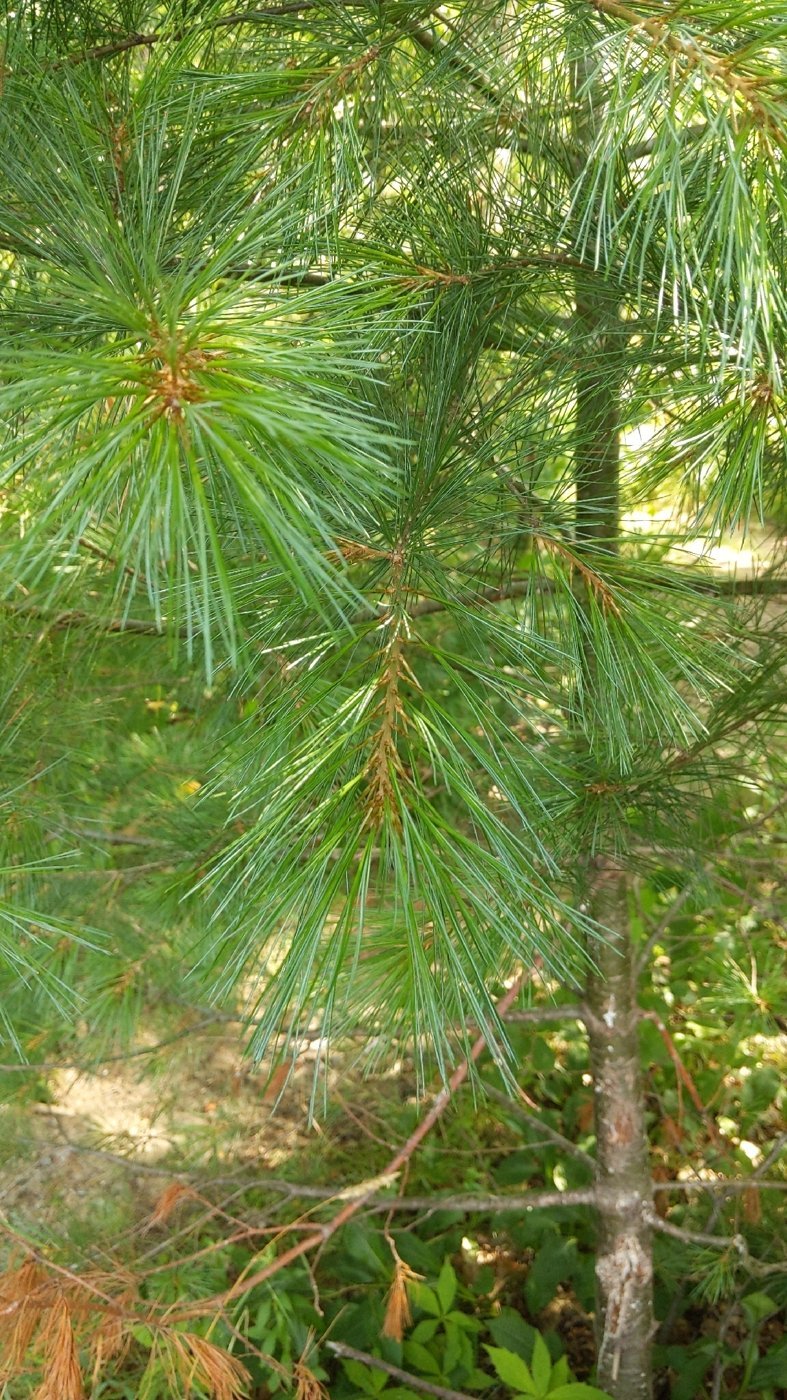
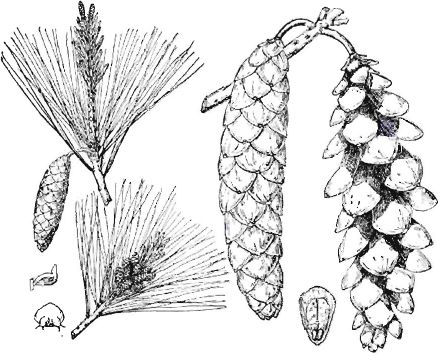
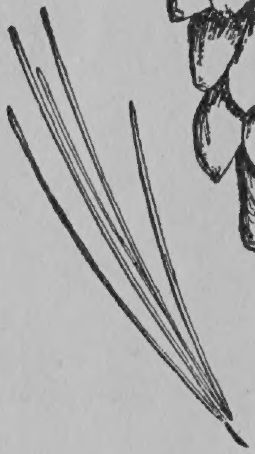
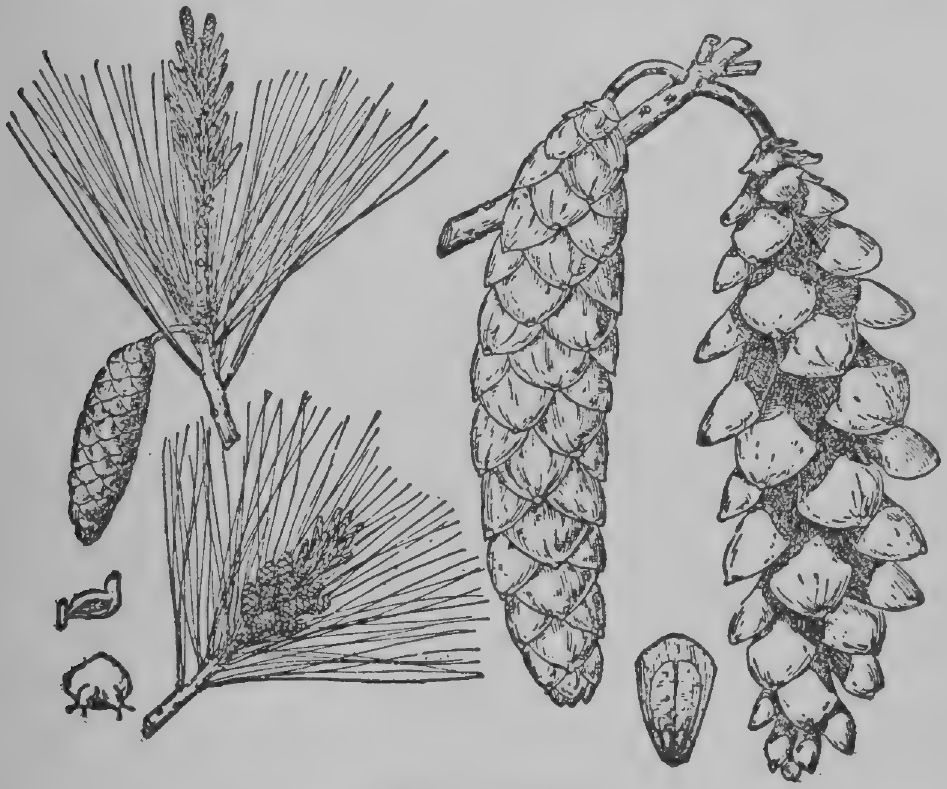
Leaves (needles) are arranged in clusters of five. They are from three to five inches in length, bluish-green on the upper surface and whitish on the under.
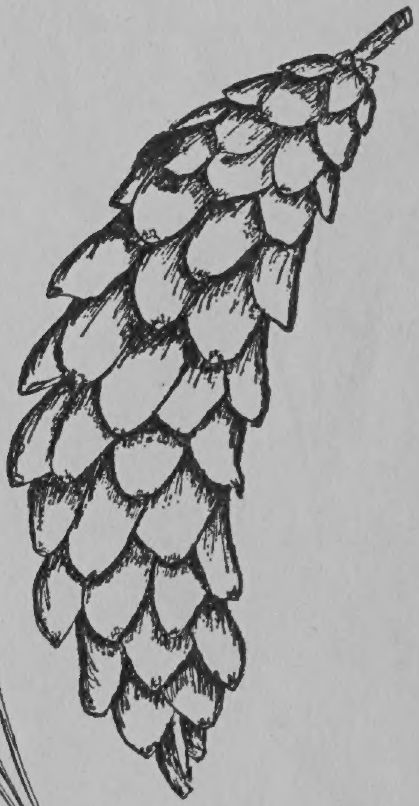
Cones are cylindrical, four to six inches in length and often sticky from pine pitch. Seeds are small and winged. Cones open early in September of their second season.
The wood is very useful. It is light in color, light in weight, not easily warped by the sun, and durable, except when in contact with the soil. It supplies lightweight boards of good size and free from knots. An interesting use for this wood in colonial days was for the masts of ships.
As early as 1685, England regulated the cutting of timber in colonial New England to protect an important source for masts for the British Navy, and by 1711 England passed the first of the White Pine Acts, prohibiting the cutting of trees larger than 24 inches in diameter at twelve inches height. Today, it is sawn into lumber, shingles, laths, used in cabinet-making, and for interior finishing. It is used for furniture, millwork, industrial applications, moldings, doors, paneling, shade and map rollers, toys, and caskets.
Where it grows
Mapped in all fourteen counties.
Forest types where the 2016 manual places it: Central Hardwoods, Transition Hardwoods.
In the forest record
Trees of this group (pine) were 13% of the trees surveyors recorded at lot corners before settlement and are 16% of trees on inventory plots today, statewide.
Each town’s own numbers are on its habitat, forest and water page.
The pine group is among the three most common kinds of tree in the surveyors’ record of 88 of the 164 towns with a surviving record, and the largest share of that record is in Yarmouth (70%), Barnstable (44%), Truro (44%). The record is by group of trees, not by species, and covers towns with at least 50 recorded trees for the “largest share” list.
Insects and disease on the record
| Agent | Years seen | Worst year | Acres that year | Last seen |
|---|---|---|---|---|
| Lophodermium needle cast of pines | 2 | 2021 | 36,508 | 2022 |
| White pine needle damage | 11 | 2019 | 28,050 | 2025 |
| Diplodia canker | 12 | 2010 | 5,252 | 2015 |
Acres are of mapped damage, which can include other trees and non-forest; some agents attack several hosts.
As described in 1925
Show
Listed as White Pine (Pinus strobus L.).
How to know the Pines (1925): Leaves — Arranged in 5-leaved clusters. Slender, flexible, bluish-green and 3 to 5 inches long. Compare the pines ›
THE White Pine is abundantly distributed throughout the State. It occurs on fertile soil, in moist situations, or on uplands.
When standing in the open, the young tree has a symmetrical, pyramidal outline. In the forest, its trunk is usually without branches for a considerable distance and the head is narrow. In old age the tree becomes very irregular and picturesque. The trunk is continuous, gradually tapering, commonly from fifty to seventy feet in height and one to two feet in diameter. The branches are usually in whorls of five and extend horizontally.
The bark on young stems is thin, green, tinged with red. On the old trunk it is thick and almost black, and divided by shallow fissures into broad, flat ridges.
The leaves are arranged in clusters of five. They are from three to five inches in length, bluish-green on the upper surface and whitish on the under.
The cone is cylindrical and from four to six inches in length. The seeds are small and winged. The cones open early in September of their second season.
The wood is very useful. It is light in color, light in weight, durable, except when in contact with the soil, and not easily warped by the sun.
It supplies boards of good size, free from knots and of light weight. It is sawed into lumber, shingles and laths. It is used in cabinet-making, for interior finishing and for masts. In this State it is very largely worked into “box-boards” for the making of boxes.
Then, in addition to serving so well these various utilitarian ends, it is a rapid-growing tree, increasing in height on the average at least a foot each year.
Text and line illustrations: Forest Trees of Massachusetts, 7th edition (2016), Massachusetts Department of Conservation and Recreation, Bureau of Forest Fire Control and Forestry, funded by the USDA Forest Service. Drawings, 1925 descriptions and the “How to know” keys: The Commercial Forest Trees of Massachusetts (1925), Massachusetts Department of Conservation, Division of Forestry. Forest shares before settlement and today: Harvard Forest data archive (Cogbill, Burk and Motzkin 2002; Thompson and others 2013). Insects and disease: USDA Forest Service Insect and Disease Survey, Region 9, with DCR. Photographs: observations on iNaturalist (inaturalist.org), each credited to its photographer under its Creative Commons licence; the list is under “Where the pictures come from” on the guide page. Species ranges by county are as the 2016 manual maps them. Transcribed by script and proofread in part; the manuals govern where they differ.