Eastern Red Cedar
Leaves needles or scales · Family Cupressaceae · Also called Red Cedar
In the inventory · Live trees fewer than 1 in 100 · Volume under 1% · Growth and mortality too few to estimate. USDA Forest Service, Forest Inventory and Analysis, 2019–2025; live trees an inch or more across, volume of trees five inches or more. Shares quoted only where the sampling error is 30% or less.
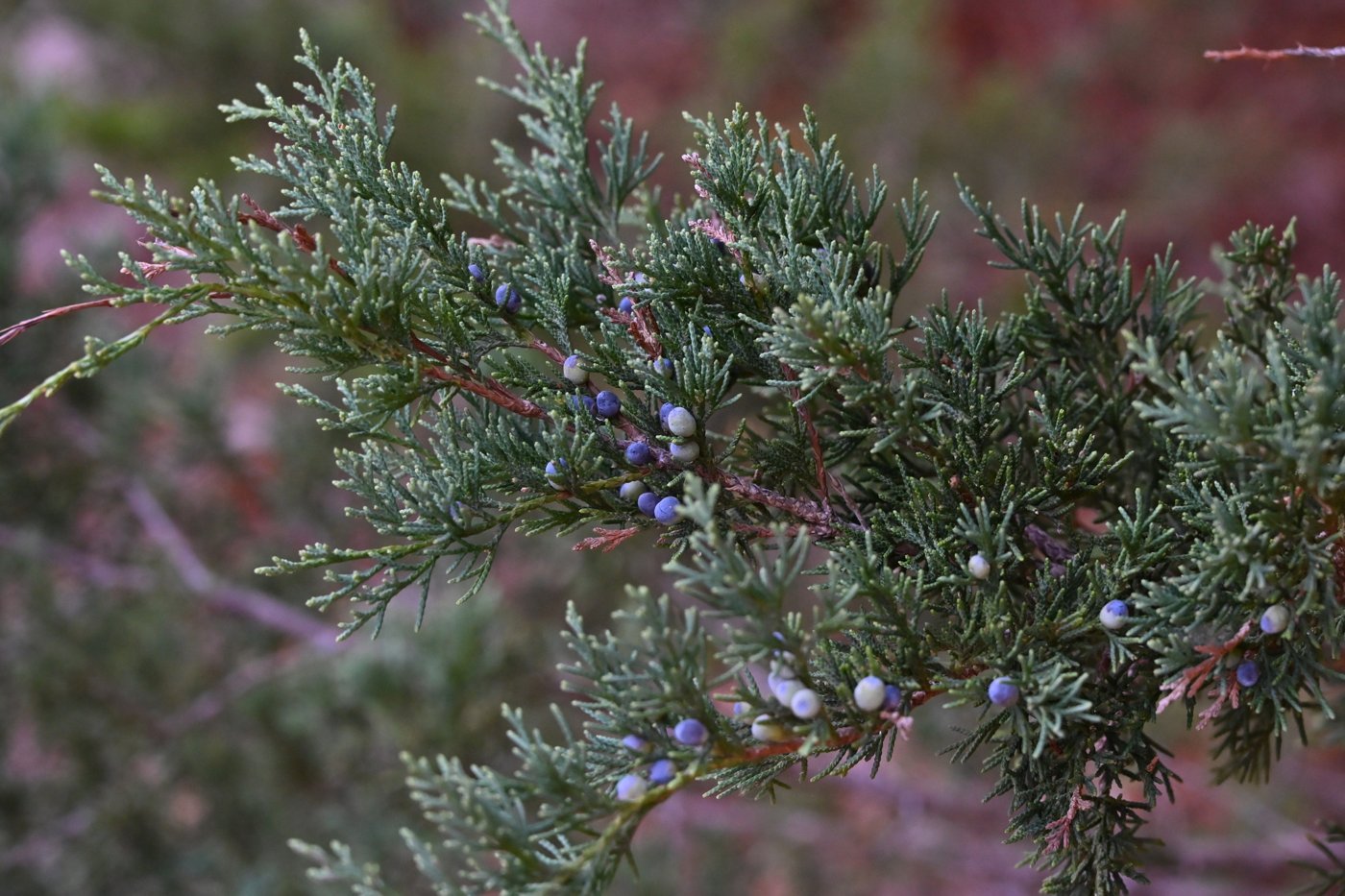
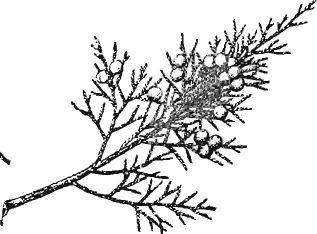
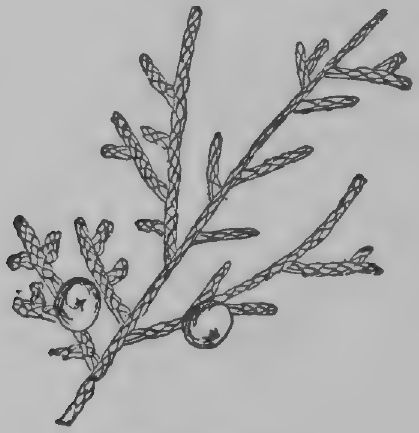
What to look for
EASTERN Red Cedar, is named for the red color of its heart-wood. Growing on dry and gravelly soil and rarely on moist ground, it is common in all sections of the State. Eastern Red Cedar has been classified as intolerant to very intolerant of shade.
It is variable in appearance. In youth its outline is normally conical, and in old age it is broad and round. The trunk, often fluted, is continuous and attains a height of forty to fifty feet and a diameter of one to two feet.
Bark on the trunk is light brown, tinged with red, and separates into long, narrow, ribbon-like flakes as the tree matures.
The typical leaves are scale-like, about a sixteenth of an inch in length and dark blue-green in color. On young trees and sometimes on the mature plants, there are needle-shaped leaves about one-quarter inch in length.
The fruit is a berry-like cone, round, about the size of a pea, and dark blue.
The wood is light, close-grained, not strong, easily worked, and durable. It is red in color, and pleasantly aromatic. It is used for posts, cedar chests, pencils, and cabinets. A volatile oil derived from the juniper leaves is used in perfumes. Dried berries are used as a cooking spice. In the wild, berries are often eaten by a variety of wildlife species.
Where it grows
Mapped in all fourteen counties.
As described in 1925
Show
Listed as Red Cedar (Red Juniper) (Juniperus virginiana L.).
THIS tree receives its popular name, Red Cedar, from the red color of its heart-wood. Growing on dry and gravelly soil and sometimes on rather moist ground, it is common in the eastern sections of the State and of occasional occurrence in the central and western parts.
/ In habit it is variable. In youth its outline is normally conical, and in old age it is broad and round. The trunk is continuous and attains a height of twenty-five to thirty feet and a diameter of eight to fifteen inches.
The bark on the trunk is light brown tinged with red. When the tree has acquired age it separates into long, narrow, ribbon-like flakes.
The typical leaves are scale-like, about a sixteenth of an inch in length and dark blue-green in color. On young trees and sometimes on the mature plants, there are needle-shaped leaves about one-half inch in length.
The fruit is berry-like, globular, about the size of a pea and dark blue.
The wood is light, close-grained, not strong, easily worked and durable. It is red in color and pleasantly aromatic. It is used for posts, for pails and in cabinet-making.
Text and line illustrations: Forest Trees of Massachusetts, 7th edition (2016), Massachusetts Department of Conservation and Recreation, Bureau of Forest Fire Control and Forestry, funded by the USDA Forest Service. Drawings, 1925 descriptions and the “How to know” keys: The Commercial Forest Trees of Massachusetts (1925), Massachusetts Department of Conservation, Division of Forestry. Forest shares before settlement and today: Harvard Forest data archive (Cogbill, Burk and Motzkin 2002; Thompson and others 2013). Insects and disease: USDA Forest Service Insect and Disease Survey, Region 9, with DCR. Photographs: observations on iNaturalist (inaturalist.org), each credited to its photographer under its Creative Commons licence; the list is under “Where the pictures come from” on the guide page. Species ranges by county are as the 2016 manual maps them. Transcribed by script and proofread in part; the manuals govern where they differ.