Eastern Hophornbeam
Leaves alternate, simple · Family Betulaceae
In the inventory · Live trees about 1 tree in 80 (1.2%) · Volume under 1% · Growth and mortality too few to estimate. USDA Forest Service, Forest Inventory and Analysis, 2019–2025; live trees an inch or more across, volume of trees five inches or more. Shares quoted only where the sampling error is 30% or less.
What to look for
EASTERN Hophornbeam is a small tree, reaching a height of twenty five to forty feet, with a rounded crown. It is a fairly rapid grower, especially in good soil, typically found on slopes and ridges in the shade of other species.
The bark is gray, flaking away into long scales which give the trunk a shaggy appearance.
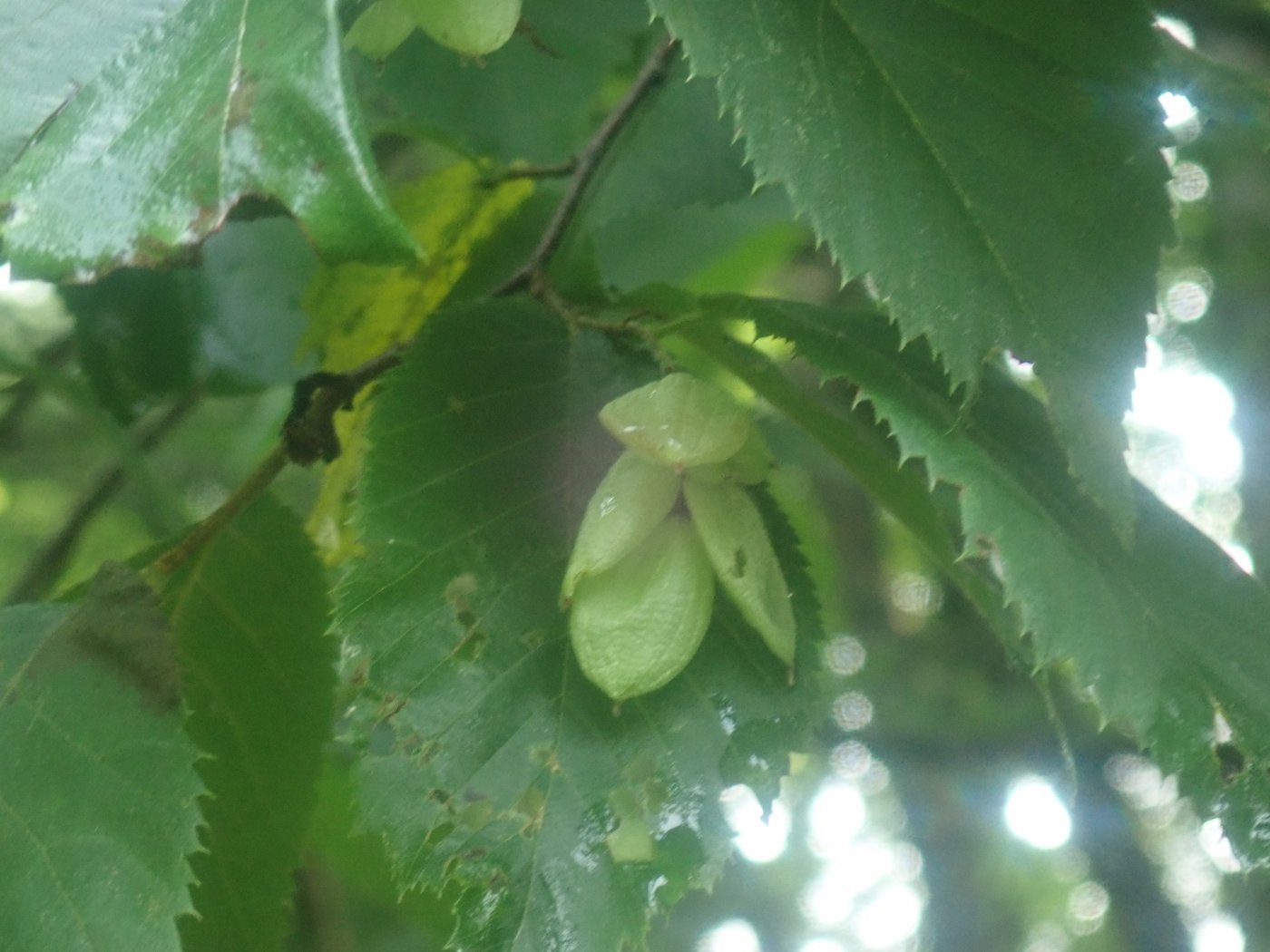
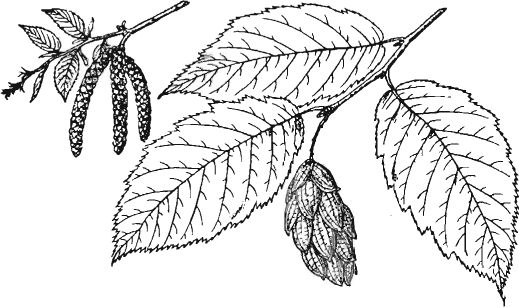
Leaves are alternate, nearly oblong lance-shaped, widest in the middle, hairy underneath, doubly and sharply toothed, and three to five inches long.
Flowers are borne in catkins which open with the leaf buds. Male catkins are formed in the preceding summer, and are usually in clusters of three.
The fruit is a cluster of bladder-like structures, enclosing a ribbed nutlet that ripens in September, and closely resemble the true hops fruit.
Twigs are dark reddish brown, slender, zigzagged, and have a small green pith.
The wood is light reddish brown, close-grained, heavy, and very strong. It is used for levers, mallets, tool handles, rollers for heavy equipment, and chopping blocks.
Where it grows
Mapped in 13 of fourteen counties: Barnstable, Berkshire, Bristol, Dukes, Essex, Franklin, Hampden, Hampshire, Middlesex, Norfolk, Plymouth, Suffolk, Worcester.
As described in 1925
Show
Listed as Hop-Hornbeam or Ironwood (Ostrya virginiana Koch.).
THE Hornbeam, so called because of its general resemblance to the European Hornbeam, is a small, slender, round-topped tree, usually not more than twenty to thirty feet tall and eight to twelve inches through.
Its branches are long, slender and somewhat drooping at the ends. It occurs commonly throughout the State, growing on gravelly and rocky slopes, often in rather open woods.
The bark on the trunk is light brown tinged with red and breaks into fine scales.. These separate easily, are narrower than the scales of any rough-barked tree and become finer and narrower as the tree grows older.
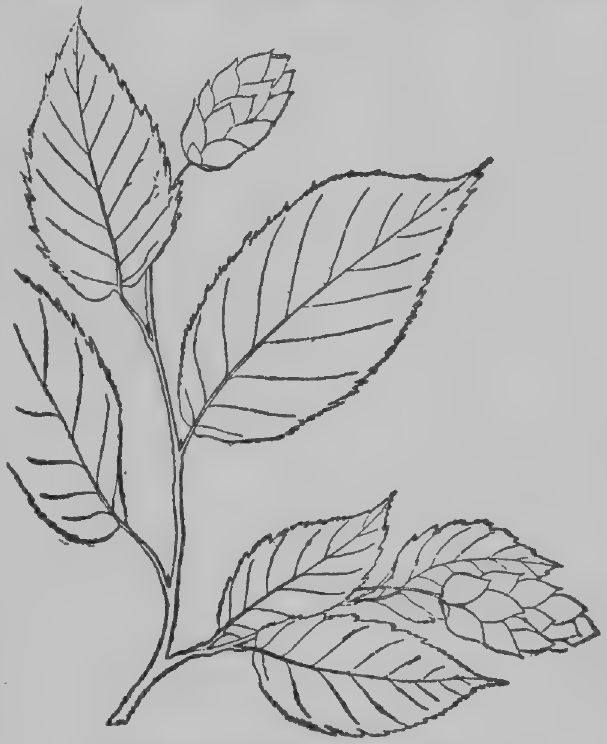
The leaves are simple, alternate, egg-shaped or nearly oblong, sharply toothed, two to three inches long and very similar to those of the Blue Beech.
The flowers are borne in catkins, the sterile ones appearing in the fall, usually in clusters of three, and the fertile ones appearing in the spring.
The fruit, which ripens in September, very closely resembles a cluster of hops.
The wood is compact, close-grained, strong, tough, durable and very heavy. It is good for levers, stakes, binding poles, handles, mallets and the like.
Text and line illustrations: Forest Trees of Massachusetts, 7th edition (2016), Massachusetts Department of Conservation and Recreation, Bureau of Forest Fire Control and Forestry, funded by the USDA Forest Service. Drawings, 1925 descriptions and the “How to know” keys: The Commercial Forest Trees of Massachusetts (1925), Massachusetts Department of Conservation, Division of Forestry. Forest shares before settlement and today: Harvard Forest data archive (Cogbill, Burk and Motzkin 2002; Thompson and others 2013). Insects and disease: USDA Forest Service Insect and Disease Survey, Region 9, with DCR. Photographs: observations on iNaturalist (inaturalist.org), each credited to its photographer under its Creative Commons licence; the list is under “Where the pictures come from” on the guide page. Species ranges by county are as the 2016 manual maps them. Transcribed by script and proofread in part; the manuals govern where they differ.