Eastern Cottonwood
Leaves alternate, simple · Family Salicaceae · Also called Southern Cottonwood, Carolina Poplar, Eastern Poplar, Necklace Poplar
In the inventory · Live trees fewer than 1 in 100 · Volume under 1% · Growth and mortality too few to estimate. USDA Forest Service, Forest Inventory and Analysis, 2019–2025; live trees an inch or more across, volume of trees five inches or more. Shares quoted only where the sampling error is 30% or less.
What to look for
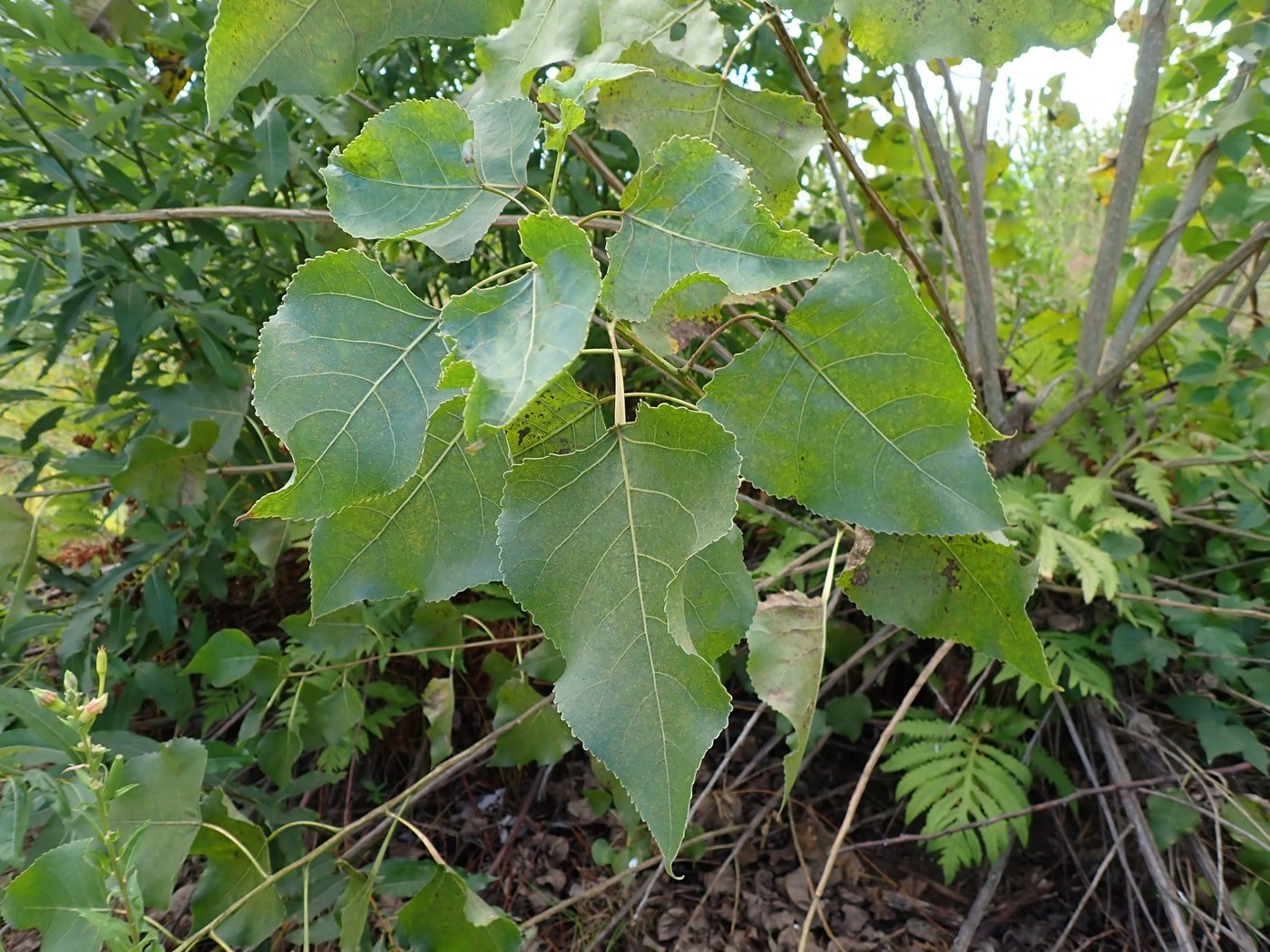
EASTERN Cottonwood is a tall tree that grows mostly in western Massachusetts. It is short-lived, but is the fastest-growing commercial forest species in North America. It grows best on moist, well-drained sands or silts near streams and along rivers, often in pure stands. Eastern Cottonwood is very shade intolerant.
It attains a height of forty to sixty feet and a trunk diameter of one to two feet. The bark is deeply ridged and dark in color.
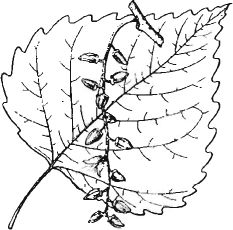
Leaves are simple, alternate, broadly heart-shaped, six to ten inches in length, with fine teeth on the margins. They can be woolly-white or hairless. The leaf stalk is flattened at right angles to the blade of the leaf.
Twigs are hairless or woolly-white and dark brown in color. End buds are three-eighths to five-eighths inch long, hairless or hairy-white toward the base and somewhat gummy. No other poplar has gummy end buds less than five-eighths inches long.
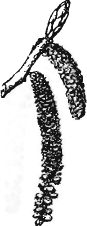
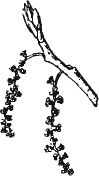
Flowers are catkins and appear in March or April, before the leaves. Fruits are in long caterpillar -like catkins which often release cottony seeds that cover the ground in a white fluff in early June.
The lightweight, rather soft wood is used primarily for core stock in manufacturing furniture and for pulpwood. Eastern Cottonwood is one of the few hardwood species that is planted and grown specifically for these purposes.
Where it grows
Mapped in 9 of fourteen counties: Berkshire, Essex, Franklin, Hampden, Hampshire, Middlesex, Norfolk, Suffolk, Worcester.
Forest types where the 2016 manual places it: Floodplain Forest.
Insects and disease on the record
| Agent | Years seen | Worst year | Acres that year | Last seen |
|---|---|---|---|---|
| Spongy moth | 21 | 2017 | 1,049,099 | 2025 |
| Forest tent caterpillar | 11 | 2006 | 362,694 | 2018 |
Acres are of mapped damage, which can include other trees and non-forest; some agents attack several hosts.
Text and line illustrations: Forest Trees of Massachusetts, 7th edition (2016), Massachusetts Department of Conservation and Recreation, Bureau of Forest Fire Control and Forestry, funded by the USDA Forest Service. Drawings, 1925 descriptions and the “How to know” keys: The Commercial Forest Trees of Massachusetts (1925), Massachusetts Department of Conservation, Division of Forestry. Forest shares before settlement and today: Harvard Forest data archive (Cogbill, Burk and Motzkin 2002; Thompson and others 2013). Insects and disease: USDA Forest Service Insect and Disease Survey, Region 9, with DCR. Photographs: observations on iNaturalist (inaturalist.org), each credited to its photographer under its Creative Commons licence; the list is under “Where the pictures come from” on the guide page. Species ranges by county are as the 2016 manual maps them. Transcribed by script and proofread in part; the manuals govern where they differ.