Downy Shadbush
Leaves alternate, simple · Family Rosaceae · Also called Juneberry, Shadbush, Servicetree, Serviceberry
In the inventory (genus figures) · Live trees fewer than 1 in 100 · Volume under 1% · Growth and mortality too few to estimate. USDA Forest Service, Forest Inventory and Analysis, 2019–2025; live trees an inch or more across, volume of trees five inches or more. Shares quoted only where the sampling error is 30% or less. Genus-level: FIA records serviceberry (Amelanchier) as one group.
What to look for
DOWNY Shadbush is widespread in Worcester county westward, and occasionally east to Middlesex county. An irregular bushy tree, with a long trunk and ascending lateral branches, it generally does not exceed a height of thirty-three feet. It is commonly seen on dry slopes and along the edges of old fields.
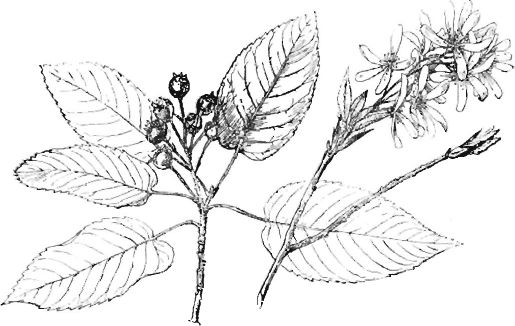
The leaves are oval, with sharp tips, toothed margins, and are one and one-half to four inches long. Young leaves have a dense, white hairy underside, while mature leaves are smooth above and slightly hairy below.
Buds are reddish brown, one-fourth to one-half inches long, narrow and sharp-pointed. Twigs are reddish-brown, and darken during the first winter. The bark is light gray with shallow fissures.
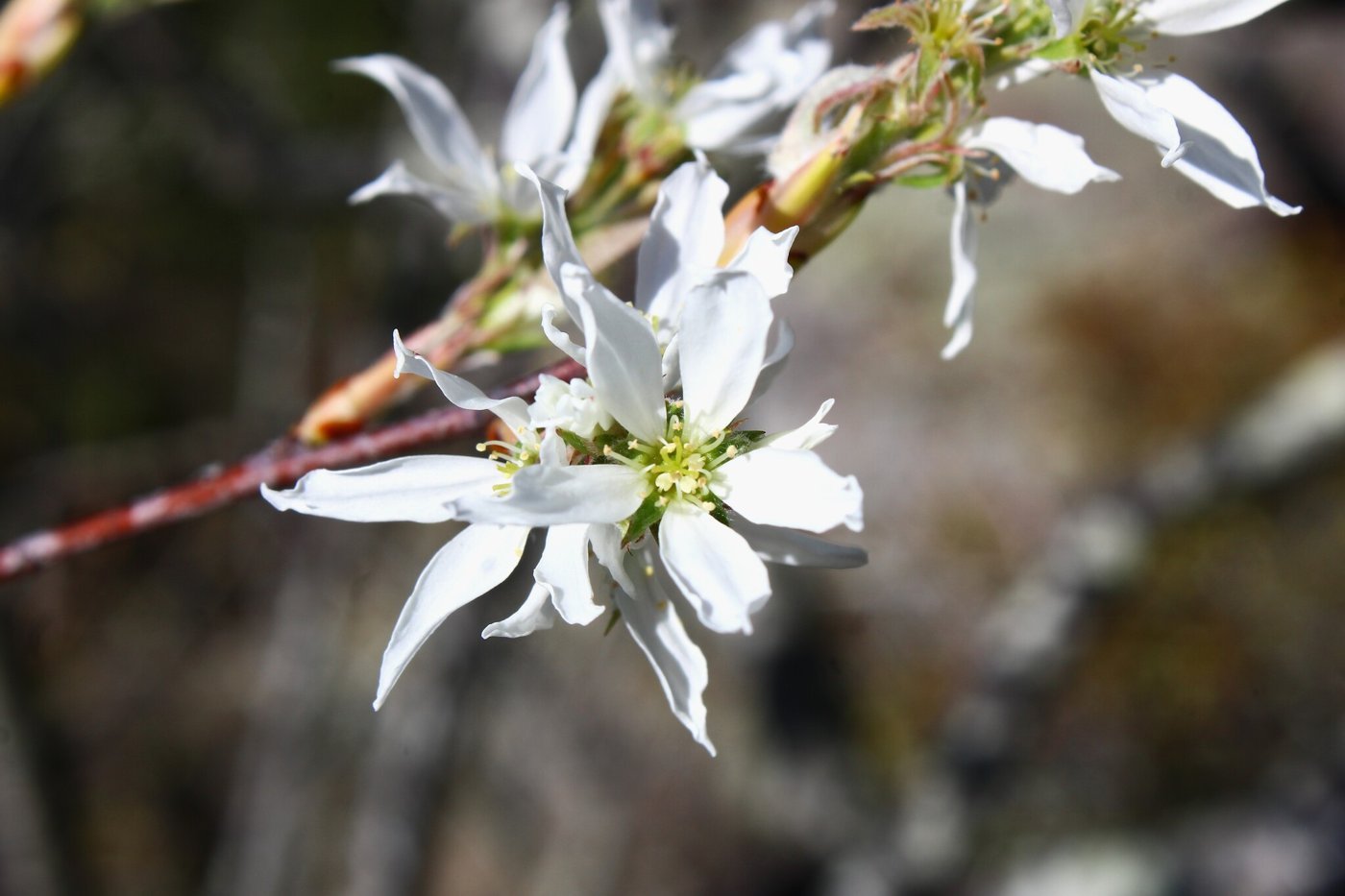
Flowers are white, one and one-half inches across and are borne in elongate drooping clusters, just as the leaves are beginning to unfold. Ripe fruits are maroon-purple, dry, and tasteless, though coveted by birds.
The wood is dark brown, strong, hard, and close grained. Its wood has no commercial value, but is typically planted to attract birds or for ornament.
Where it grows
Mapped in all fourteen counties.
Text and line illustrations: Forest Trees of Massachusetts, 7th edition (2016), Massachusetts Department of Conservation and Recreation, Bureau of Forest Fire Control and Forestry, funded by the USDA Forest Service. Drawings, 1925 descriptions and the “How to know” keys: The Commercial Forest Trees of Massachusetts (1925), Massachusetts Department of Conservation, Division of Forestry. Forest shares before settlement and today: Harvard Forest data archive (Cogbill, Burk and Motzkin 2002; Thompson and others 2013). Insects and disease: USDA Forest Service Insect and Disease Survey, Region 9, with DCR. Photographs: observations on iNaturalist (inaturalist.org), each credited to its photographer under its Creative Commons licence; the list is under “Where the pictures come from” on the guide page. Species ranges by county are as the 2016 manual maps them. Transcribed by script and proofread in part; the manuals govern where they differ.