Chinkapin Oak
Leaves alternate, simple · Family Fagaceae · Also called Yellow Chestnut Oak, Rock Oak and Yellow Oak
What to look for
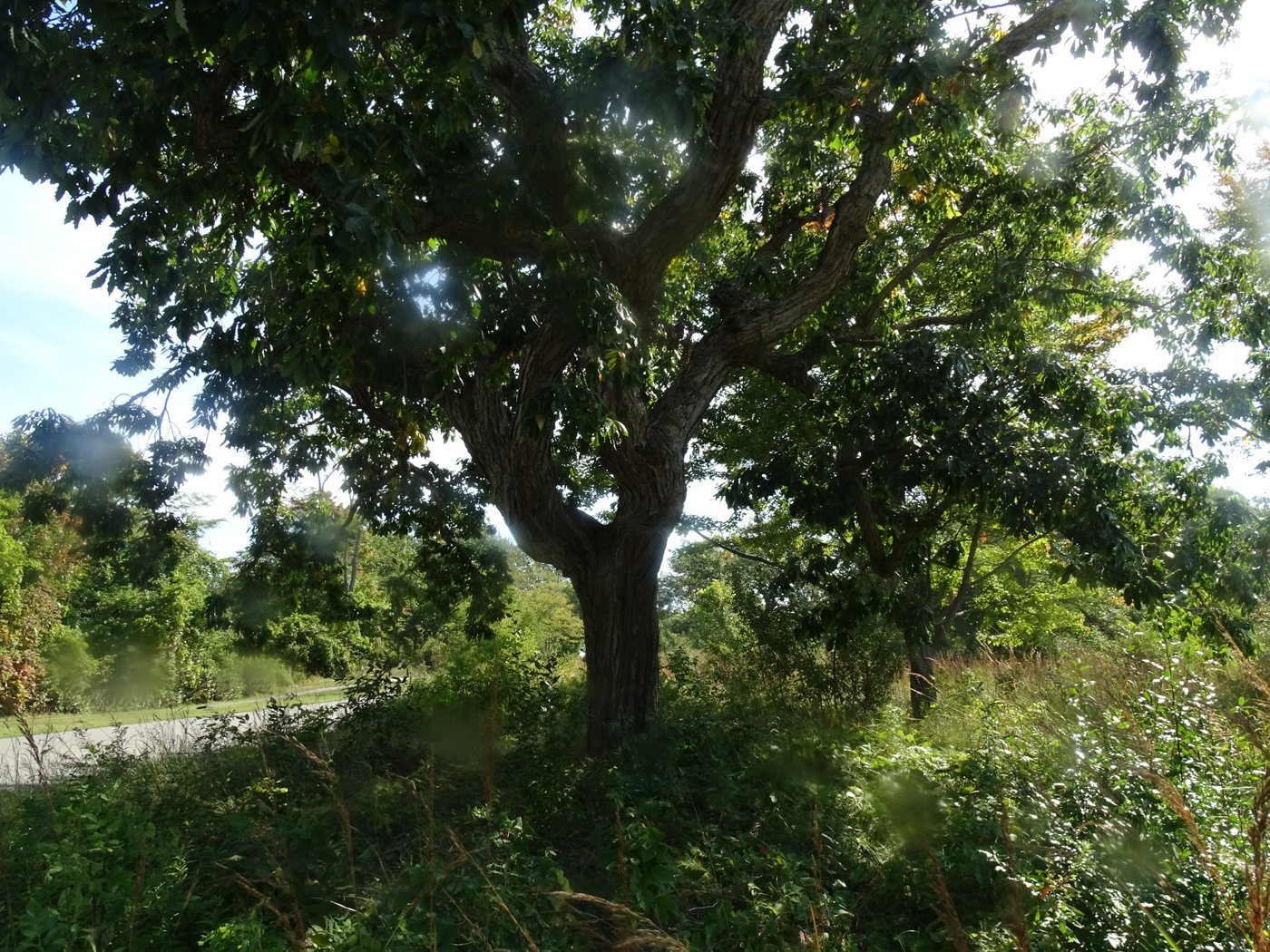
CHINKAPIN Oak grows in alkaline soils on limestone outcrops and well-drained slopes of the uplands, usually with other hardwoods. It can be found mainly in the lower southwest section of Berkshire County. Chinkapin Oak is shade intolerant. It withstands moderate shading when young but becomes more intolerant of shade with age, It is usually a medium-sized upland tree, twenty to fifty feet in height and six to twenty-four inches in diameter. The trunk is straight, tapering, dark, and finely grooved. The trunk is straight, columnar, and buttressed at the base.
Bark is pale or light gray and scaly, often flaky, but not ridged. Twigs are hairless. End buds are narrow, sharp, hairless, and mostly about three-sixteenth of an inch long.
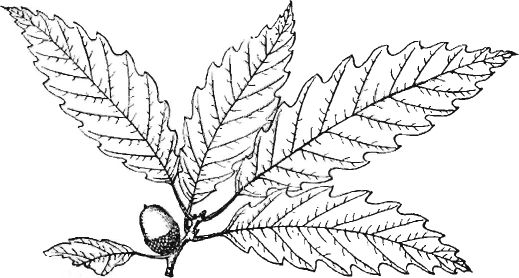
Leaves are simple, and arranged alternately on the stem. Each leaf is lance-shaped and coarsely toothed (ten or more pairs). The leaf is smooth and yellow-green on the upper surface, paler and lightly hairy on the lower surface, four to nine inches long and up to five inches wide.
Male (staminate) and female (pistillate) flowers are separate but occur on the same tree. The tiny flowers do not have petals. Male flowers are arranged in catkins; female flowers are in small groups.
The fruit is a bowl-shaped acorn. Borne in groups of one or two, each acorn is ovoid, chestnut-colored, and up to three quarters of an inch long with tight scales. The cup has hairy scales and covers about half of the nut.
Its heavy, strong wood is used for fence posts, fuel, and railroad ties.
Where it grows
Mapped in 1 of fourteen counties: Berkshire.
In the forest record
Trees of this group (oak) were 45% of the trees surveyors recorded at lot corners before settlement and are 19% of trees on inventory plots today, statewide.
Each town’s own numbers are on its habitat, forest and water page.
The oak group is among the three most common kinds of tree in the surveyors’ record of 127 of the 164 towns with a surviving record, and the largest share of that record is in Boxford (81%), Natick (80%), Newton (77%). The record is by group of trees, not by species, and covers towns with at least 50 recorded trees for the “largest share” list.
Insects and disease on the record
| Agent | Years seen | Worst year | Acres that year | Last seen |
|---|---|---|---|---|
| Spongy moth | 21 | 2017 | 1,049,099 | 2025 |
| Forest tent caterpillar | 11 | 2006 | 362,694 | 2018 |
| Winter moth | 13 | 2011 | 88,793 | 2018 |
Acres are of mapped damage, which can include other trees and non-forest; some agents attack several hosts.
Text and line illustrations: Forest Trees of Massachusetts, 7th edition (2016), Massachusetts Department of Conservation and Recreation, Bureau of Forest Fire Control and Forestry, funded by the USDA Forest Service. Drawings, 1925 descriptions and the “How to know” keys: The Commercial Forest Trees of Massachusetts (1925), Massachusetts Department of Conservation, Division of Forestry. Forest shares before settlement and today: Harvard Forest data archive (Cogbill, Burk and Motzkin 2002; Thompson and others 2013). Insects and disease: USDA Forest Service Insect and Disease Survey, Region 9, with DCR. Photographs: observations on iNaturalist (inaturalist.org), each credited to its photographer under its Creative Commons licence; the list is under “Where the pictures come from” on the guide page. Species ranges by county are as the 2016 manual maps them. Transcribed by script and proofread in part; the manuals govern where they differ.