Butternut
Leaves alternate, compound · Family Juglandaceae · Also called White Walnut and Oilnut
In the inventory · Live trees fewer than 1 in 100 · Volume under 1% · Growth and mortality too few to estimate. USDA Forest Service, Forest Inventory and Analysis, 2019–2025; live trees an inch or more across, volume of trees five inches or more. Shares quoted only where the sampling error is 30% or less.
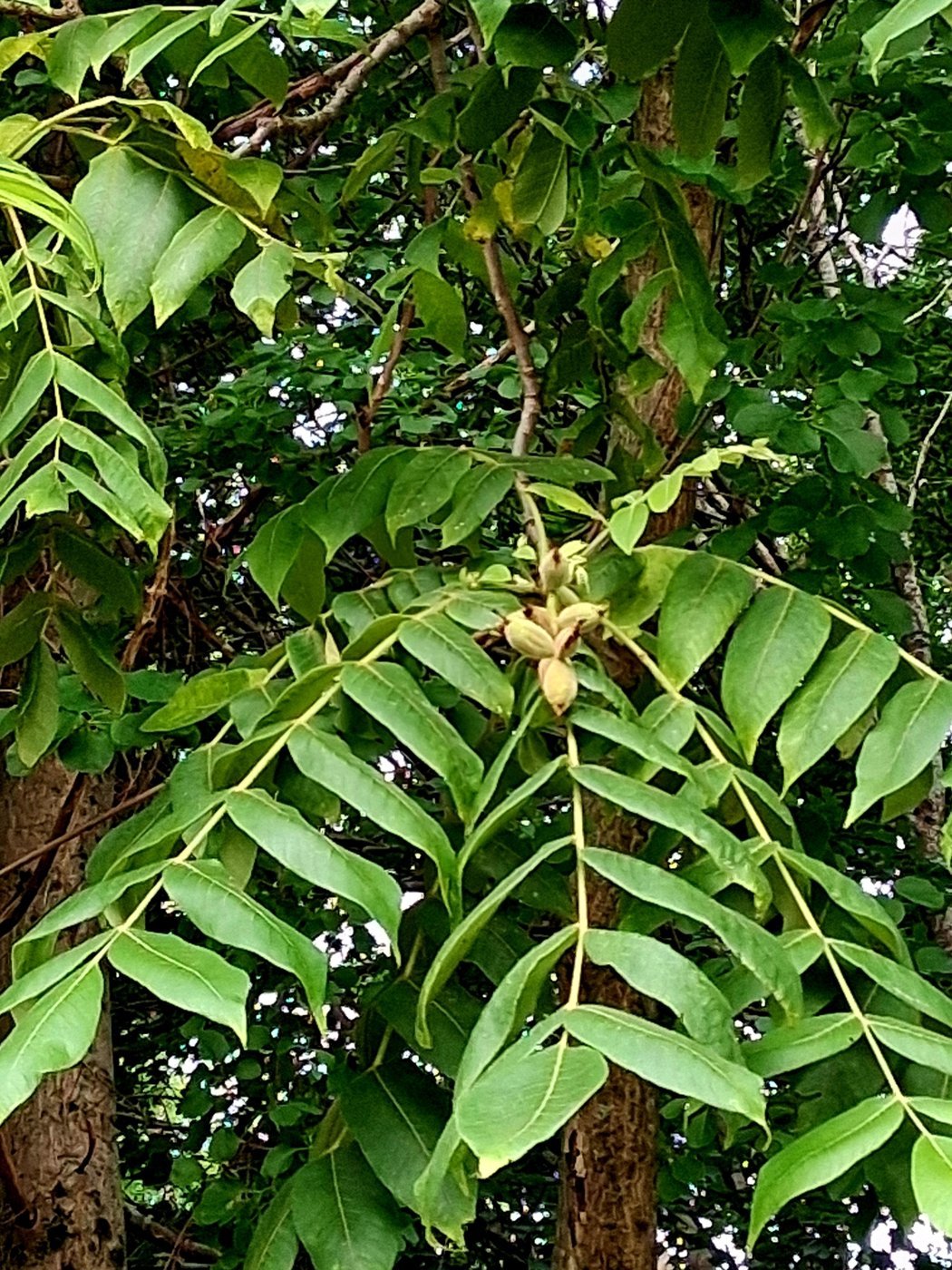
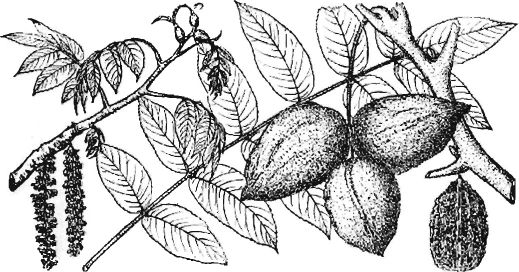

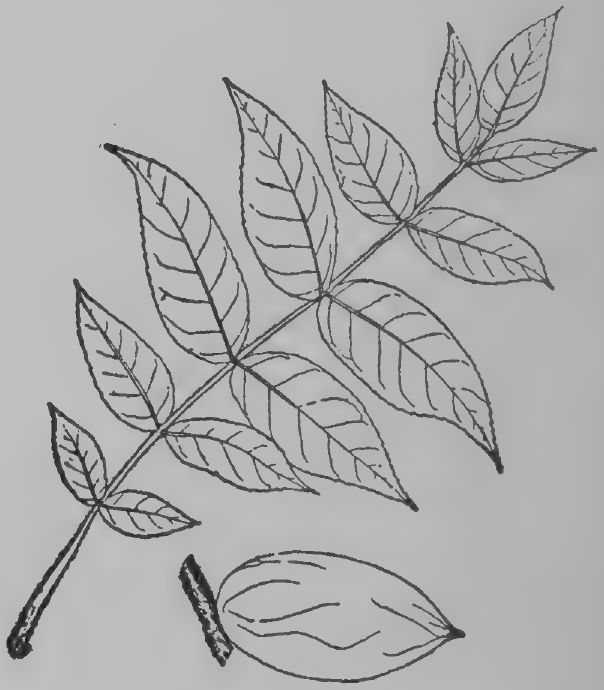
What to look for
GROWING in rich, moist soil near streams and on low, rocky hills, the Butternut once occurred throughout Massachusetts. It was most abundant in the western and central portions, but it is now rare. Although young trees may withstand competition from the side, Butternut does not survive under shade from above. It must be in the overstory to thrive and, therefore, is classed as intolerant of shade and competition.
It is a low, broad-headed tree, usually rising to a height of forty to eighty feet, and a diameter of one to two feet. Branches start a few feet from the ground, with long, rather stout, horizontal limbs. The pith of the twigs is dark brown and chambered.
Bark on the trunk is dark gray and divided into broad, flat ridges.
Leaves are alternate, range from fifteen to thirty inches long, and have from eleven to seventeen leaflets. End leaflets are usually present in Butternuts. In Black Walnuts, end leaflets are often absent. The end bud is one half to three quarters of an inch long and pointed, similar to that of the Black Walnut, but with a prominent hairy fringe above the leaf scar.
The fruit, nuts, which are borne in drooping clusters, are oblong-cylindrical in shape, and about three inches long and covered with sticky hairs.
The wood is light, soft and weak. It is employed for the interior finish of houses, manufacturing of furniture, and instrument cases. The tree is considered more valuable for its nuts.
Where it grows
Mapped in 11 of fourteen counties: Berkshire, Bristol, Essex, Franklin, Hampden, Hampshire, Middlesex, Norfolk, Plymouth, Suffolk, Worcester.
Forest types where the 2016 manual places it: Northern Hardwoods.
As described in 1925
Show
Listed as Butternut (Juglans cinerea L.).
How to know the Walnuts (1925): Habit — Low, wide-branching, with a broad, round-topped head. Bark_On_Trunk — Dark gray and divided into broad, flat ridges. Leaves — Leaflets 11 to 17 in number. Fruit — Oblong, cylindrical and covered with sticky hairs. Compare the walnuts ›
GROWING in rich, moist soil near streams and on low, rocky hills, the Butternut occurs throughout Massachusetts, though most abundantly in the eastern and central portions.
It is a low, broad-headed tree, usually rising to a height of thirty to forty feet with a trunk diameter of one to four feet. It branches a few feet from the ground, sending out long, rather stout, horizontal limbs.
The bark on the trunk is dark gray and divided into broad, flat ridges. The leaves are alternate, from fifteen to thirty inches long and have from eleven to seventeen leaflets. The nuts, which are borne in drooping clusters, are oblong-cylindrical in shape, about three inches long and covered with sticky hairs.
The wood is light, soft and weak.
It is employed for the interior finish of houses and used in the manufacture of furniture.
Text and line illustrations: Forest Trees of Massachusetts, 7th edition (2016), Massachusetts Department of Conservation and Recreation, Bureau of Forest Fire Control and Forestry, funded by the USDA Forest Service. Drawings, 1925 descriptions and the “How to know” keys: The Commercial Forest Trees of Massachusetts (1925), Massachusetts Department of Conservation, Division of Forestry. Forest shares before settlement and today: Harvard Forest data archive (Cogbill, Burk and Motzkin 2002; Thompson and others 2013). Insects and disease: USDA Forest Service Insect and Disease Survey, Region 9, with DCR. Photographs: observations on iNaturalist (inaturalist.org), each credited to its photographer under its Creative Commons licence; the list is under “Where the pictures come from” on the guide page. Species ranges by county are as the 2016 manual maps them. Transcribed by script and proofread in part; the manuals govern where they differ.