Black Walnut
Leaves alternate, compound · Family Juglandaceae · Also called Eastern Black Walnut and American Walnut
In the inventory · Live trees fewer than 1 in 100 · Volume under 1% · Growth and mortality too few to estimate. USDA Forest Service, Forest Inventory and Analysis, 2019–2025; live trees an inch or more across, volume of trees five inches or more. Shares quoted only where the sampling error is 30% or less.

What to look for
BLACK Walnut is rather rare in Massachusetts, though it occurs more frequently in the western part of the State. It is one of the most scarce and coveted native hardwoods. When found, it is usually growing in rich bottomlands or on fertile hillsides such as the Connecticut River Valley area. Black Walnut is classified as intolerant of shade. In mixed forest stands it must be dominant or co-dominant to survive.
It is a large tree with a narrow, round head, which normally attains a height of seventy to one hundred feet tall and a trunk diameter of two to four feet.
Branches are stout, and the lower ones extend horizontally. The pith is light brown and chambered.
Bark on the trunk is blackish and deeply divided into rounded ridges which have a tendency to cross.
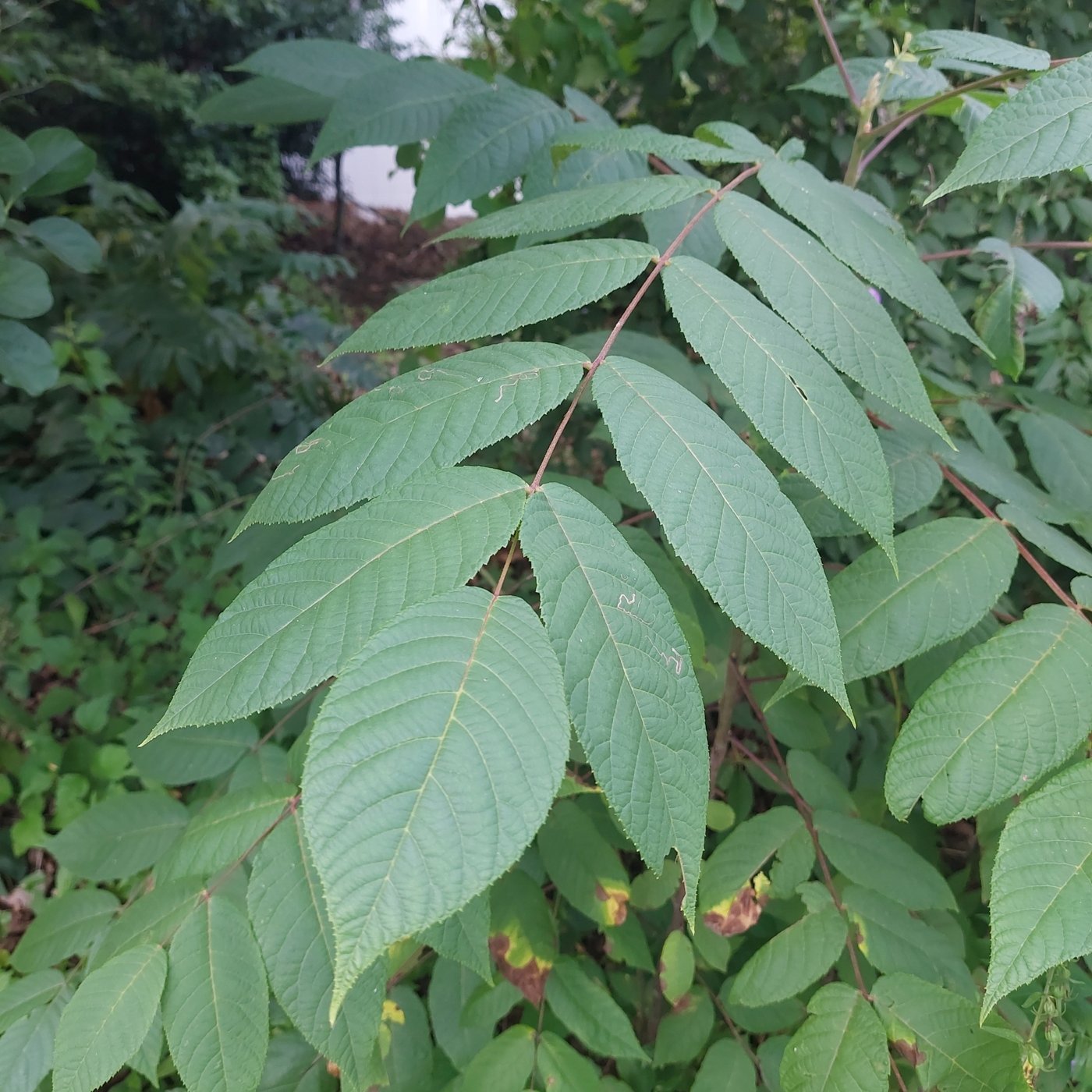
Leaves are compound and alternate, ranging from one to two feet long, and having from fifteen to twenty-three leaflets. Often the end leaflet is missing. When crushed, the leaves emit a spicy scent. End buds are blunt, whitish, woolly, and one-eighth to three-eighth inch long. Leaf scars are large, and without a hairy fringe.
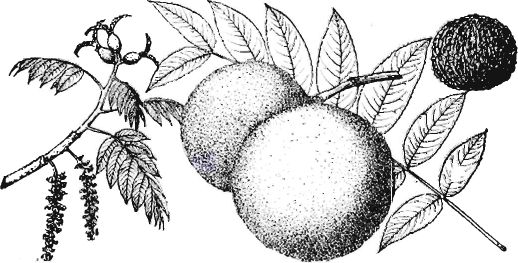
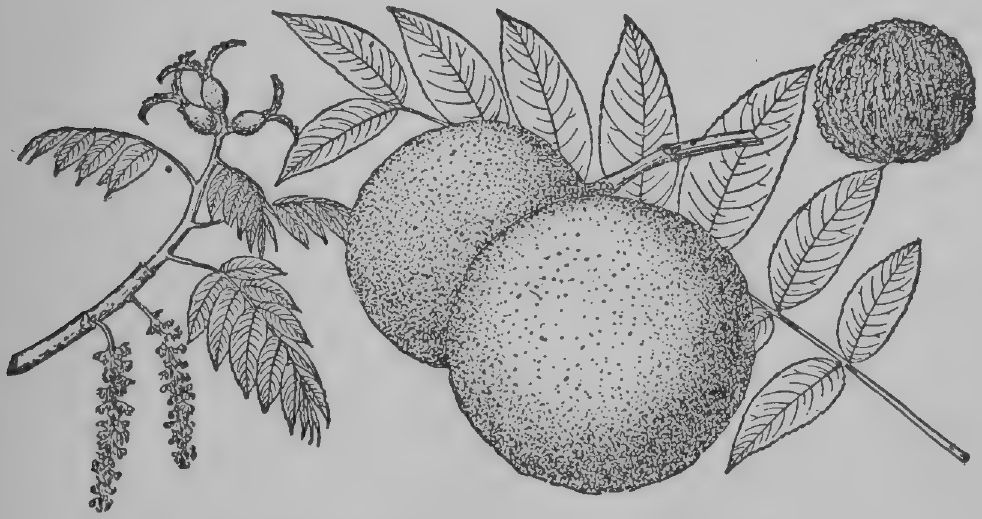
The fruit is a large round nut, about two inches in diameter, with a slightly rough surface. Husks are in one piece, unlike Hickories which break into sections.
Wood is heavy, hard, strong, durable, and capable of taking a fine polish. The older the tree, generally speaking, the darker and more valuable the wood is. The best known uses of Black Walnut are for its lumber and veneer. The wood is used for fine furniture of all kinds, interior paneling, specialty products, and gunstocks.
Where it grows
Mapped in 1 of fourteen counties: Suffolk. Introduced, not native.
As described in 1925
Show
Listed as Black Walnut (Juglans nigra L.).
How to know the Walnuts (1925): Habit — Tall, straight, destitute of branches for a considerable distance from the ground, with a narrow, round-topped head. Bark_On_Trunk — Dark brown or almost black and deeply divided into rounded ridges which cross each other obliquely. Leaves — Leaflets 15 to 23 in number. Fruit — Globular, without sticky hairs, and somewhat rough. Compare the walnuts ›
THE Black Walnut is rather rare in Massachusetts, though it occurs more frequently in the western part of the State than in the eastern. When found, it is usually growing in rich bottomlands or on fertile hillsides.
It is a large tree of upright growth and narrow, round head, which normally attains a height of fifty to seventy-five feet and a trunk diameter of two to five feet. The branches are stout and rigid and the lower ones extend horizontally.
The bark on the trunk is blackish and deeply divided into rounded ridges which have a tendency to cross each other obliquely.
The leaves are alternate, from one to two feet long and have from fifteen to twenty-three leaflets.
The fruit is a globose nut, about two inches in diameter, with a slightly roughened surface.
The wood is heavy, hard, strong, durable and capable of taking a fine polish. It is very valuable for cabinet-making and the interior finish of houses. The older the tree, generally speaking, the darker and more valuable is the wood.
Text and line illustrations: Forest Trees of Massachusetts, 7th edition (2016), Massachusetts Department of Conservation and Recreation, Bureau of Forest Fire Control and Forestry, funded by the USDA Forest Service. Drawings, 1925 descriptions and the “How to know” keys: The Commercial Forest Trees of Massachusetts (1925), Massachusetts Department of Conservation, Division of Forestry. Forest shares before settlement and today: Harvard Forest data archive (Cogbill, Burk and Motzkin 2002; Thompson and others 2013). Insects and disease: USDA Forest Service Insect and Disease Survey, Region 9, with DCR. Photographs: observations on iNaturalist (inaturalist.org), each credited to its photographer under its Creative Commons licence; the list is under “Where the pictures come from” on the guide page. Species ranges by county are as the 2016 manual maps them. Transcribed by script and proofread in part; the manuals govern where they differ.