Black Spruce
Leaves needles or scales · Family Pinaceae · Also called Bog Spruce, Swamp Spruce, and Shortleaf Black Spruce
What to look for
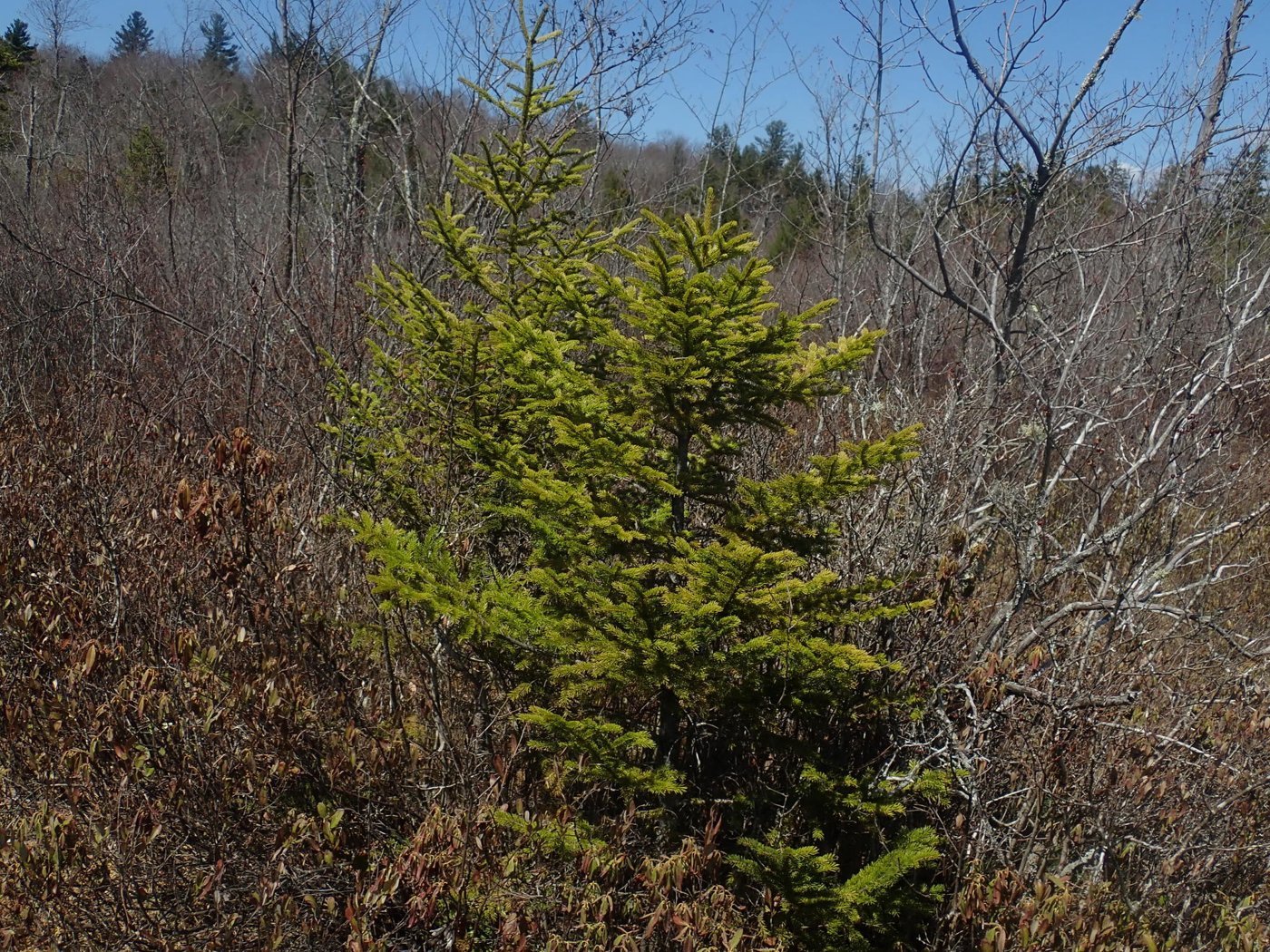
BLACK Spruce is a small tree, growing in the northern and western sections of the State. Usually it grows in swamps and on the borders of streams, though sometimes it is found in uplands. Black Spruce is classified as shade tolerant, but is less tolerant than Balsam Fir and Northern White Cedar, two common competitors in northern New England.
It is a conical tree with a height of twenty to thirty feet, and a diameter of six to twelve inches. Branches are short, horizontal or slightly declining and tend to turn upwards at the extremities, somewhat in the manner of the Norway Spruce.
The bark on the trunk is a grayish-brown and broken into scales. Leaves (needles) are about one-half inch long four sided, blue-green color, and like all spruces are borne on a peg-like projection. Twigs and buds are hairy. Buds in winter are acutely pointed.
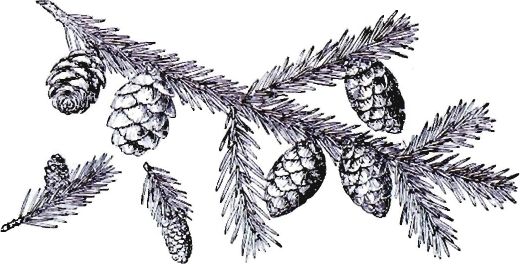
Cones are egg-shaped, one-half to one and one-half inches in length, and grayish-brown with finely ragged scale edges. They usually remain on the trees and can persist for as many as twenty years.
The wood is light, soft and weak. The principal commercial use of Black Spruce, both in Canada and the United States, is for making high quality pulp with balanced strength properties. It is also used for lumber, Christmas trees, and other products. Black Spruce Christmas trees were harvested in considerable numbers from natural stands until fairly recently.
At one time Black and Red Spruces were considered the same species. They were ultimately separated, but more recent work has suggested that many individuals may in fact be back-crossed hybrids, further complicating the differentiation of the two.
Where it grows
Mapped in 9 of fourteen counties: Berkshire, Essex, Franklin, Hampden, Hampshire, Middlesex, Norfolk, Plymouth, Worcester.
In the forest record
Trees of this group (spruce and fir) were 1% of the trees surveyors recorded at lot corners before settlement and are 1% of trees on inventory plots today, statewide.
Each town’s own numbers are on its habitat, forest and water page.
The spruce and fir group is among the three most common kinds of tree in the surveyors’ record of 4 of the 164 towns with a surviving record, and the largest share of that record is in Tyringham (12%), Northampton (10%), Royalston (9%). The record is by group of trees, not by species, and covers towns with at least 50 recorded trees for the “largest share” list.
As described in 1925
Show
Listed as Black Spruce (Picea mariana B. S. P.).
How to know the Spruces (1925): Leaves — Blue-green and not glossy. Cones — One-half to one and a half inches in length. Usually remain on the tree for many years. Compare the spruces ›
THE Black Spruce is a small and rather unimportant tree which is of frequent occurrence in the northern and western sections of the State. Usually it grows in swamps and on the borders of streams, though sometimes on uplands.
In habit it is a conical tree with a height of twenty to thirty feet and a diameter of six to twelve inches. The branches are short, horizontal or slightly declining and tend to turn upwards at the extremities, somewhat after the manner of the Norway Spruce.
The bark on the trunk is grayish-brown and broken into three scales.
The leaves are about one-half inch long and blue-green in color.
The cones are egg-shaped, one-half to one and one-half inches in length and grayish-brown in color. They usually remain on the trees for several years and often persist for as many as twenty years.
The wood is light, soft and weak. It is seldom used here except for making paper, pulp.
Black and Red Spruce have, until recently, been considered the same species, but under the new classification the Black Spruce now becomes a far less valuable tree, commercially, than the Red.
Text and line illustrations: Forest Trees of Massachusetts, 7th edition (2016), Massachusetts Department of Conservation and Recreation, Bureau of Forest Fire Control and Forestry, funded by the USDA Forest Service. Drawings, 1925 descriptions and the “How to know” keys: The Commercial Forest Trees of Massachusetts (1925), Massachusetts Department of Conservation, Division of Forestry. Forest shares before settlement and today: Harvard Forest data archive (Cogbill, Burk and Motzkin 2002; Thompson and others 2013). Insects and disease: USDA Forest Service Insect and Disease Survey, Region 9, with DCR. Photographs: observations on iNaturalist (inaturalist.org), each credited to its photographer under its Creative Commons licence; the list is under “Where the pictures come from” on the guide page. Species ranges by county are as the 2016 manual maps them. Transcribed by script and proofread in part; the manuals govern where they differ.