Black Locust
Leaves alternate, compound · Family Fabaceae
In the inventory · Live trees fewer than 1 in 100 · Volume under 1% · Growth and mortality too few to estimate. USDA Forest Service, Forest Inventory and Analysis, 2019–2025; live trees an inch or more across, volume of trees five inches or more. Shares quoted only where the sampling error is 30% or less.
What to look for
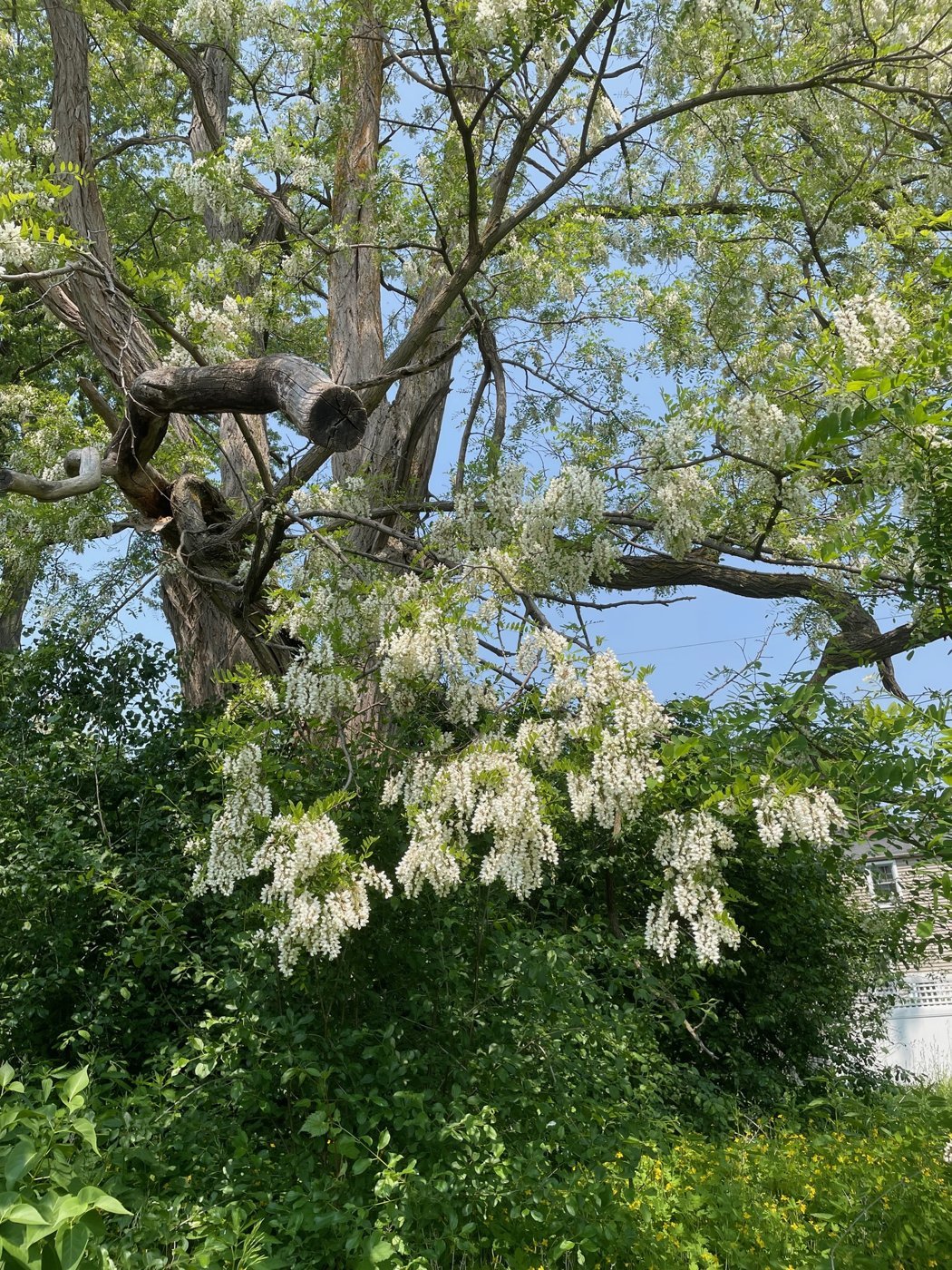
ALTHOUGH Black Locust is not native to the state, it has become so thoroughly naturalized that it is as common as many of the native species, especially in the south-central and southwestern parts of the state. It prefers rich ground, yet it is found in various soils. Black Locust is very sensitive to competition and is very shade intolerant.
When young, it is a rapid-growing tree, often attaining a height of twenty feet in half as many years as other trees. After that period the growth rate slows. It is usually a small tree, from twenty-five to fifty feet in height and from eight inches to two feet in diameter.
The trunk is erect or sometimes oblique and irregular. Branches are small and brittle and form a narrow, oblong head.
Bark on old trunks and branches is dark gray, thick, and deeply and irregularly furrowed. Young branches are armed with spines which disappear as the tree ages.
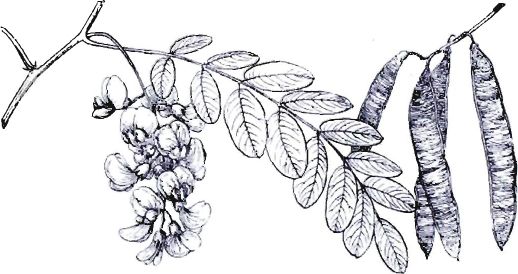
Leaves are alternate, compound, and composed of seven to twenty-one leaflets. Leaflets are small, about an inch and a quarter in length, and oval in outline.
Twigs are stout, brittle, greenish to reddish-brown and bear two short spines at each node. Buds are small, imbedded in bark, and three to four occur above each other.
Flowers, which appear in early June after the leaves unfold, are borne in loose hanging racemes, four to five inches in length. They are creamy-white, showy, fragrant, and much frequented by bees.
The fruit is a pod which is smooth, flat, dark brown, and about three inches in length.
The wood is heavy, exceedingly hard, strong and very durable when in contact with the soil. It is employed for ship building, for fence posts, and for fuel.
Where it grows
Mapped in all fourteen counties. Introduced, not native.
As described in 1925
Show
Listed as Locust (Robinia pseudacacia L.).
ALTHOUGH the Locust is not native to the State, it has become so thoroughly naturalized that it is as common as many of the indigenous species. It prefers rich ground, yet it is found in various soils and situations.
When young it is a rapid-growing tree, often attaining a height of twenty feet in half as many years. After that period its increase is much slower. Here it is usually a small tree, from twenty-five to fifty feet in height and from eight inches to two feet in diameter. The trunk is erect or sometimes oblique and irregular. The branches are small and brittle and form a narrow, oblong head.
The bark on the old trunk is dark gray, thick and deeply and irregularly furrowed. The young branches are armed with spines which disappear as the tree ages.
The leaves are pinnately compound and composed of seven to twenty-one leaflets. The individual leaflets are small, about an inch or an inch and a quarter in length and oval in outline.
The flowers, which appear in early June after the leaves unfold, are borne in loose racemes, four to five inches in length. They are creamy-white, showy, fragrant and much frequented by bees.
The fruit is a pod which is smooth, flat, dark brown and about three inches in length.
The wood is heavy, exceedingly hard, strong and very durable when in contact with the soil. It is employed for shipbuilding, for fence-posts, in turnery and for fuel.
Text and line illustrations: Forest Trees of Massachusetts, 7th edition (2016), Massachusetts Department of Conservation and Recreation, Bureau of Forest Fire Control and Forestry, funded by the USDA Forest Service. Drawings, 1925 descriptions and the “How to know” keys: The Commercial Forest Trees of Massachusetts (1925), Massachusetts Department of Conservation, Division of Forestry. Forest shares before settlement and today: Harvard Forest data archive (Cogbill, Burk and Motzkin 2002; Thompson and others 2013). Insects and disease: USDA Forest Service Insect and Disease Survey, Region 9, with DCR. Photographs: observations on iNaturalist (inaturalist.org), each credited to its photographer under its Creative Commons licence; the list is under “Where the pictures come from” on the guide page. Species ranges by county are as the 2016 manual maps them. Transcribed by script and proofread in part; the manuals govern where they differ.