Black Cherry
Leaves alternate, simple · Family Rosaceae
In the inventory · Live trees about 1 tree in 50 (2.0%) · Volume 2% · Growth and mortality too few to estimate. USDA Forest Service, Forest Inventory and Analysis, 2019–2025; live trees an inch or more across, volume of trees five inches or more. Shares quoted only where the sampling error is 30% or less.

What to look for
BLACK Cherry is the most important of the native cherries for the economic value of its wood. It commonly occurs in all parts of the state, growing on many soils, yet preferring moist, rich ground. Aside from its commercial value, it provides fruit for birds and wildlife, and flowers for bees. Black Cherry is shade intolerant. Though sometimes a mere shrub, it usually reaches a height of seventy-five feet and acquires a diameter of thirty six inches.
The trunk is usually continuous and the branches are small and horizontal. The head is narrow and oblong.
Bark on young stems is red-brown, somewhat lustrous, marked with conspicuous white, horizontally elongated lenticels, and peels off in thin film-like layers, exposing green inner bark.
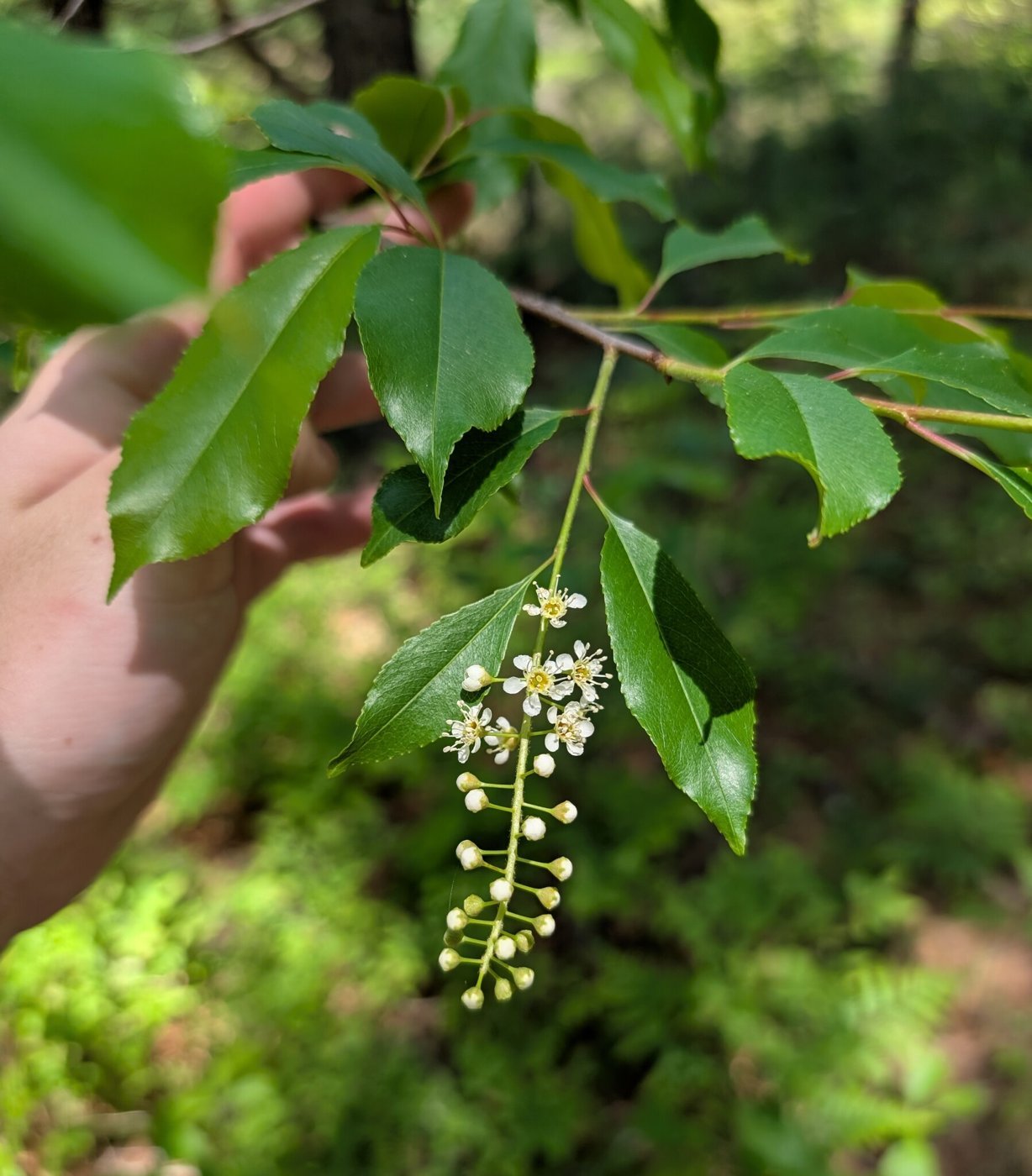
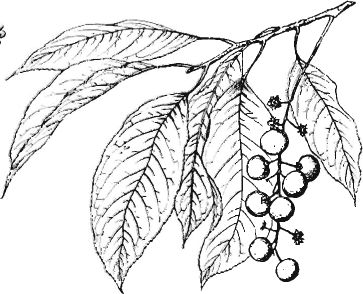
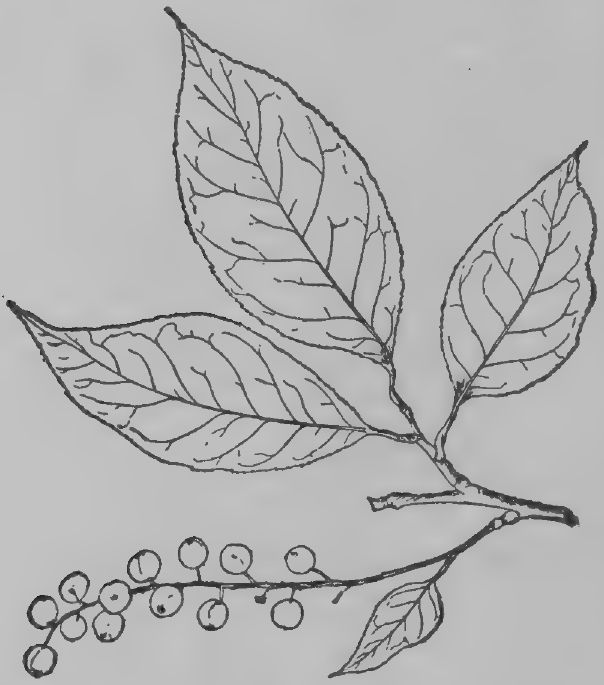
Leaves are simple, alternate, oblong to lance-shape, three to five inches in length. The margin is notched with fine teeth, somewhat leathery in texture, and dark green and lustrous on the upper surface.
Twigs are smooth, reddish-brown, and marked with numerous small whitish lenticels. Buds are about an eighth of an inch long, smooth, glossy, reddish-brown and covered with about four visible scales.
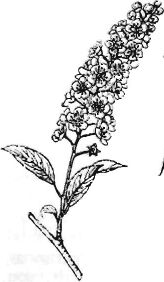
Flowers appear in late May or early June, when the leaves are only half grown. Many small white flowers are clustered on a hanging raceme which is four to five inches in long.
Fruits are round, about the size of a pea, dark purple in color, and usually slightly bitter. In addition to the bark, the fruit also possesses valuable medicinal properties.
The wood is moderately heavy, hard, strong, fine-grained, and has reddish-brown heartwood. It is durable and used for furniture, interior finishing, tools, ties, implements, and high-end panels.
Where it grows
Mapped in all fourteen counties.
As described in 1925
Show
Listed as Black Cherry (Prunus serotina Ehrh.).
FOR the economic value of its wood, the Black Cherry is the most important of the native Cherries. It is of common occurrence in all parts of the State, growing on many soils and in many situations, yet preferring moist, rich ground.
As to habit, though sometimes a mere shrub, it usually reaches a height of thirty to forty feet and acquires a diameter of ten to fifteen inches, — at times even exceeding these dimensions. The trunk is usually continuous and the branches are small and horizontal. The head is narrow and oblong.
The bark on young stems is red-brown and somewhat lustrous. On the old trunk it is darker and broken into small, irregular plates. The inner bark is bitter to the taste.
The leaves are simple, alternate, oblong to lance-oblong in shape, three to five inches in length, the margin notched with fine teeth, somewhat leathery in texture and dark green and lustrous on the upper surface.
The flowers appear in late May or early June, when the leaves are only half grown. They are small, white and borne in many-flowered racemes which are four to five inches in length.
The fruit is globular, about the size of a pea, dark purple in color and usually slightly bitter.
The wood is light, close-grained, rather hard, not liable to warp and capable of taking a good polish. It is employed in cabinet-making and for interior finishing.
The fruit and bark possess valuable medicinal properties..
Text and line illustrations: Forest Trees of Massachusetts, 7th edition (2016), Massachusetts Department of Conservation and Recreation, Bureau of Forest Fire Control and Forestry, funded by the USDA Forest Service. Drawings, 1925 descriptions and the “How to know” keys: The Commercial Forest Trees of Massachusetts (1925), Massachusetts Department of Conservation, Division of Forestry. Forest shares before settlement and today: Harvard Forest data archive (Cogbill, Burk and Motzkin 2002; Thompson and others 2013). Insects and disease: USDA Forest Service Insect and Disease Survey, Region 9, with DCR. Photographs: observations on iNaturalist (inaturalist.org), each credited to its photographer under its Creative Commons licence; the list is under “Where the pictures come from” on the guide page. Species ranges by county are as the 2016 manual maps them. Transcribed by script and proofread in part; the manuals govern where they differ.