Bigtooth Aspen
Leaves alternate, simple · Family Salicaceae · Also called Largetooth Aspen, Poplar or Popple
In the inventory · Live trees fewer than 1 in 100 · Volume too few to estimate · Growth and mortality too few to estimate. USDA Forest Service, Forest Inventory and Analysis, 2019–2025; live trees an inch or more across, volume of trees five inches or more. Shares quoted only where the sampling error is 30% or less.
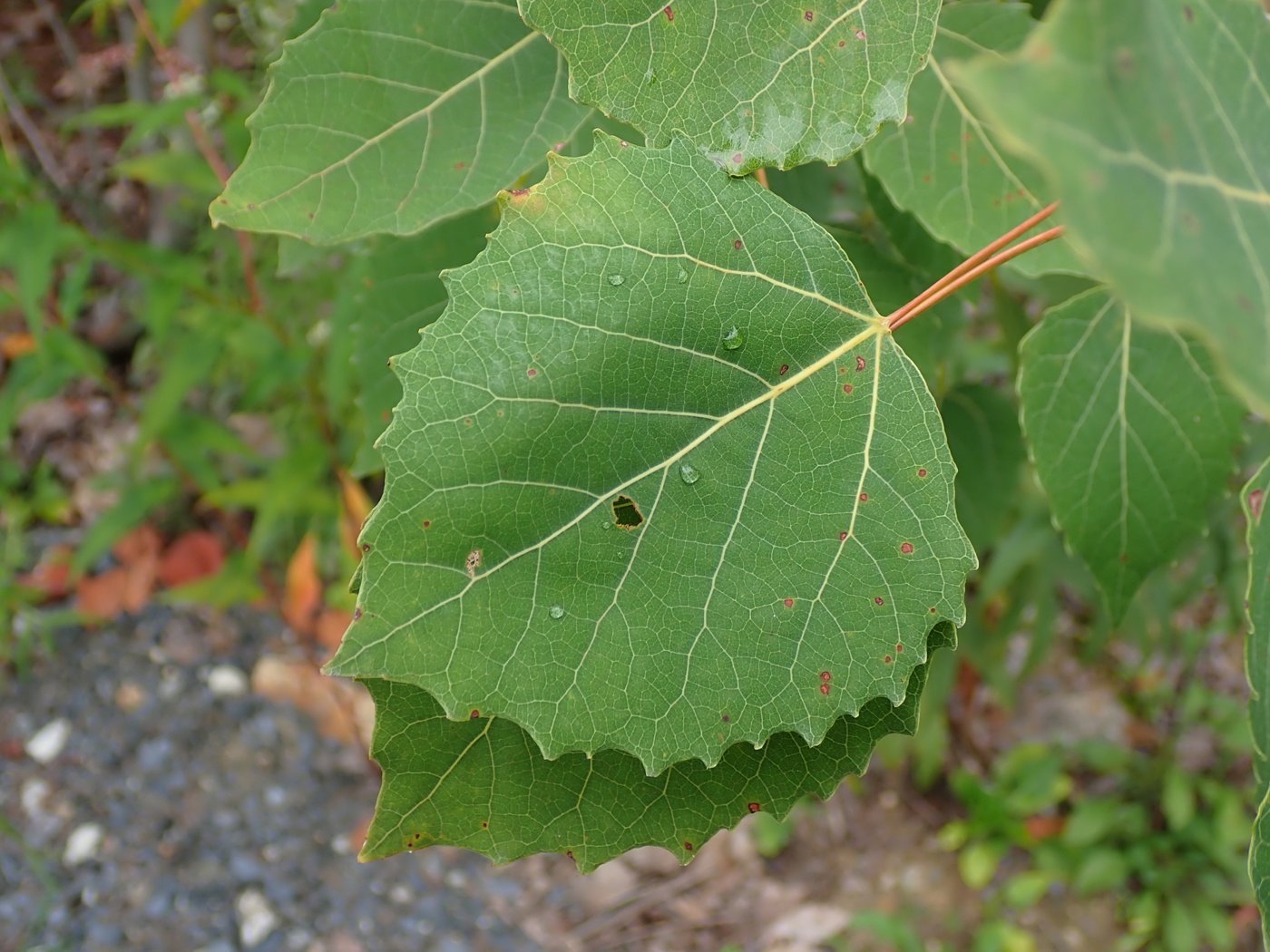
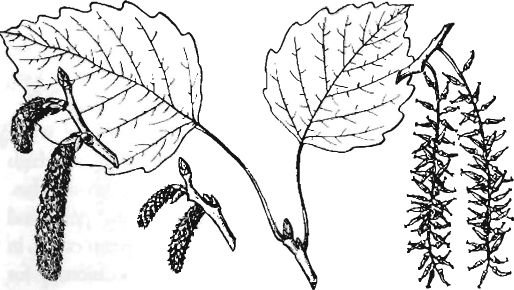
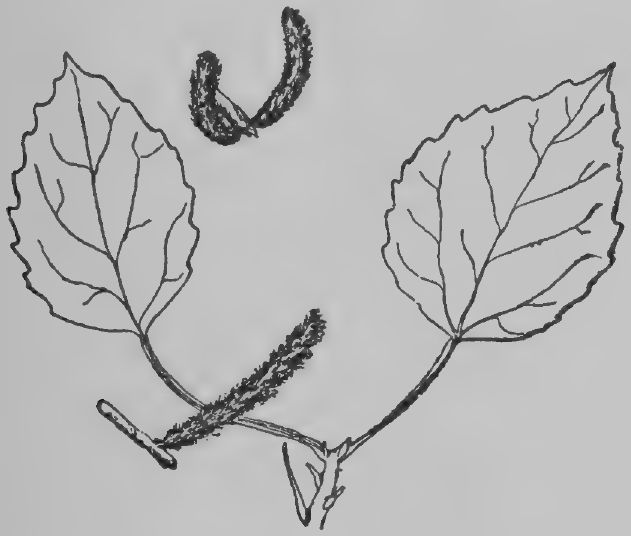
What to look for
BIGTOOTH Aspen is common throughout the state, growing in various soils, but preferring rich, sandy soil in the vicinity of streams and swamps. It is a quick-growing tree, very similar in appearance to the Quaking Aspen. Bigtooth Aspen is classed as very shade intolerant. It cannot successfully reproduce under its own shade, and seedlings must be kept free of competing brush and grasses. However, sucker growth is rapid enough to outgrow its competition.
It attains a height of thirty to forty feet and a trunk diameter of one to two feet. The bark is smooth and greenish-gray in color. On old trees it is somewhat darker and divided into broad, flat ridges.
Leaves are simple, alternate, broadly egg-shaped, two to six inches in length, coarsely scalloped on the margins and dark green on the upper surface. The leaf stalk is flattened at right angles to the blade of the leaf. Young leaves are white-woolly on the underside.
Twigs are hairless or slightly silky-gray. End buds are dull, more than three-eighths of an inch long, and decidedly hairy-gray.
Flowers are catkins and appear in March or April, before the leaves. Fruit are in long caterpillar -like catkins which often release cottony seeds.
The wood is similar to that of the Quaking Aspen, being light, soft and of little value. In the 1900’s it was used for paper pulp, box-boards and sometimes for fuel. Today the light-colored wood Is used mostly for paper pulp, although Aspen bark has been pelletized for supplemental cattle feed and fuel.
Where it grows
Mapped in all fourteen counties.
Insects and disease on the record
| Agent | Years seen | Worst year | Acres that year | Last seen |
|---|---|---|---|---|
| Spongy moth | 21 | 2017 | 1,049,099 | 2025 |
| Forest tent caterpillar | 11 | 2006 | 362,694 | 2018 |
Acres are of mapped damage, which can include other trees and non-forest; some agents attack several hosts.
As described in 1925
Show
Listed as Largetooth Aspen (Populus grandidentata Michx.).
How to know the Poplars (1925): Leaves — Broadly egg-shaped. Margin coarsely scalloped. Upper surface not lustrous. Winter_Buds — Broadly egg-shaped. Not sticky and covered with whitish, matted hairs. Bark — Not bitter. Compare the poplars ›
THE Largetooth Aspen is of common occurrence throughout the State, growing in various soils and situations, but preferring rich, sandy soil in the vicinity of streams and swamps.
It is a quick-growing tree, very similar in habit to the Aspen. Naturally it attains a height of thirty to forty feet and a trunk diameter of twelve to twenty inches.
The bark is smooth and greenish-gray in color. On old trees it is somewhat darker and divided into broad, flat ridges.
The leaves are simple, alternate, broadly egg-shaped, three to four inches in length, coarsely scalloped on the margins and dark green on the upper surface. The leaf stalk is flattened at right angles to the blade of the leaf.
The flowers are in catkins and appear in March or April, before the leaves.
The wood is similar to that of the preceding, being light, soft and of little value. It is used for paper pulp, box-boards and sometimes for fuel.
Text and line illustrations: Forest Trees of Massachusetts, 7th edition (2016), Massachusetts Department of Conservation and Recreation, Bureau of Forest Fire Control and Forestry, funded by the USDA Forest Service. Drawings, 1925 descriptions and the “How to know” keys: The Commercial Forest Trees of Massachusetts (1925), Massachusetts Department of Conservation, Division of Forestry. Forest shares before settlement and today: Harvard Forest data archive (Cogbill, Burk and Motzkin 2002; Thompson and others 2013). Insects and disease: USDA Forest Service Insect and Disease Survey, Region 9, with DCR. Photographs: observations on iNaturalist (inaturalist.org), each credited to its photographer under its Creative Commons licence; the list is under “Where the pictures come from” on the guide page. Species ranges by county are as the 2016 manual maps them. Transcribed by script and proofread in part; the manuals govern where they differ.