Balsam Fir
Leaves needles or scales · Family Pinaceae
In the inventory · Live trees fewer than 1 in 100 · Volume under 1% · Growth and mortality too few to estimate. USDA Forest Service, Forest Inventory and Analysis, 2019–2025; live trees an inch or more across, volume of trees five inches or more. Shares quoted only where the sampling error is 30% or less.
What to look for
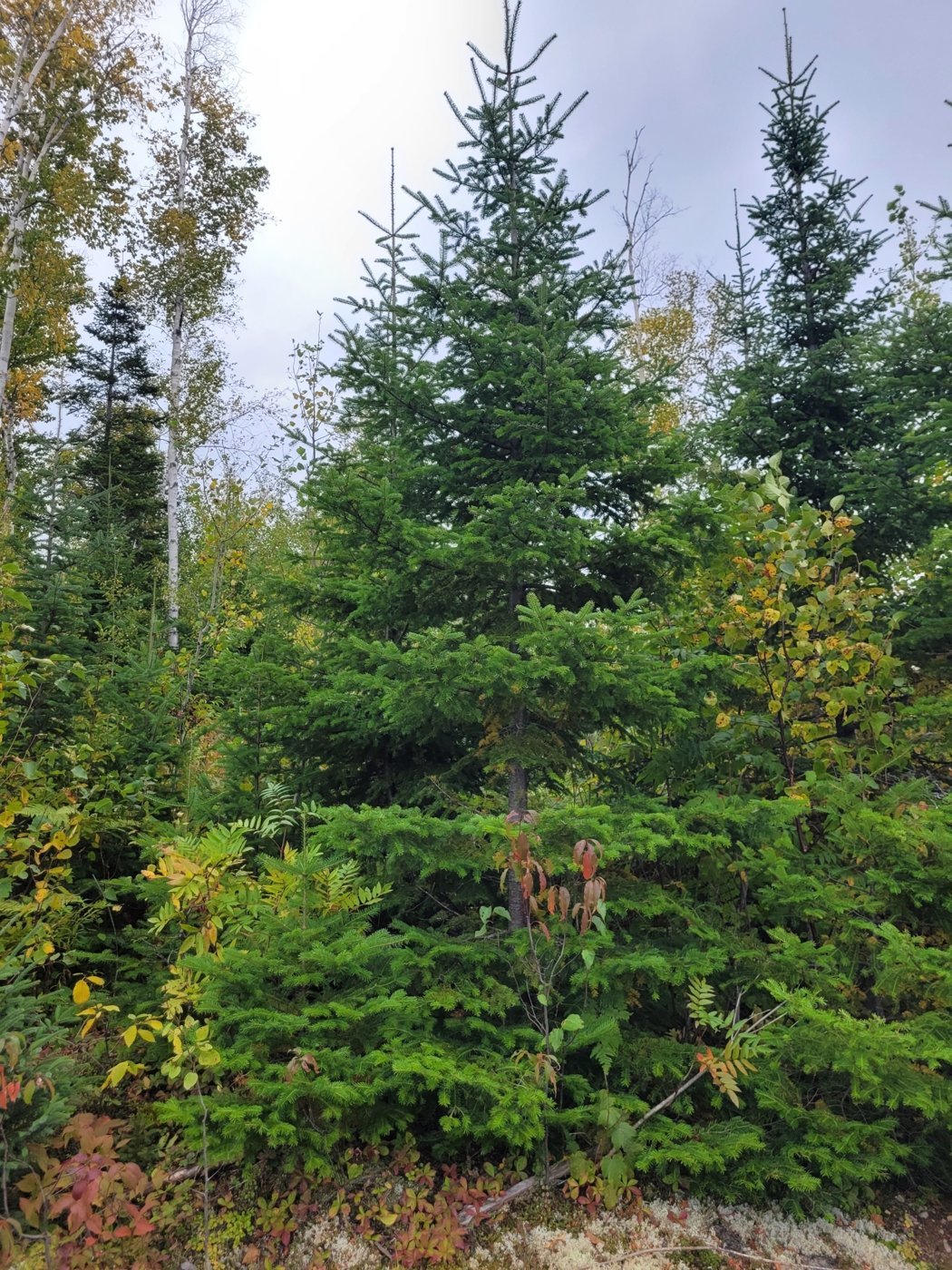
BALSAM Fir is native to the higher elevations of our western counties as well as certain cold, acidic swamps on the Monadnock Plateau (along the NH border). It has also been widely planted as an ornamental and for Christmas trees throughout the state. A small to medium-sized conical tree, it typically attains a height of twenty five to sixty feet but is generally short-lived, possibly due to climate stress from being at the southern limit of its range.
The bark on young trees is pale gray, smooth, thin, and has prominent blisters which are filled with a resinous liquid known as “Canada balsam.” On old trees, the bark is dark brown and broken into small plates.
Leaves (needles) are one-third to one and one-fourth inches long, pitchy, dark green and lustrous above, grayish -white below, and with the tips occasionally notched. On top branches leaves turn up, but on lower branches they spread out at right angles to the branch, giving it a flattened appearance.
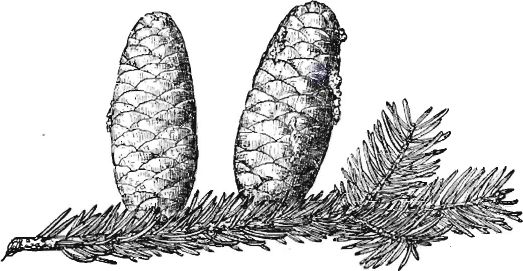
Cones are one and one-fourth to three and one-fourth inches long, erect and dark purple in color before maturity, and ripen in August to September of the first year.
Twigs are dark grayish brown and covered with hairs.
The wood is pale-brown tinged with yellow, weak, soft, light, and coarse-grained. It is sawn into lumber chiefly for light and medium building construction and pulpwood. Resin in the bark is the source of Canada balsam, which has a variety of uses that includes the manufacture of varnishes, folk remedies, and mounting media for microscopic preparations.
Balsam fir is favored for Christmas trees and greens. Small trees are cut in great numbers for the northeastern Christmas tree market. It is very closely related to another popular Christmas tree, Fraser Fir (Abies fraseri), which is native to the mountaintops of the southern Appalachians.
Where it grows
Mapped in 8 of fourteen counties: Barnstable, Berkshire, Bristol, Franklin, Hampshire, Middlesex, Plymouth, Worcester.
Forest types where the 2016 manual places it: Northern Hardwoods, Spruce-Fir / Northern Hardwoods.
In the forest record
Trees of this group (spruce and fir) were 1% of the trees surveyors recorded at lot corners before settlement and are 1% of trees on inventory plots today, statewide.
Each town’s own numbers are on its habitat, forest and water page.
The spruce and fir group is among the three most common kinds of tree in the surveyors’ record of 4 of the 164 towns with a surviving record, and the largest share of that record is in Tyringham (12%), Northampton (10%), Royalston (9%). The record is by group of trees, not by species, and covers towns with at least 50 recorded trees for the “largest share” list.
Text and line illustrations: Forest Trees of Massachusetts, 7th edition (2016), Massachusetts Department of Conservation and Recreation, Bureau of Forest Fire Control and Forestry, funded by the USDA Forest Service. Drawings, 1925 descriptions and the “How to know” keys: The Commercial Forest Trees of Massachusetts (1925), Massachusetts Department of Conservation, Division of Forestry. Forest shares before settlement and today: Harvard Forest data archive (Cogbill, Burk and Motzkin 2002; Thompson and others 2013). Insects and disease: USDA Forest Service Insect and Disease Survey, Region 9, with DCR. Photographs: observations on iNaturalist (inaturalist.org), each credited to its photographer under its Creative Commons licence; the list is under “Where the pictures come from” on the guide page. Species ranges by county are as the 2016 manual maps them. Transcribed by script and proofread in part; the manuals govern where they differ.