Atlantic White Cedar
Leaves needles or scales · Family Cupressaceae
In the inventory · Live trees fewer than 1 in 100 · Volume under 1% · Growth and mortality too few to estimate. USDA Forest Service, Forest Inventory and Analysis, 2019–2025; live trees an inch or more across, volume of trees five inches or more. Shares quoted only where the sampling error is 30% or less.
What to look for
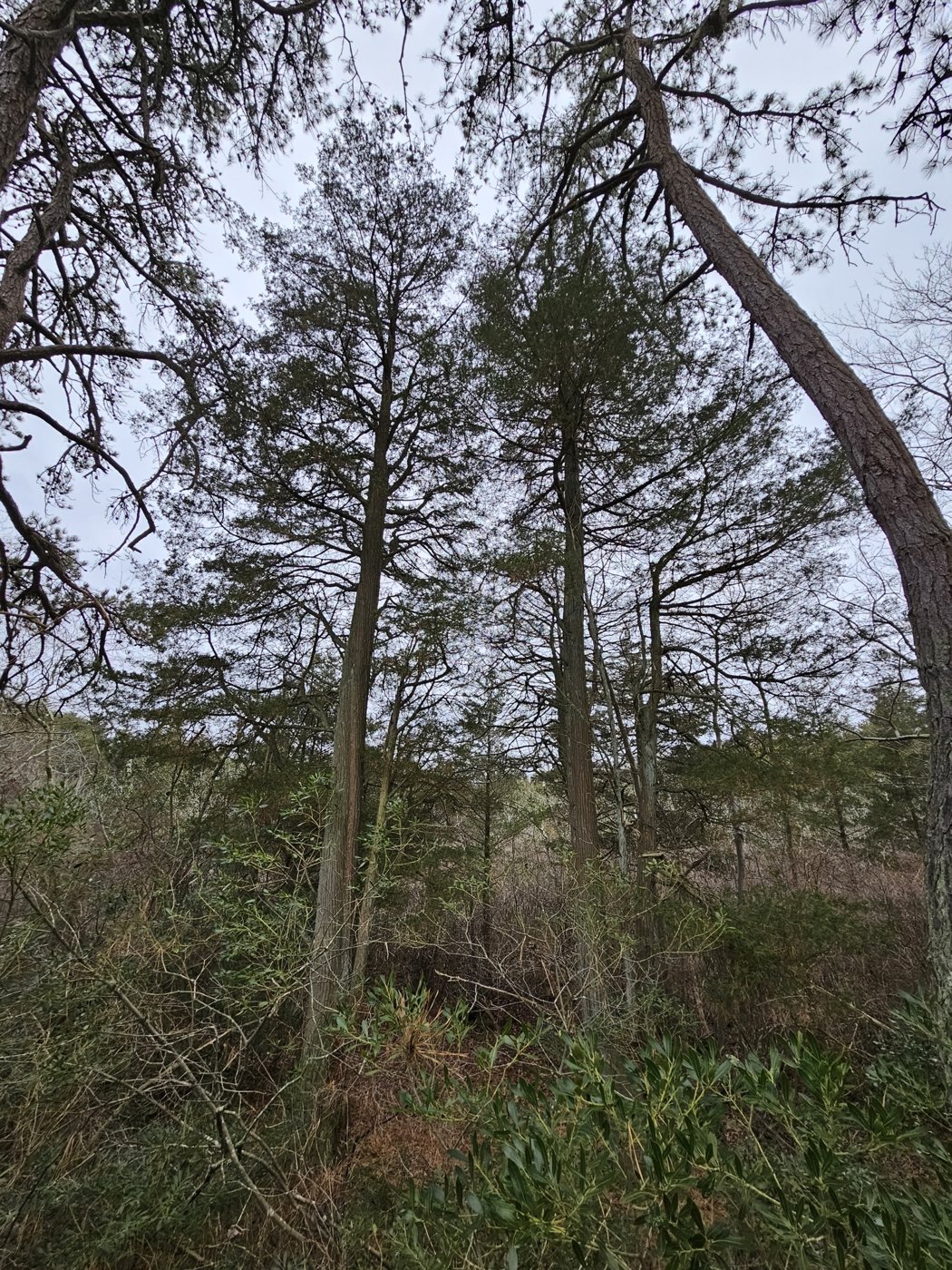
ATLANTIC White Cedar typically grows in acidic swamps throughout the Atlantic coastal plain. In Massachusetts, it is most common in the south eastern counties, though it is found sporadically far inland and occasionally at higher elevations. Although it grows in swamps, its foliage is highly flammable, which is of importance in the landscape of the fire-dependent Pitch Pine-Oak forest type where it is most common. Atlantic White Cedar often occurs in pure even-aged stands, reflecting its shade intolerance and its tendency to seed in after major disturbances (e.g. hurricanes and major fires). Its slender, horizontal branches form a narrow conical head. The trunk is continuous, and attains a height of forty to sixty feet and a diameter of one to two feet.
Bark on the trunk is reddish-brown and flakes off in thin scales. On old trees, particularly near the base, it is irregularly furrowed.
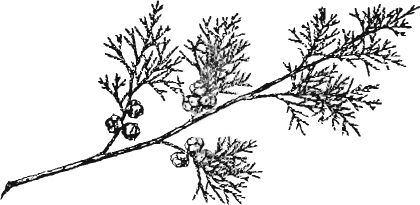
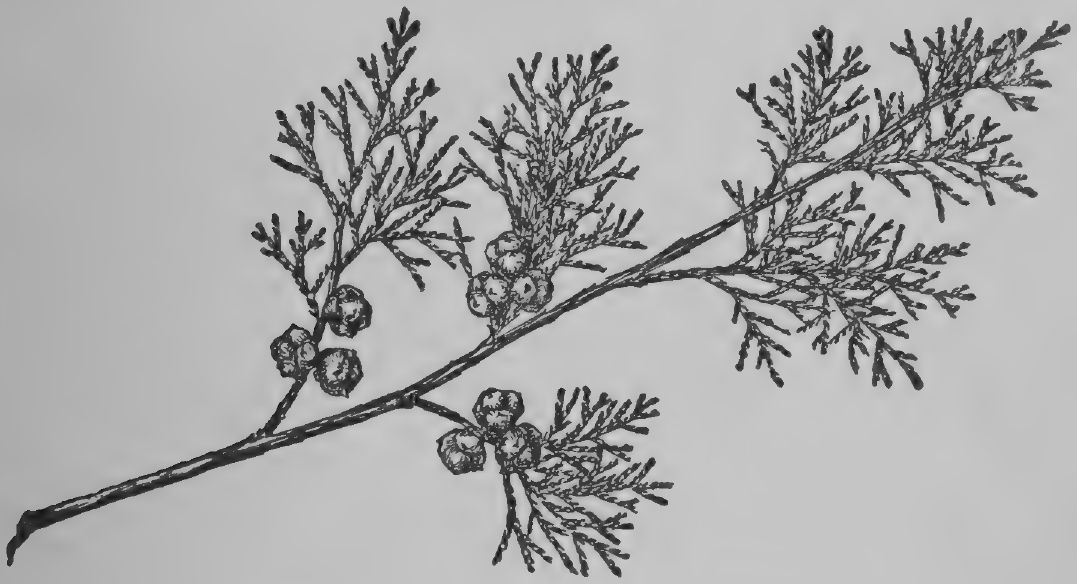
Leaves are scale-like, less than an eighth of an inch in length and dull blue-green in color. Cones are woody, globose, about three sixteenth to one quarter inch in diameter and red-brown at maturity. The seed is small and winged.
The wood is light, soft, weak, very durable, and aromatic. It is used for boat-building, interior finishing, shingles, and is particularly desirable for posts.
Where it grows
Mapped in 11 of fourteen counties: Barnstable, Bristol, Dukes, Essex, Hampden, Middlesex, Nantucket, Norfolk, Plymouth, Suffolk, Worcester.
Forest types where the 2016 manual places it: Pitch Pine-Oak.
As described in 1925
Show
Listed as White Cedar (Chamaecyparis thyoides B. S. P.).
THE White Cedar grows almost wholly in swamps, particularly those that are flooded for most of the year. In Massachusetts it occurs in patches of considerable area in the southeastern sections and to a limited extent in other parts.
As to habit, its slender, horizontal branches form a narrow, conical head of neat appearance. The trunk is continuous and attains a height of twenty to forty feet and a diameter of eight to fifteen inches.
On the trunk the bark is reddish-brown and flakes off in thin scales. On old trees, particularly near the base, it is irregularly furrowed.
The leaves are scale-like, not over an eighth of an inch in length and dull blue-green in color.
The cones are roundish, about a half-inch in diameter and red-brown at maturity. The seed is small and winged.
The wood is light, soft, weak, very durable and aromatic. It is used for boat-building, interior finishing and for posts. For this last purpose it is particularly desirable.
Text and line illustrations: Forest Trees of Massachusetts, 7th edition (2016), Massachusetts Department of Conservation and Recreation, Bureau of Forest Fire Control and Forestry, funded by the USDA Forest Service. Drawings, 1925 descriptions and the “How to know” keys: The Commercial Forest Trees of Massachusetts (1925), Massachusetts Department of Conservation, Division of Forestry. Forest shares before settlement and today: Harvard Forest data archive (Cogbill, Burk and Motzkin 2002; Thompson and others 2013). Insects and disease: USDA Forest Service Insect and Disease Survey, Region 9, with DCR. Photographs: observations on iNaturalist (inaturalist.org), each credited to its photographer under its Creative Commons licence; the list is under “Where the pictures come from” on the guide page. Species ranges by county are as the 2016 manual maps them. Transcribed by script and proofread in part; the manuals govern where they differ.