Amur Corktree
Leaves opposite, compound · Family Rutaceae
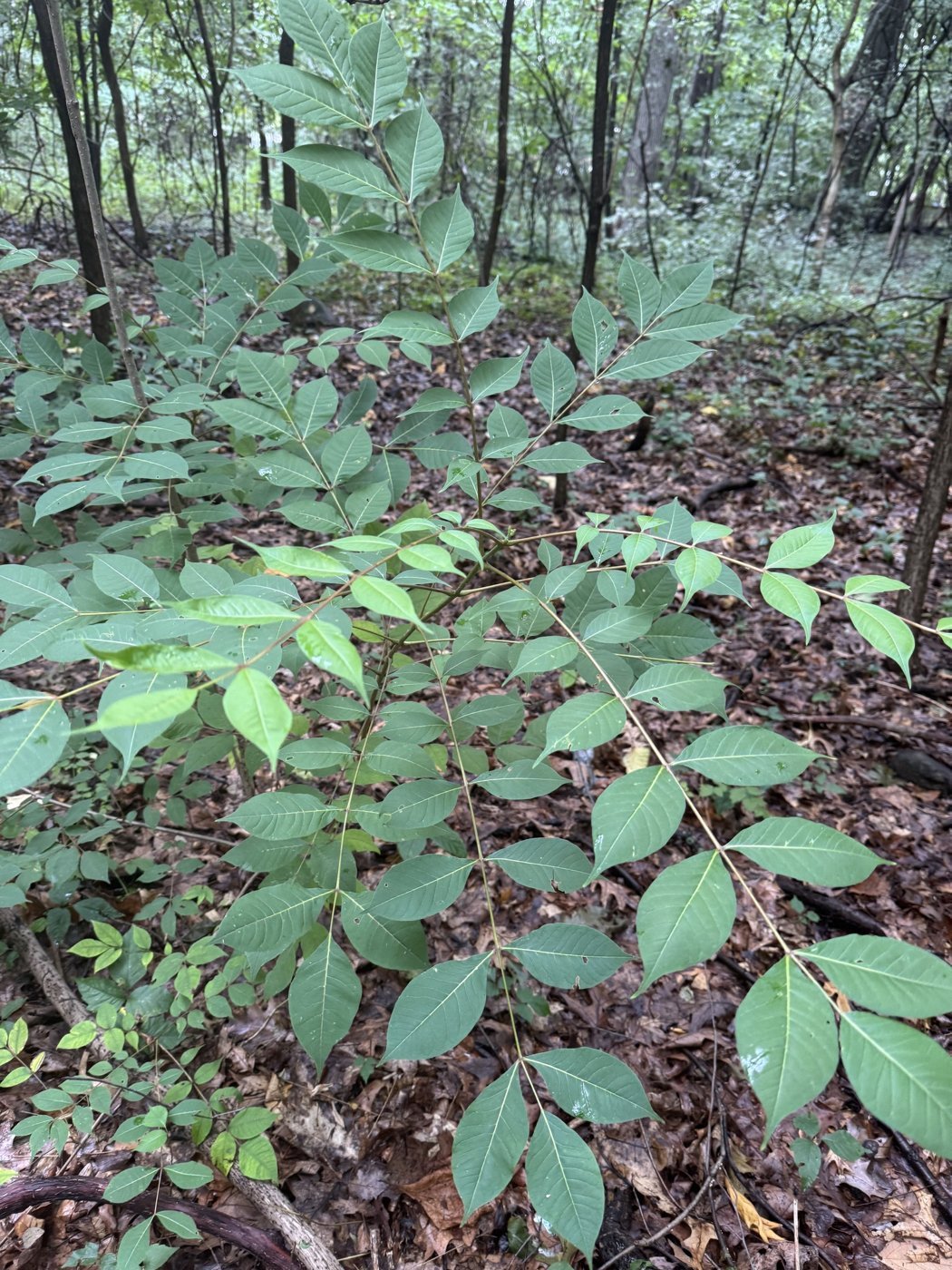
What to look for
NATIVE to China and Japan, Amur Corktree, a member of the citrus family, has escaped from cultivation and can now be found naturalized in woodlands. It is on the state prohibited plant list. Amur Corktree is a medium-sized tree, reaching heights of forty five feet, often with an equal or greater spread and a flat-topped crown.
Leaves are 10 — 15 inches long and opposite and pinnately compound, with seven to eleven leaflets. The leaflets are two to four inches long, entire, ovate with a pointy tip, and with a narrow or rounded base. They are dark green above and paler below.
On mature trees, bark is dark gray and corklike in appearance with ridges and furrows. On younger trees, the corky ridges are not as developed.
Twigs are stout and shiny brown or orange-brown, with prominent lenticels. The leaf scar is a distinctive horseshoe shape, with the bud set in the “U.”
Flowers, not ornamentally important, are small and yellow and borne in panicles two to three-and-a-half inches long. Amur Corktree is dioecious, meaning that male and female flowers occur on separate trees.
The fruit, developing from female flowers, is a small black drupe that ripens in the fall and can persist on trees through winter. When crushed, the fruit gives off a strong odor.
Where it grows
Mapped in 4 of fourteen counties: Essex, Hampshire, Norfolk, Suffolk. Introduced, not native.
Text and line illustrations: Forest Trees of Massachusetts, 7th edition (2016), Massachusetts Department of Conservation and Recreation, Bureau of Forest Fire Control and Forestry, funded by the USDA Forest Service. Drawings, 1925 descriptions and the “How to know” keys: The Commercial Forest Trees of Massachusetts (1925), Massachusetts Department of Conservation, Division of Forestry. Forest shares before settlement and today: Harvard Forest data archive (Cogbill, Burk and Motzkin 2002; Thompson and others 2013). Insects and disease: USDA Forest Service Insect and Disease Survey, Region 9, with DCR. Photographs: observations on iNaturalist (inaturalist.org), each credited to its photographer under its Creative Commons licence; the list is under “Where the pictures come from” on the guide page. Species ranges by county are as the 2016 manual maps them. Transcribed by script and proofread in part; the manuals govern where they differ.