American Mountain-Ash
Leaves alternate, compound · Family Rosaceae
In the inventory · Live trees fewer than 1 in 100 · Volume under 1% · Growth and mortality too few to estimate. USDA Forest Service, Forest Inventory and Analysis, 2019–2025; live trees an inch or more across, volume of trees five inches or more. Shares quoted only where the sampling error is 30% or less.
What to look for
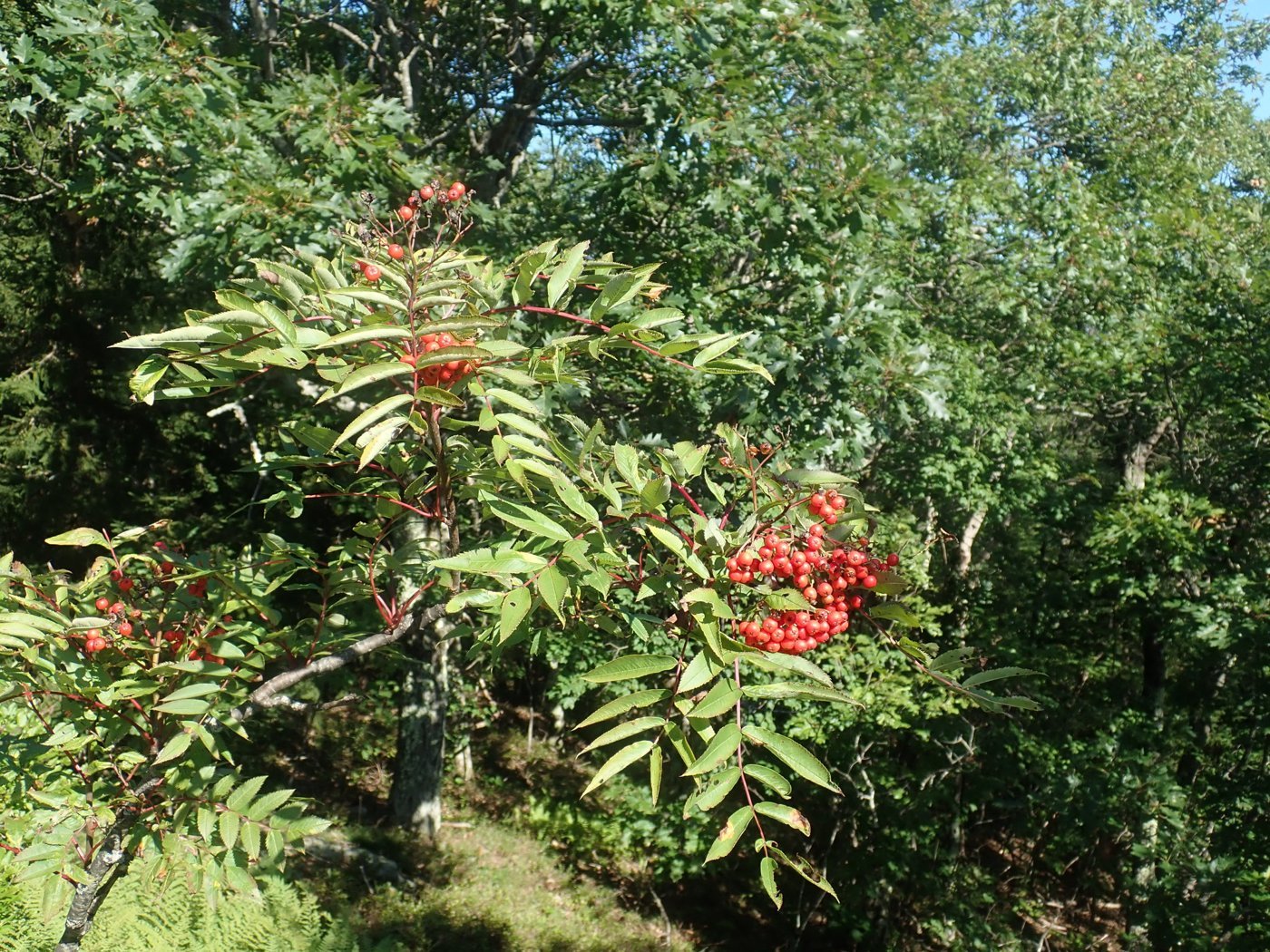
This attractive native tree is commonly overlooked, as it seldom attains abundance and may not always exhibit the prolific flowering and fruiting that would catch the eye. This is a medium -sized tree of open habitats, most often found at forest edges, regenerating clearcuts, abandoned fields, and shrubby mountain balds. The Mountain -Ashes are not related to the true ashes (genus Fraxinus), though their large compound leaves suggest a kinship. When receiving ample sunlight, the tree will produce copious flowers to the benefit of native pollinators, and these in turn yield attractive, though unpalatable, fruits in late summer/early fall that are an important food source for migrating and overwintering birds.
The bark is gray-brown and smooth with many long, raised lenticels, somewhat reminiscent of ornamental cherry trees, roughening with age. The twigs are stout and glaucous, marked by prominent white lenticels. Buds are large with lustrous reddish-brown scales.
The leaves are large and pinnately compound, alternately arranged along the stem (as opposed to the opposite leaf arrangement of true ashes). Leaflets are long-ovate to lanceolate, serrate on the margins, and lying sessile to the axils of the leaf. The petiole and leaf axis (rachis) are commonly tinged with red.
The flowers are especially attractive, forming large panicles of white blossoms in June. Like its relatives in the Rose family, including hawthorn and apple, each flower has five petals that are fused with the calyx and ovary to form a hypanthium, collectively developing into the mature fruit.
The fruits are small apple-like pomes, each around one-quarter inch in diameter, turning a deep red to orange-red color in autumn.
Where it grows
Mapped in 8 of fourteen counties: Berkshire, Essex, Franklin, Hampden, Hampshire, Middlesex, Plymouth, Worcester.
Forest types where the 2016 manual places it: Spruce-Fir / Northern Hardwoods.
Text and line illustrations: Forest Trees of Massachusetts, 7th edition (2016), Massachusetts Department of Conservation and Recreation, Bureau of Forest Fire Control and Forestry, funded by the USDA Forest Service. Drawings, 1925 descriptions and the “How to know” keys: The Commercial Forest Trees of Massachusetts (1925), Massachusetts Department of Conservation, Division of Forestry. Forest shares before settlement and today: Harvard Forest data archive (Cogbill, Burk and Motzkin 2002; Thompson and others 2013). Insects and disease: USDA Forest Service Insect and Disease Survey, Region 9, with DCR. Photographs: observations on iNaturalist (inaturalist.org), each credited to its photographer under its Creative Commons licence; the list is under “Where the pictures come from” on the guide page. Species ranges by county are as the 2016 manual maps them. Transcribed by script and proofread in part; the manuals govern where they differ.