American Holly
Leaves alternate, simple · Family Caprifoliaceae
In the inventory · Live trees fewer than 1 in 100 · Volume under 1% · Growth and mortality too few to estimate. USDA Forest Service, Forest Inventory and Analysis, 2019–2025; live trees an inch or more across, volume of trees five inches or more. Shares quoted only where the sampling error is 30% or less.
What to look for
AMERICAN Holly is a small to medium-sized tree, forty to fifty feet tall, with relatively short horizontal branches forming a pyramidal crown. When grown in the open, it is clothed with branches to the ground. It is found from Quincy, Norfolk County, southward in sandy, well-drained soils, usually near water.
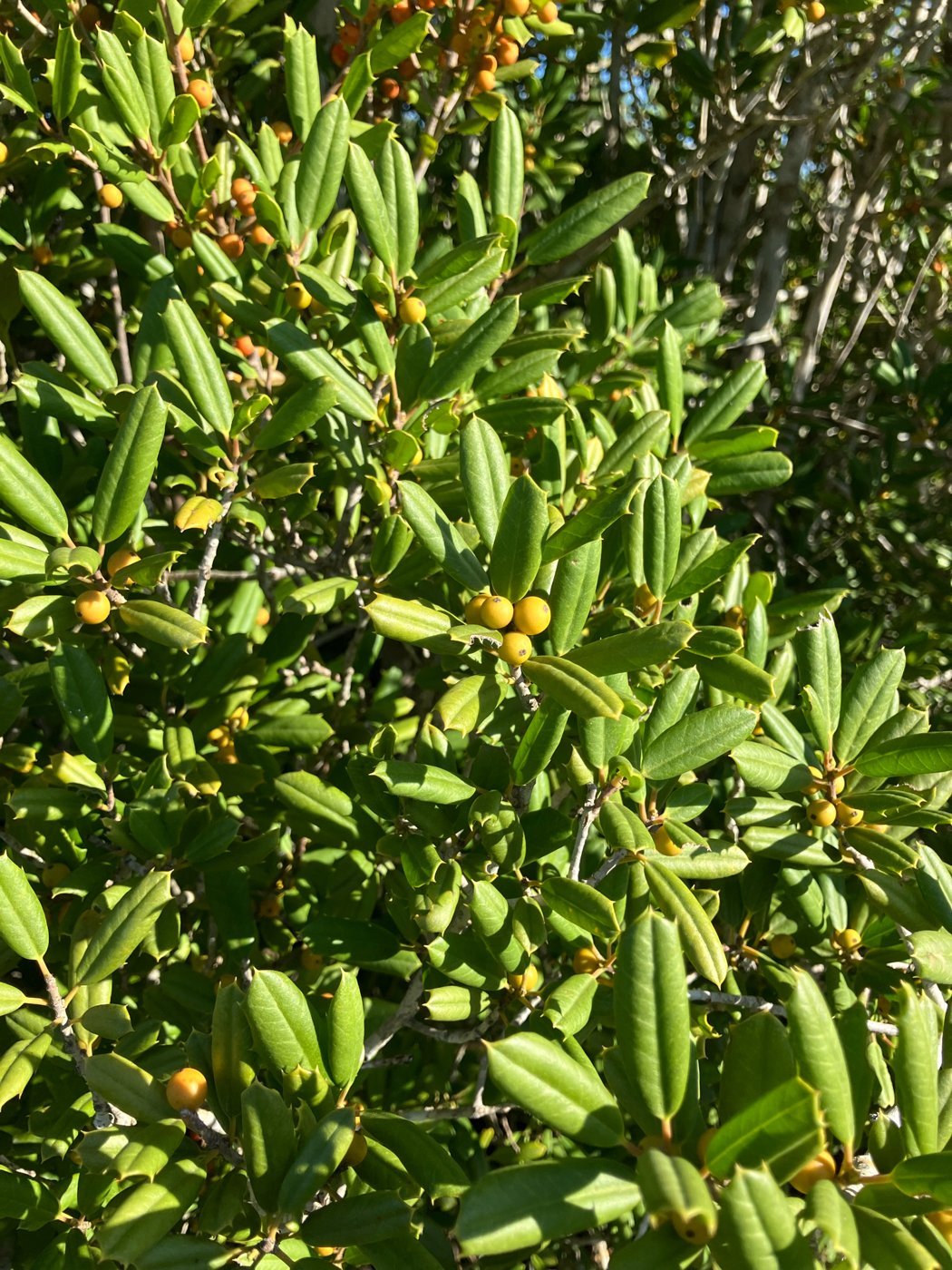
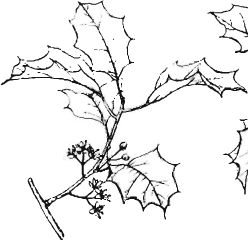
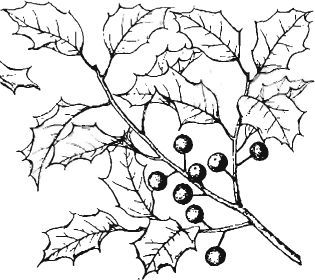
Leaves are two to four inches long, alternate, elliptical, and with widely separated spiny teeth on the margins. The leaves are dull dark green on top, paler below, and persist on the plant for two to three years.
Buds are one-eighth to one-fourth inch long, rounded, obtuse, and with a fringe of minute hairs on the bud scales.
Twigs are brown, slender, and at first hairy, becoming smooth by the first winter.
The bark is smooth, light to medium gray, and sometimes with warty excrescences.
Male and female flowers are borne on separate trees and appear in late May or June. Flowers are small, one-third of an inch in diameter with four whitish petals. Male flowers are borne in clusters of three to nine, while female flowers are either solitary or grouped in threes.
Fruit is in the form of a red berry-like drupe, one-fourth inch in diameter, that matures in October and may persist on the tree till the following June.
The wood is white to brown, tough but weak, light, and close-grained. It has been used for cabinet work and turnery.
Where it grows
Mapped in 7 of fourteen counties: Barnstable, Bristol, Dukes, Essex, Nantucket, Norfolk, Plymouth.
Text and line illustrations: Forest Trees of Massachusetts, 7th edition (2016), Massachusetts Department of Conservation and Recreation, Bureau of Forest Fire Control and Forestry, funded by the USDA Forest Service. Drawings, 1925 descriptions and the “How to know” keys: The Commercial Forest Trees of Massachusetts (1925), Massachusetts Department of Conservation, Division of Forestry. Forest shares before settlement and today: Harvard Forest data archive (Cogbill, Burk and Motzkin 2002; Thompson and others 2013). Insects and disease: USDA Forest Service Insect and Disease Survey, Region 9, with DCR. Photographs: observations on iNaturalist (inaturalist.org), each credited to its photographer under its Creative Commons licence; the list is under “Where the pictures come from” on the guide page. Species ranges by county are as the 2016 manual maps them. Transcribed by script and proofread in part; the manuals govern where they differ.