American Chestnut
Leaves alternate, simple · Family Fagaceae
In the inventory · Live trees fewer than 1 in 100 · Volume no volume estimate (not a timber species) · Growth and mortality too few to estimate. USDA Forest Service, Forest Inventory and Analysis, 2019–2025; live trees an inch or more across, volume of trees five inches or more. Shares quoted only where the sampling error is 30% or less.

What to look for
AMERICAN Chestnut was found commonly throughout Massachusetts, though less frequently near the sea coast. Its habitat was rich, well-drained soil.
Unfortunately, the chestnut blight changed all this. It was caused by a fungus which entered our country on Asian nursery stock imported to New York around 1900. Spread by wind, rain, birds and other animals, it enters through cracks or wounds in the bark, multiplies rapidly, making sunken cankers which expand and girdle the stem, killing everything above the canker, usually in one growing season. The American Chestnut is highly susceptible and was devastated throughout the natural range, extending over the Appalachian hills and highlands from Maine to Georgia. By 1940, three and a half billion American Chestnuts trees had perished. This species has an intermediate shade tolerance and grows best in gravelly, rocky, well-drained soils on hillsides or mountain slopes.
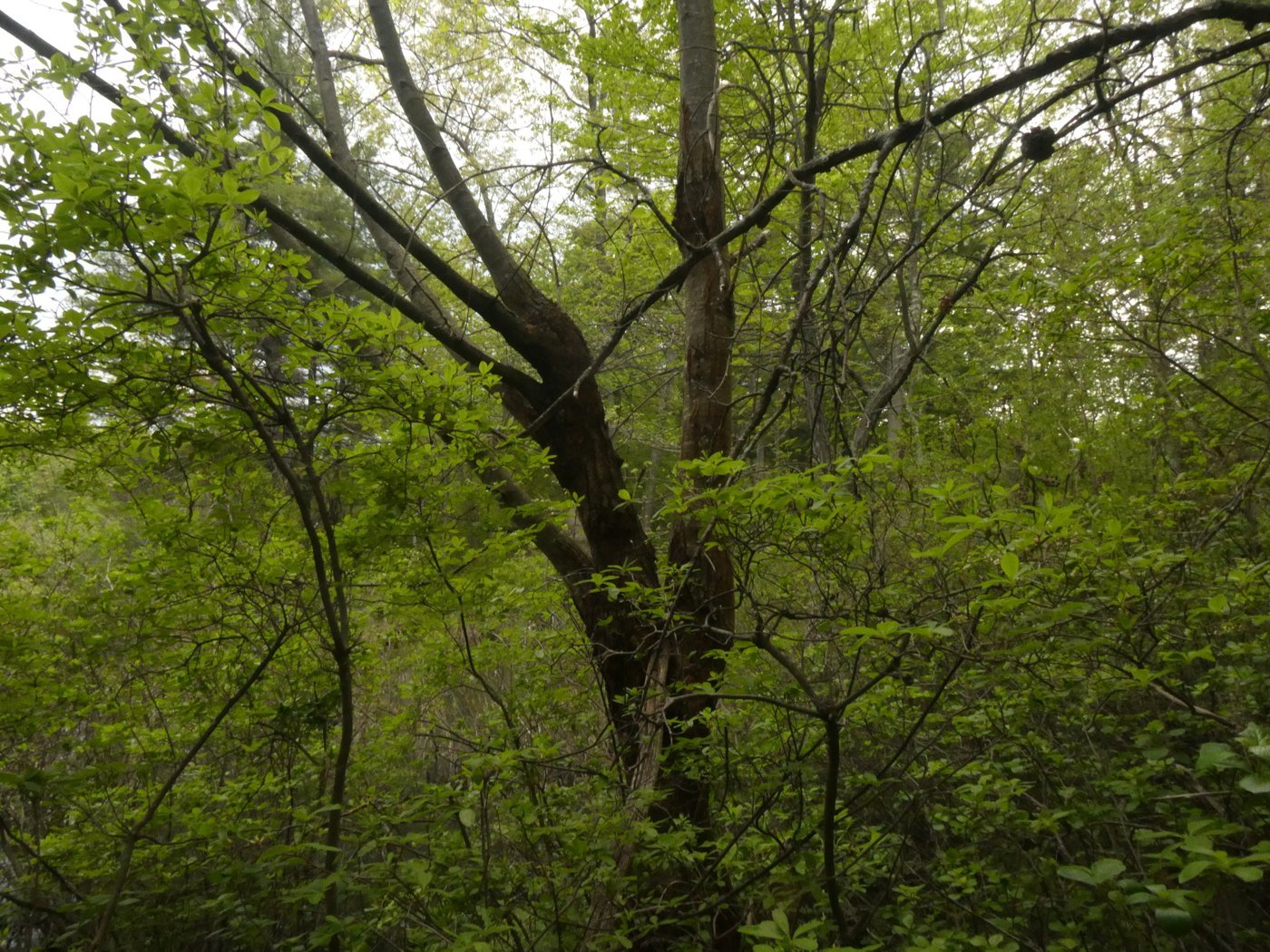
Formerly one of the tallest trees in our eastern hardwood forests, one hundred feet tall Chestnuts were common. Now, American Chestnuts survive mostly as small understory trees that sprout back from the original root systems and are continuously attacked by the blight The bark on the trunk of a small tree is dark gray and smooth. On the older trunk it is thick and divided by shallow furrows into broad, flat ridges. On the twigs the bark is dark brown.
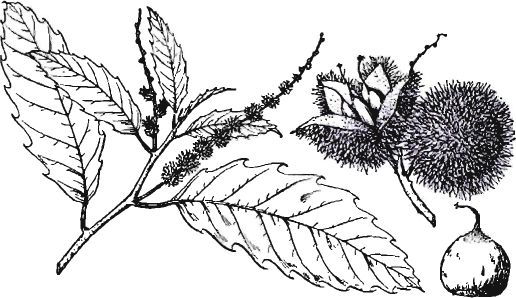
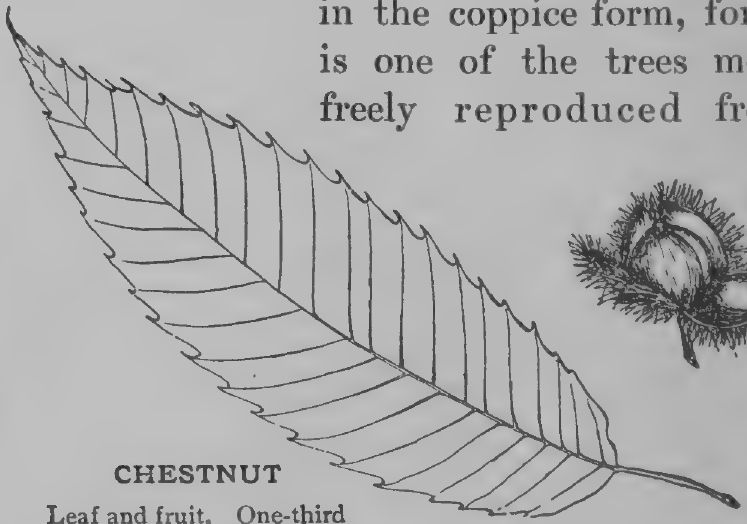
Leaves are simple, alternate, five to ten inches in length, sharply toothed, and dark yellow-green in color. Buds are blunt with only two to three visible scales.
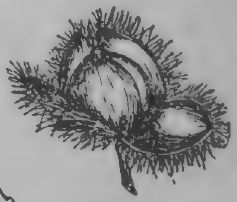
Flowers appear from June to August, and male blossoms are small in catkins six to eight inches long, Fruits are round, four-valved, prickly burs that contain, as a rule, two to three dark brown nuts.
The wood is coarse-grained, light, soft, and weak, but durable when exposed to alternations of dryness and moisture.
Tt was used in the making of furniture, railroad ties, fence posts, house finishing, and fuel before the chestnut blight decimated this native tree by the late 1940s,
There is no cure for the chestnut blight and young trees exist because the chestnut sprouts readily from old stumps that remain healthy for thirteen to fifteen years. The young trees rarely live long enough to produce flowers and fruit before infection sets in.
Where it grows
Mapped in all fourteen counties.
Forest types where the 2016 manual places it: Central Hardwoods.
In the forest record
Trees of this group (chestnut) were 6% of the trees surveyors recorded at lot corners before settlement and are 0% of trees on inventory plots today, statewide.
Each town’s own numbers are on its habitat, forest and water page.
The chestnut group is among the three most common kinds of tree in the surveyors’ record of 31 of the 164 towns with a surviving record, and the largest share of that record is in Mount Washington (28%), Westhampton (26%), Shelburne (24%). The record is by group of trees, not by species, and covers towns with at least 50 recorded trees for the “largest share” list.
As described in 1925
Show
Listed as Chestnut (Castanea dentata Borkh.).
THE Chestnut is found commonly throughout Massachusetts, though less frequently near the sea-coast than inland. Its habitat is rich, well-drained soil. A rapid grower and one of the tallest and straightest of our trees, it usually has a single trunk destitute of limbs for a considerable distance and a rather small, round head. However, when it is uncrowded, the trunk often separates into several stout branches which form a low, round head of great breadth. In the former case it often attains a height of sixty to eighty feet and has a diameter of three to four feet. Most frequently it is met with in the coppice form, for it is one of the trees most freely reproduced from sprouts. In this case it has a height of thirty to forty feet and a diameter of eight to fifteen inches.
The bark on the trunk of a small tree is dark gray and smooth. On the old trunk it is thick and divided by shallow furrows into broad, flat ridges. On the twigs the bark is dark brown. The leaves are simple, alternate, five to ten inches in length, sharply toothed and dark yellow-green in color. The fruit is a round, four-valved, prickly bur and contains, as a rule, two to three dark brown nuts. The wood is coarse-grained, light, soft, weak, but durable when exposed to alternations of dryness and moisture. It is used in the making of furniture, for house finishing, for railway ties, fence-posts and for fuel.
Text and line illustrations: Forest Trees of Massachusetts, 7th edition (2016), Massachusetts Department of Conservation and Recreation, Bureau of Forest Fire Control and Forestry, funded by the USDA Forest Service. Drawings, 1925 descriptions and the “How to know” keys: The Commercial Forest Trees of Massachusetts (1925), Massachusetts Department of Conservation, Division of Forestry. Forest shares before settlement and today: Harvard Forest data archive (Cogbill, Burk and Motzkin 2002; Thompson and others 2013). Insects and disease: USDA Forest Service Insect and Disease Survey, Region 9, with DCR. Photographs: observations on iNaturalist (inaturalist.org), each credited to its photographer under its Creative Commons licence; the list is under “Where the pictures come from” on the guide page. Species ranges by county are as the 2016 manual maps them. Transcribed by script and proofread in part; the manuals govern where they differ.