American Basswood
Leaves alternate, simple · Family Tiliaceae
In the inventory · Live trees fewer than 1 in 100 · Volume under 1% · Growth and mortality too few to estimate. USDA Forest Service, Forest Inventory and Analysis, 2019–2025; live trees an inch or more across, volume of trees five inches or more. Shares quoted only where the sampling error is 30% or less.
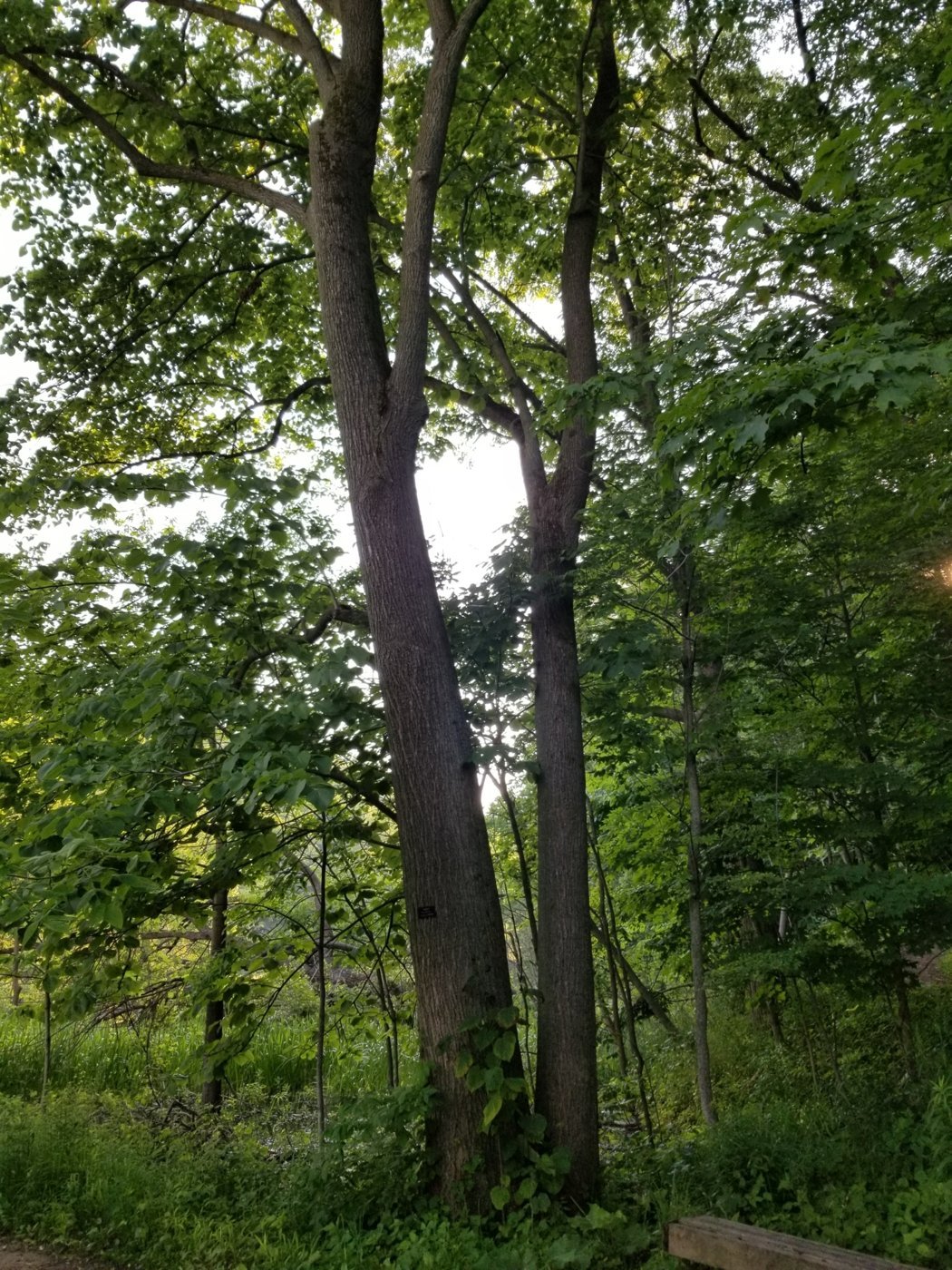
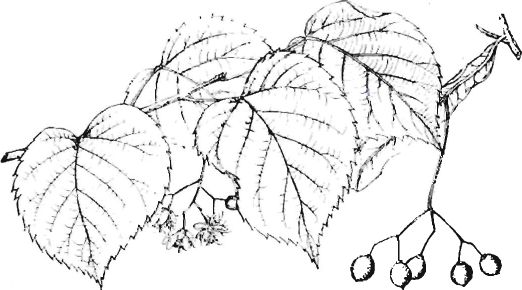

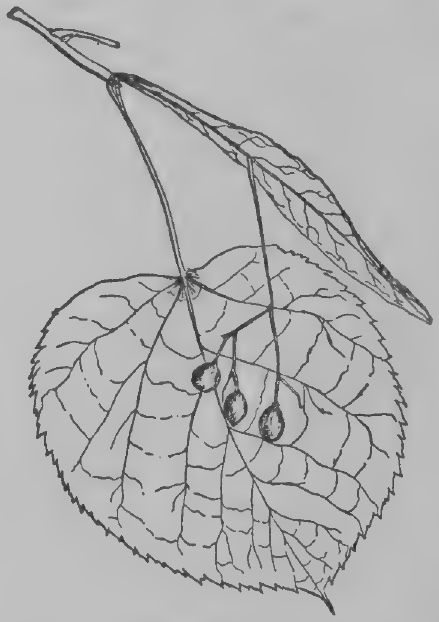
What to look for
AMERICAN Basswood is found in rich, moist bottomland soil in almost every part of the state, being most common west of the Connecticut River. American Basswood is shade tolerant and a prolific sprouter.
It is a large tree, with an average height of seventy to eighty feet and a diameter of two to three feet.
Branches are numerous, comparatively small and slender, and often somewhat pendulous.
The bark on young trees is dark gray and smooth, while on older trunks it is dark, with deep and irregular furrows.
Leaves are simple, alternate, very broadly egg-shaped to round, from four to seven inches in long, firm in texture, toothed along the margin, and unequally heart-shaped at the base.
Twigs are smooth, shiny, rather stout, and bright red. Buds are egg-shaped, two-ranked, stout, blunt-pointed, usually deep red, and with three visible bud-scales.
Flowers are greenish-yellow and appear in late June or early July. The stalk which bears the flowers is attached to an oblong, yellowish, leaf-like body. The flowers themselves are pleasantly fragrant and rich in nectar, attracting bees and insects.
The fruit is a woody, nut-like berry about the size of a pea. It usually occurs in small clusters attached to wing-like bract by slender stalks, often persisting far into winter.
The wood is light, close-grained, and soft. The homogenous white wood lends itself well to carving, and it is preferred in the making of decoys and wooden utensils. It is employed for paper pulp, in carriage making, and for furniture. The tree is a favorite with bee-keepers and choice honey can be made.
Where it grows
Mapped in 12 of fourteen counties: Barnstable, Berkshire, Bristol, Essex, Franklin, Hampden, Hampshire, Middlesex, Norfolk, Plymouth, Suffolk, Worcester.
Forest types where the 2016 manual places it: Northern Hardwoods.
As described in 1925
Show
Listed as Basswood or Linden (Tilia americana L.).
THE Linden is found in rich, moist soil in almost every part of the State. In habit it is a large tree, with an average height of fifty to sixty feet and a diameter of two to three feet. The branches are very numerous, comparatively small and slender and often somewhat pendulous. The head may be broad and round-topped or it may be conical.
On young trees the bark is gray and smooth, while on older trunks it is darker and deeply and irregularly furrowed. The twigs are yellowish-green or reddish-brown in color.
The leaves are simple, alternate, very broadly egg-shaped, from four to five inches in length and toothed.
The flowers are greenish-yellow and appear in late June or early July.
The stalk which bears the flowers is attached to an oblong, yellowish, leaf-like body. The flowers themselves are Pleasantly fragrant and rich in honey.
The fruit is globular, about the size of a pea, woody and gray in color.
The wood is light, close-grained, soft and more tough and pliable than almost any other wood. It is employed for paper pulp, in carriage-making, for furniture and for wooden utensils.
The tree is a favorite with bee-keepers, for bees collect from its flowers a large amount of honey of a very desirable quality.
Text and line illustrations: Forest Trees of Massachusetts, 7th edition (2016), Massachusetts Department of Conservation and Recreation, Bureau of Forest Fire Control and Forestry, funded by the USDA Forest Service. Drawings, 1925 descriptions and the “How to know” keys: The Commercial Forest Trees of Massachusetts (1925), Massachusetts Department of Conservation, Division of Forestry. Forest shares before settlement and today: Harvard Forest data archive (Cogbill, Burk and Motzkin 2002; Thompson and others 2013). Insects and disease: USDA Forest Service Insect and Disease Survey, Region 9, with DCR. Photographs: observations on iNaturalist (inaturalist.org), each credited to its photographer under its Creative Commons licence; the list is under “Where the pictures come from” on the guide page. Species ranges by county are as the 2016 manual maps them. Transcribed by script and proofread in part; the manuals govern where they differ.