Alternate-Leaf Dogwood
Leaves alternate, simple · Family Cornaceae · Also called Pagoda Dogwood and Blue Dogwood
What to look for
ALTERNATE-LEAF Dogwood grows in the understory of open mixed woodland, along streams, in margins of forest areas, and in hedges, on fertile, reasonably well-drained soils, often on lower slopes. It tolerates some shade, but requires good light conditions to grow well.
Alternate-Leaf Dogwood is a large, straggly shrub or small irregular tree that can reach heights of up to thirty five feet and stem diameters of up to six inches. The crown is irregular and often made up of attractive, horizontal tiers of branches that carry many short, upwardly growing shoots on which foliage tends to be clustered, but oriented outwards with upper leaf surfaces mostly at. Dead branches may occur throughout the crown.
The trunk forks near the ground into several branches that spread horizontally in layers, giving it a pagoda-like appearance.
Bark, when young, is thin, dark olive-green to reddish or purplish brown with thin, pale brown, mostly vertical fissures. With increasing age, the fissures deepen and broaden and become separate grayish-brown and flattish ridges.
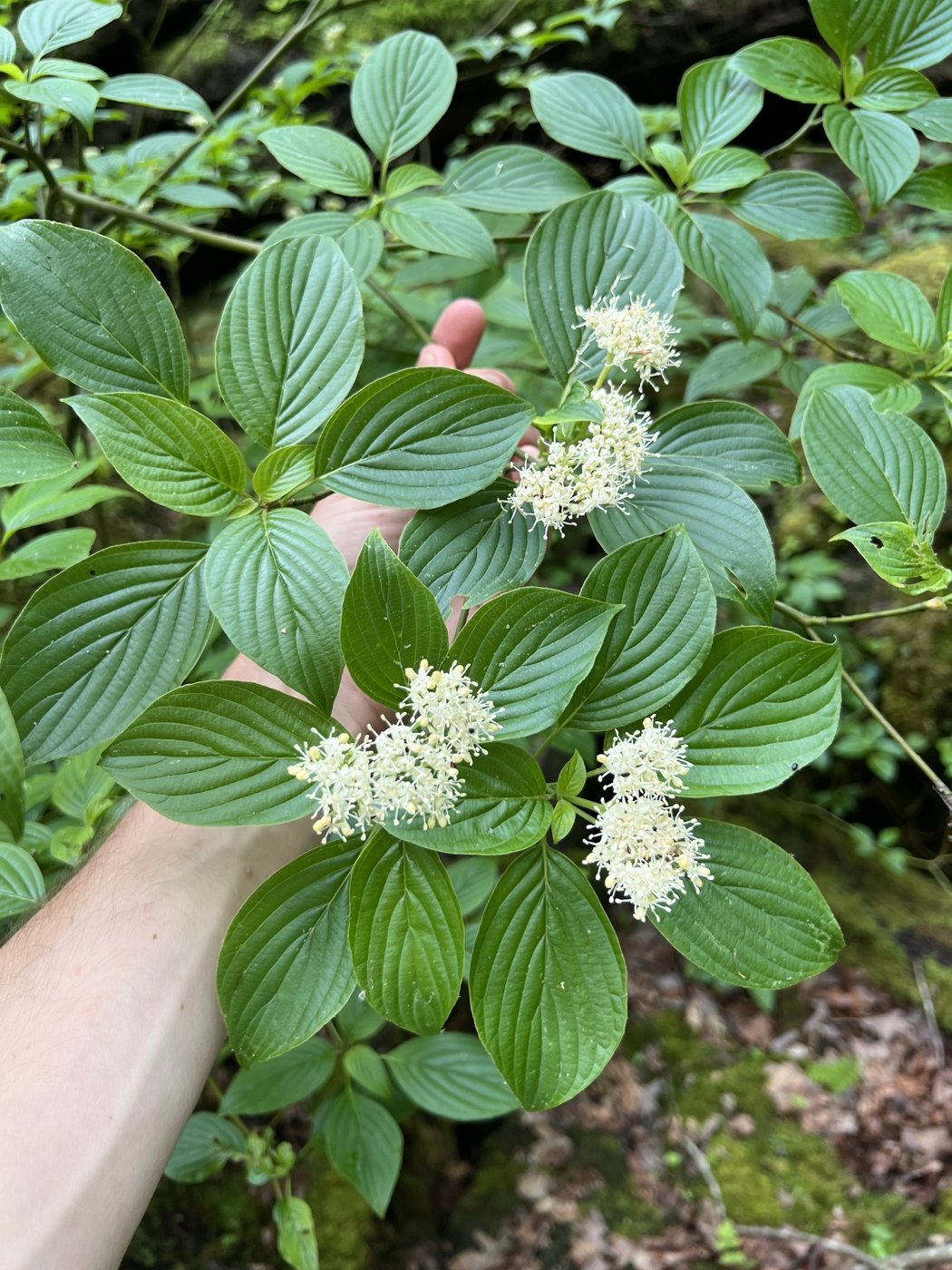
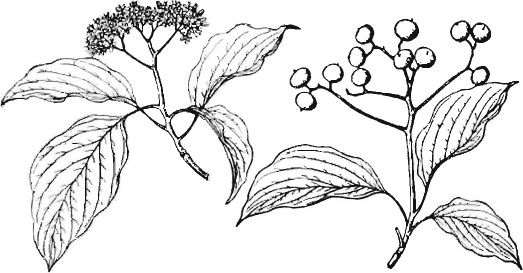
Leaves are alternate, enure, elliptic-ovate, and tend to be crowded at the ends of the twigs. They are two and a half to four and a half inches long, yellowish-green, smooth above, and have pressed hairs beneath.
Twigs are often lustrous, and greenish-brown. Dead twigs become bright yellow-green in color.
Flowers appear in June after the leaves have developed and occur in white clusters.
The fruit is a bluish-black drupe, somewhat round, about one third of an inch in diameter, and ripens in September and October.
The wood is diffuse porous, heavy, hard and close grained. It resists abrasion, and has no commercial value, but may find local use in wooden bearings and slides.
Where it grows
Mapped in 13 of fourteen counties: Barnstable, Berkshire, Bristol, Dukes, Essex, Franklin, Hampden, Hampshire, Middlesex, Norfolk, Plymouth, Suffolk, Worcester.
Text and line illustrations: Forest Trees of Massachusetts, 7th edition (2016), Massachusetts Department of Conservation and Recreation, Bureau of Forest Fire Control and Forestry, funded by the USDA Forest Service. Drawings, 1925 descriptions and the “How to know” keys: The Commercial Forest Trees of Massachusetts (1925), Massachusetts Department of Conservation, Division of Forestry. Forest shares before settlement and today: Harvard Forest data archive (Cogbill, Burk and Motzkin 2002; Thompson and others 2013). Insects and disease: USDA Forest Service Insect and Disease Survey, Region 9, with DCR. Photographs: observations on iNaturalist (inaturalist.org), each credited to its photographer under its Creative Commons licence; the list is under “Where the pictures come from” on the guide page. Species ranges by county are as the 2016 manual maps them. Transcribed by script and proofread in part; the manuals govern where they differ.